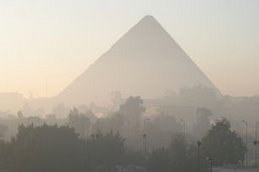
Wishing everyone a great night tonight, if you are celebrating, and a happy 2005.
All the best
Andie
Friday, December 31, 2004


Egyptology 2004 - A Review
http://weekly.ahram.org.eg/print/2004/723/heritage.htm
"From the Mediterranean bed to Kom Al-Dikka, from Akhmim to Sinai, from the Egyptian Museum in Cairo to Basle and Germany and from auction halls in Europe and America to Egypt, there were several exciting archaeological events to highlight this outstanding year." Al Ahram weekly's review of Egyptology through 2004 - the good and the bad.
"From the Mediterranean bed to Kom Al-Dikka, from Akhmim to Sinai, from the Egyptian Museum in Cairo to Basle and Germany and from auction halls in Europe and America to Egypt, there were several exciting archaeological events to highlight this outstanding year." Al Ahram weekly's review of Egyptology through 2004 - the good and the bad.
Chephren pyramid open for visitors Saturday
http://www.sis.gov.eg/online/html11/o311224g.htm
"Culture Minister Farouk Hosni will re-open the Pyramid of King Chephren in Giza as of Saturday after the completion of restoration works. In statements, Hosni said the third Pyramid of Mycerinus will be closed for a year to start necessary rejuvenations, adding 2005 will see a giant restoration project to restore King Chephren's funerary temple and the stone blocks in the area south of the temple. These steps fall within a plan by the ministry and the Supreme Council of Antiquities (SCA) which started in 1995 to preserve the Giza pyramids through regular restoration activities, said Hosni".
See the link above for more information
"Culture Minister Farouk Hosni will re-open the Pyramid of King Chephren in Giza as of Saturday after the completion of restoration works. In statements, Hosni said the third Pyramid of Mycerinus will be closed for a year to start necessary rejuvenations, adding 2005 will see a giant restoration project to restore King Chephren's funerary temple and the stone blocks in the area south of the temple. These steps fall within a plan by the ministry and the Supreme Council of Antiquities (SCA) which started in 1995 to preserve the Giza pyramids through regular restoration activities, said Hosni".
See the link above for more information
Thursday, December 30, 2004
And More on the Faiyum Granaries!
http://www.sis.gov.eg/online/html11/o291224f.htm
The only additional news contained in this item is that the granaries contained dried cereals, fruits and flax. Which cereals and fruits I hear you cry! I'll let you know if I find out.
The only additional news contained in this item is that the granaries contained dried cereals, fruits and flax. Which cereals and fruits I hear you cry! I'll let you know if I find out.
More on Faiyum Granaries, and on Suez Archaeology
http://www.sis.gov.eg/online/html11/o291224i.htm
This article contains some more information about the Faiyum Neolithic discoveries by UCLA, and also discusses archaeogy in the Suez Govenorate of Northern Egypt. As usual with the State Information Service, this is not the most lucid of descriptions, but it is more detailed than usual.
This article contains some more information about the Faiyum Neolithic discoveries by UCLA, and also discusses archaeogy in the Suez Govenorate of Northern Egypt. As usual with the State Information Service, this is not the most lucid of descriptions, but it is more detailed than usual.
Wednesday, December 29, 2004
Eight New Granaries Found in the Faiyum
http://www.reuters.com/newsArticle.jhtml?type=scienceNews&storyID=7193576
Thanks to Tony Cagle for directing my attention to this item on his blog at http://www.archaeoblog.blogspot.com/. The Faiyum Depression is a triangular depression to the southwest of Cairo, with the immense Lake Qarun at its lowest point, 45m below sea level. In prehistoric times (the Epipalaeolithic and Neolithic in particular) it was a well populated area, and excavations since the 1920s have revealed an immense amount of detail about thse occupations. The Neolithic period marks the first agricultural activitiy in the Faiyum at around 5500bc, which, together with the site of Merimde Beni Salama to the northwest of Cairo, represents the earliest known farming in Egypt. In the 1920s, and reported in their two volume 1934 report "The Desert Fayoum" Gertrude Caton Thompson and Elinor Gardiner reported fining 167 grain silos (pits sunk into the groun) in the northeast Faiyum in a zone between two sites named Kom K and Kom W. Although many other Neolithic sites have been found, until today this site has remained the only one containing granaries. This makes the above report of eight new granaries having been found even more important. I'm trying to find out more information about it, and will post if I have an update. A summary of the prehistoric period in the Faiyum and Cairo areas can be found at my other site: http://www.faiyum.historians.co.uk/html/archaeology.html
Thanks to Tony Cagle for directing my attention to this item on his blog at http://www.archaeoblog.blogspot.com/. The Faiyum Depression is a triangular depression to the southwest of Cairo, with the immense Lake Qarun at its lowest point, 45m below sea level. In prehistoric times (the Epipalaeolithic and Neolithic in particular) it was a well populated area, and excavations since the 1920s have revealed an immense amount of detail about thse occupations. The Neolithic period marks the first agricultural activitiy in the Faiyum at around 5500bc, which, together with the site of Merimde Beni Salama to the northwest of Cairo, represents the earliest known farming in Egypt. In the 1920s, and reported in their two volume 1934 report "The Desert Fayoum" Gertrude Caton Thompson and Elinor Gardiner reported fining 167 grain silos (pits sunk into the groun) in the northeast Faiyum in a zone between two sites named Kom K and Kom W. Although many other Neolithic sites have been found, until today this site has remained the only one containing granaries. This makes the above report of eight new granaries having been found even more important. I'm trying to find out more information about it, and will post if I have an update. A summary of the prehistoric period in the Faiyum and Cairo areas can be found at my other site: http://www.faiyum.historians.co.uk/html/archaeology.html
Monday, December 27, 2004
More on various items missing from Egypt's collections
http://www.egypttoday.com/article.aspx?ArticleID=1750
An overview of the problems with items going missing from the Cairo Museum and other storage facilities in Egypt. According to the article the last full invetory of the museum's basement storage was taken 71 years ago!
An overview of the problems with items going missing from the Cairo Museum and other storage facilities in Egypt. According to the article the last full invetory of the museum's basement storage was taken 71 years ago!
Odds and Ends from Egypt Today Magazine
http://www.egypttoday.com/article.aspx?ArticleID=1805
I've copied this in full, because it can be a bit awkward to find on the page:
"The Daftarkhana, or what is today known as Dar El-Kutub and the National Manuscript Center, celebrates its 175th anniversary in October. An international conference will be held in honor of the occasion and should include discussions about manuscript preservation laws and techniques.
While eating in a Zamalek restaurant, Supreme Council for Antiquities head Zahi Hawass discovered the cover of a sarcophagus dating back to the modern dynasty. The antiquity was simply lying there, and no one was able to tell him how arrived. Hawass promptly ordered the cover moved to the antiquities storerooms in Matariyya.
Twelve years after a French expedition discovered the tomb of Bet-Shoo, the SCA has finally signed off on the expeditions request to piece together the Dakhla-area antiquity. Meanwhile, another tomb was recently discovered in the most unlikely of locations: Ard El-Naam (Ostrich Land) in Ain Shams. The beautifully decorated tomb is surrounded by moist ground, leaving the SCA to research ways of opening it without ruining the delicate reliefs and drawings inside.
Water is also proving a challenge at Qenas Esna Temple, where the infiltration of underground water has the SCA planning to commission a Dutch company to tear the temple apart, raise it above the water level, then piece it back together.
Finally, the War Path of Horus has long been the subject of debate. Was it a myth, or historical fact? Only a handful of the 11 forts said to mark the ancient protective boundaries delineating Egypts territories have been discovered. Last month, three new forts believed to have been a part of the path were unearthed north of Ismailiyya, where they are thought to have marked and protected the kingdoms eastern borders. SCA officials are ecstatic, saying they believe the forts could shed new light on the military logic of the ancient Egyptian."
I've copied this in full, because it can be a bit awkward to find on the page:
"The Daftarkhana, or what is today known as Dar El-Kutub and the National Manuscript Center, celebrates its 175th anniversary in October. An international conference will be held in honor of the occasion and should include discussions about manuscript preservation laws and techniques.
While eating in a Zamalek restaurant, Supreme Council for Antiquities head Zahi Hawass discovered the cover of a sarcophagus dating back to the modern dynasty. The antiquity was simply lying there, and no one was able to tell him how arrived. Hawass promptly ordered the cover moved to the antiquities storerooms in Matariyya.
Twelve years after a French expedition discovered the tomb of Bet-Shoo, the SCA has finally signed off on the expeditions request to piece together the Dakhla-area antiquity. Meanwhile, another tomb was recently discovered in the most unlikely of locations: Ard El-Naam (Ostrich Land) in Ain Shams. The beautifully decorated tomb is surrounded by moist ground, leaving the SCA to research ways of opening it without ruining the delicate reliefs and drawings inside.
Water is also proving a challenge at Qenas Esna Temple, where the infiltration of underground water has the SCA planning to commission a Dutch company to tear the temple apart, raise it above the water level, then piece it back together.
Finally, the War Path of Horus has long been the subject of debate. Was it a myth, or historical fact? Only a handful of the 11 forts said to mark the ancient protective boundaries delineating Egypts territories have been discovered. Last month, three new forts believed to have been a part of the path were unearthed north of Ismailiyya, where they are thought to have marked and protected the kingdoms eastern borders. SCA officials are ecstatic, saying they believe the forts could shed new light on the military logic of the ancient Egyptian."
Helwan Mural Returned to Egypt
http://www.sis.gov.eg/online/html11/o211224n.htm
Reading between the lines of this somewhat confusing article I am guessing that a predynastic mural found at Helwan has been returned to Egypt, having been smuggled out of the country and sold off at auction.
Reading between the lines of this somewhat confusing article I am guessing that a predynastic mural found at Helwan has been returned to Egypt, having been smuggled out of the country and sold off at auction.
Zahi Hawass on Anis Mansour
http://weekly.ahram.org.eg/2004/722/hr2.htm
Hawass's "Dig Days" column is devoted, this week, to Egyptian writer Anis Mansour, and his involvement in Egyptology.
Hawass's "Dig Days" column is devoted, this week, to Egyptian writer Anis Mansour, and his involvement in Egyptology.
Chicago Museum Identifies Fake Mummy
http://www.rednova.com/news/display/?id=113707
http://www.suntimes.com/output/news/cst-nws-mummy21.html
Chicago Natural History Museum's digital x-ray analysis of a mummified cat revealed that it was a 500 B.C. fake - although the mummy has the form of a cat, there is no cat on the inside! The article discusses the museum's other uses of digital x-ray and why this technology is so useful.
http://www.suntimes.com/output/news/cst-nws-mummy21.html
Chicago Natural History Museum's digital x-ray analysis of a mummified cat revealed that it was a 500 B.C. fake - although the mummy has the form of a cat, there is no cat on the inside! The article discusses the museum's other uses of digital x-ray and why this technology is so useful.
Tuesday, December 21, 2004
Christmas Break
I won't be updating again until the 27th December, so please check again then!
Happy Christmas.
Andie
predynastica@yahoo.co.uk
Happy Christmas.
Andie
predynastica@yahoo.co.uk
Sunday, December 19, 2004
NY Met Refuses Tutankhamun Exhibition
http://www.newsday.com/news/local/state/ny-bc-ny--kingtut-tour1217dec17,0,1168364.story?coll=ny-region-apnewyork
The New York Metropolitan Museum has refused the Tutankhamun exhibition which will be touring the US next year on the grounds that it has a 17 year tradition of not charging for special exhibitions. The admission fee being charged by Egypt is to be used to finance restoration and other work in Egyptian archaeology, but the Met believe that it is contrary to their own policies.
The New York Metropolitan Museum has refused the Tutankhamun exhibition which will be touring the US next year on the grounds that it has a 17 year tradition of not charging for special exhibitions. The admission fee being charged by Egypt is to be used to finance restoration and other work in Egyptian archaeology, but the Met believe that it is contrary to their own policies.
Friday, December 17, 2004
Generating Cash for the SCA
http://weekly.ahram.org.eg/2004/721/eg11.htm
A new company has been established in Egypt to combat Egypt's inability to pay for conservation, restoration and excavation programmes: "The company is designed to generate revenue for the Supreme Council of Antiquities (SCA) to enable it to better invest in archaeological excavation and restoration, promoting archaeological and cultural awareness among the public, diversifying archaeology-related professional services, and producing high-quality commercial products".
This fascinating article examines the new company, its objectives and its activities.
It also says that professional photography will be completely prohibited in museums and at sites, but educational photography will be free. It makes no mention of ordinary tourist photography, so things are still clouded on that subject.
A new company has been established in Egypt to combat Egypt's inability to pay for conservation, restoration and excavation programmes: "The company is designed to generate revenue for the Supreme Council of Antiquities (SCA) to enable it to better invest in archaeological excavation and restoration, promoting archaeological and cultural awareness among the public, diversifying archaeology-related professional services, and producing high-quality commercial products".
This fascinating article examines the new company, its objectives and its activities.
It also says that professional photography will be completely prohibited in museums and at sites, but educational photography will be free. It makes no mention of ordinary tourist photography, so things are still clouded on that subject.
More on Live Excavation, Bahariya
http://weekly.ahram.org.eg/2004/721/eg10.htm
The excavation of burials of middle ranking officials and professional people were excavated live on Channel 5, by Zahi Hawass. Bahariya, the nearest of the northern oases to the Nile, was the home of wine production during the 26th Dynasty, and this was responsible for the wealth of its occupants. This article offers a blow by blow description of the activities as presented on the programme. For another photo, click here and click on the photo to see the caption:
http://weekly.ahram.org.eg/2004/721/index.htm
The excavation of burials of middle ranking officials and professional people were excavated live on Channel 5, by Zahi Hawass. Bahariya, the nearest of the northern oases to the Nile, was the home of wine production during the 26th Dynasty, and this was responsible for the wealth of its occupants. This article offers a blow by blow description of the activities as presented on the programme. For another photo, click here and click on the photo to see the caption:
http://weekly.ahram.org.eg/2004/721/index.htm
Wednesday, December 15, 2004
Three ancient pieces seized in Menia
http://www.sis.gov.eg/online/html11/o151224q.htm
"Monuments and tourism police seized in Menia governorate three rare ancient pieces dating back to the pharaoh era including a human head made of alabaster, from a farmer and a grocer before they sold to monuments merchants. "
"Monuments and tourism police seized in Menia governorate three rare ancient pieces dating back to the pharaoh era including a human head made of alabaster, from a farmer and a grocer before they sold to monuments merchants. "
More on Medieval Arab Scholars re Cleopatra
http://dsc.discovery.com/news/briefs/20041213/cleopatra.html
I posted about this on November 9th, when Radio Netherlands published an article on the subject at http://www2.rnw.nl/rnw/en/features/science/10631355. Okasha el Daly's work identified that Medieval Arabic scholars came to a number of extremely astute conclusions about ancient Egypt. This Discovery Channel further discusses the fact that the medieval writers concerned described Cleopatra in terms of her intellectual achievements, admiring her for her work in mathematics, science and philosophy. The article adds that Okasha's new book is coming out soon, describing his findings in detail. "Egyptology: The Missing Millennium, Ancient Egypt in Medieval Arabic Writings," will be published in January by the University College London Press.
I posted about this on November 9th, when Radio Netherlands published an article on the subject at http://www2.rnw.nl/rnw/en/features/science/10631355. Okasha el Daly's work identified that Medieval Arabic scholars came to a number of extremely astute conclusions about ancient Egypt. This Discovery Channel further discusses the fact that the medieval writers concerned described Cleopatra in terms of her intellectual achievements, admiring her for her work in mathematics, science and philosophy. The article adds that Okasha's new book is coming out soon, describing his findings in detail. "Egyptology: The Missing Millennium, Ancient Egypt in Medieval Arabic Writings," will be published in January by the University College London Press.
Tuesday, December 14, 2004
Egyptian Officials Charged with Smuggling
http://www.guardian.co.uk/worldlatest/story/0,1280,-4670995,00.html
This disturbing article concerns the theft of 57,000 artifacts from antiquity warehouses. The acused officials are thought to have been part of a gang that the government now accuses of stealing and smuggling thousands of items abroad.
This disturbing article concerns the theft of 57,000 artifacts from antiquity warehouses. The acused officials are thought to have been part of a gang that the government now accuses of stealing and smuggling thousands of items abroad.
Hierakonpolis Online
http://www.archaeology.org/interactive/hierakonpolis/fort.html
Archeology Online's Interactive Dig has been updated with the latest from the important site of Hierakonpolis. It concerns that only upstanding structure at Hierakonpolis, the so-called "fort", built by King Khasekhemwy, the last king of the Second Dynasty (ca. 2686 B.C.). As usual, there is a lot of fascinating information in this article.
Archeology Online's Interactive Dig has been updated with the latest from the important site of Hierakonpolis. It concerns that only upstanding structure at Hierakonpolis, the so-called "fort", built by King Khasekhemwy, the last king of the Second Dynasty (ca. 2686 B.C.). As usual, there is a lot of fascinating information in this article.
Monday, December 13, 2004
Archaeology Magazine Review of Ramesses TV Show
http://www.archaeology.org/online/reviews/mummies&bones.html
It is necessary to page down to about half way down this page, which shows a number of reviews. The show described is Rameses - Wrath of God or Man - it offers a critique of the programme, starting with the words: "Bones from Egypt's Valley of the Kings are a sure-fire attention getter, but a big budget and lots of computer-generated images are not guarantees of a great program as the Discovery Channel's heavily promoted Rameses: Wrath of God or Man shows. Here, what could be an interesting, if less ambitious, documentary about trying to identify the human remains from KV 5 is hijacked by the biblical tale of the plagues and Exodus." It goes on from there.
It is necessary to page down to about half way down this page, which shows a number of reviews. The show described is Rameses - Wrath of God or Man - it offers a critique of the programme, starting with the words: "Bones from Egypt's Valley of the Kings are a sure-fire attention getter, but a big budget and lots of computer-generated images are not guarantees of a great program as the Discovery Channel's heavily promoted Rameses: Wrath of God or Man shows. Here, what could be an interesting, if less ambitious, documentary about trying to identify the human remains from KV 5 is hijacked by the biblical tale of the plagues and Exodus." It goes on from there.
Subscribe to:
Posts (Atom)