Friday, February 20, 2009

Lecture Notes: 'Egypt guy' discusses pilgrimages, graffiti

The Brown Daily Herald - Campus News (Matthew Klebanoff)

Issue date: 2/19/09 Section: Campus News

Known in his field as "the Egypt Guy," Eugene Cruz-Uribe, a professor of history at Northern Arizona University, discussed Egyptian pilgrimages before a small audience in Salomon 001 Wednesday night.

In his lecture, "Valley of the Kings to Philae: Ancient and Modern Pilgrimages," Cruz-Uribe explained that people often went on pilgrimages for medical reasons, both physical and spiritual.

"A pilgrimage would be a journey of at least a day, if not multiple days, and it had to have some sort of significance," he said.

The sites that Cruz-Uribe discussed included the Temple of Seti I at Abydos, the Colossi of Memnon and Philae - the three main pilgrimage destinations for Romans traveling through ancient Egypt, he said.

Cruz-Uribe discussed research he conducted primarily after receiving a Fulbright scholarship to teach at Egypt's South Valley University for the 2006-07 academic year.

Much of Cruz-Uribe's talk focused on ancient graffiti covering the sites. Written in the third person, the graffiti often served as prayers for individuals who were deemed gods after their deaths.

"I always wonder about what kind of society allows people to write on the sides and walls of their church," he said, adding that he believes people etched graffiti onto churches once they were no longer in use.

One inscription, which read "Djedhor forever," will serve as the title for a book Cruz-Uribe plans to write on ancient Egyptian graffiti, he said.

More re scroll of Amenemhat at ROM

The Torontoist

With photograph.

The ROM is kicking off Egypt Month on Saturday, February 28 with a new attraction: the Book of the Dead (and no, it’s not the Necronomicon from the Evil Dead series—that demonic text was Sumerian). The seven metre–long scroll, which is part of the ROM’s Out of the Vault Series, has recently been restored to its full beauty. Written in 320 BC for a wealthy Ptolemaic Egyptian named Amen-em-hat, the text of the scroll contains numerous spells, hymns, and instructions to help guide the deceased through the underworld. The scroll also depicts Amen-em-hat fishing, farming, and standing in judgement before the Egyptian gods.

In Ptolemaic Egypt, the scroll was usually written on papyrus and placed in the tomb or coffin of the dead. It was believed that the various hymns and spells would grant the dead magical powers, protection against fire and water, new body parts, and a voice with which to speak. All of these abilities were thought to be necessary to reach the Hall of Judgement, where the heart of the deceased would be weighed on a scale against a feather, the symbol of Maat, goddess of truth and justice. If the deceased led an honest life, the scale would balance and they would be granted eternal life; if not, a monster would eat their heart.

See the above page for more.

Fiction: Egypt, a seven-issue graphic novel mini-series

Comic Book Resources

I loved the cover, which Kat brought to my attention. There's a big version of it on the above page.

Today we’re looking at Egypt, a seven-issue mini-series from 1995 Milligan did with artists Glyn Dillon and Roberto Corona, Dillon doing only the first two issues and Corona filling in thereafter.

The series chronicles with the time-hopping adventures of one Vincent Me, a self-loathing, charming but completely irresponsible and utterly untrustworthy British slacker; the type who shacks up with any willing woman (and he apparently finds plenty) long enough to get a hand on her wallet.

After being thrown out into the street for the umpteenth time, Vincent gets meets up with a bunch of self-absorbed college students who it turns out are fascinated with Egyptian history and, more significantly, religion.

It turns out they’re conducting some experiments in after-death experiences a la the Pharoahs of old, and Vincent is their latest guinea pig, trussed up and sealed alive in a tomb. Apparently the experiment doesn’t go too well for Vincent however, because the next thing he knows, he’s actually back in ancient Egypt, inhabiting the body of one Vin Centhotep.

Vincent tries to figure out what exactly happened to cause this backward reincarnation, but there are … obstacles in his way. Centhotep apparently is even more of a bastard than Vincent, acting as a bit of a double-agent, fluttering between the city’s rebels who seek to overturn the authoritarian power structure and the high priests who would prefer everything to stay just like it is, led by one Soter, a “boo-hiss” villain if there ever was one.

Oh, and then there are the gods. Seems our archaeologists were wrong about a lot of Egyptian mythology, as Seth, Osiris and at several other members of the pantheon are alive and running around, at times laying waste to whoever gets in their way.

Trivia: More re pharaoh floating down Thames

Yahoo! News

Thanks to Geoff Carter for letting me know that there's a photograph accompanying the above piece about the Lego pharaoh which was transported down the Thames earlier this week. The photograph shows the pharaoh in front of Tower Bridge. I would have loved to have seen it! That joins a large list of fun things I've missed being moved up and down the Thames including the vast Anubis for the Tutankhamun exhibition and Concorde.

Daily Photo - Cairo Museum

. . .


Lion in the Cairo Museum garden

I didn't take note of the label and neither of my books about the museum
is forthcoming on the subject, but if anyone has the details about this statue
let me know and I'll add them to this post

I haven't run out of Bob's photos, by the way, but I've been in complete airhead mode all week and cannot find where I've stored them on this machine. There's backup set on my laptop so I'll dig them out over the weekend.

I'm on a training course tomorrow (surveying historic places of worship) so I probably won't update the blog until Sunday.


. . .

Thursday, February 19, 2009

Egyptian archaeologists uncover ancient statues in Luxor

xinhuanet

Egyptian archaeologists on Wednesday uncovered a statue of pharaoh and a bust of the famous woman pharaoh Hatshepsut in the southern city of Luxor, the state MENA news agency reported.

The three-meter Amenhotep statue was "dug out with only one damage in the nose and one in the teeth," said Moustafa el-Waziri, director of the archaeological mission, adding that more antiques would be unearthed in the future.

Video: Meresamun

Discovery News

See the above page for the video.

The face of Meresamun, a priestess who sang in the temples of Ancient Egypt hundreds of years before the birth of Christ, has been revealed to the world for the first time thanks to a X-ray with a light ten billion times brighter than the sun.

Known as Joint Engineering, Environmental and Processing beamline or Jeep, the cutting edge technology uses intense radiation known as synchrotron light to see through solid objects.

The Jeep beamline showed astonishing 3D images of the a 3,000-year-old Egyptian mummy, still wrapped in her linen bandages.

According to an inscription on the casket, Meresamun (whose name means “She Lives for Amun”) served as a “Singer in the Interior of the Temple of Amun”. She was in her late twenties or early thirties when she died.

An exhibition featuring the mummy is running at the University of Chicago’s Oriental Institute Museum ("The Life of Meresamun: A Temple Singer in Ancient Egypt”, until December 6, 2009)

Here is a video showing the virtual unwrapping of the mummy. One roughly oval-shaped amulet covers each of Meresamun's eyes. Her eyeballs are shrunken but intact.

Tourism in Egypt suffers crisis

FT.com (Heba Saleh)

Tourist buses line the street in front of the Egyptian Museum (above) in downtown Cairo, and visitors cluster in groups around their guides as they prepare to enter the pink neoclassical building that houses the treasures of Tutankhamun and other world-famous pharaonic artefacts.

Despite the hustle and bustle in the courtyard, and the presence of hundreds of tourists, Walid Abdel Razek, a salesman in one of the museum gift shops, laments what he says is a serious drop in the number of visitors.

He reckons his shop is taking half the money it made last year. It is, he claims, the worst crisis to hit Egyptian tourism since 1997 when Islamic militants slaughtered dozens of foreign visitors during an attack in Luxor.

Tourism is an industry that is crucial to the health of the wider Egyptian economy, providing direct and indirect employment to 12.6 per cent of the workforce, according to official figures. After foreign direct investment, it is the country’s largest source of foreign revenue, bringing in $10.8bn in 2007-08 and accounting for 6.5 per cent of gross domestic product.

Last year brought unprecedented growth, beating analysts’ expectations. Arrivals reached a record 12.8m visitors, according to the ministry of tourism, up 15 per cent on the year before.

The sector, however, now faces the threat of a slowdown as a result of the global recession.

“There is a decline in tourist numbers in comparison to last year,” says Adela Ragab, an adviser to the tourism minister. “Those who lost their jobs won’t travel and neither will those who are anxious about their job security. There will be a problem – but how severe and for how long no one can tell you right now.”

Economic conditions have been deteriorating in most of the countries from which tourists come to Egypt. The top four – Russia, Britain, Germany and Italy – all have weakening economies and falling currencies.


See the above page for the full story.

Trivia: Pharaoh floats down the Thames

Press Association

It is always a shame to hear about these events after they have passed. I live a two minute walk from the Thames and would have loved to have seen it. It must have been somewhat surreal.

An unusual royal procession has sailed serenely down the Thames as river traffic made way for a 16ft Egyptian Pharaoh made entirely of Lego.

Weighing one tonne and comprising more than 200,000 building blocks, the enormous statue - one of the largest Lego models yet built - will be part of a new £3 million attraction at Legoland Windsor.

It was the end of a long voyage for the model, which has travelled 1,395 miles by truck and boat from the Czech Republic to the theme park's Kingdom of the Pharaohs, which opens on March 21.


New Fiction: Spies of Sobeck (Amerotke 7)

Monsters and Critics

A short review about Paul Doherty's latest nove.
Paul Doherty's brilliant new Amerotke novel will take you on a compelling journey into the glory, splendour and corruption of AncientEgypt. 1477 BC and once again treacherous forces are on the rise inEgypt. Fresh from her victories in the north, Pharaoh Queen Hatusu has returned toThebes to find sinister threats emerging from neighbouring provinceNubia. The Arites, a secret murderous sect, are waging bloody war against the Pharaoh. Imperial messengers and members of the Medjay,Egypt's elite army, are disappearing around the Oasis of Sinjar and now Imothep, formerly chief scout for the Spies of Sobeck, has been found strangled in a fortified room at his mansion.

Daily Photo - Cairo Museum

. . .

Wednesday, February 18, 2009

Particle accelerator may shed new light on ancient Egypt

The Times Online (Mark Henderson)

A scientific instrument is to transform research into the Ancient World by using a light ten billion times brighter than the Sun to reveal the secrets of statues, mummies and sarcophagi.

The imaging facility at the Diamond Light Source in Oxfordshire will allow objects weighing up to two tonnes to be examined in brilliant X-ray light, to expose clues to their construction and contents. Three Egyptian bronze figurines from the British Museum will be among the first treasures to be investigated by the Joint Engineering, Environmental and Processing beamline or Jeep. It uses intense radiation known as synchrotron light, generated by the Diamond Light Source, which allows scientists to see through solid objects and to show structural details that cannot be seen by standard X-rays.

The Diamond synchrotron has been running since 2007, but had been able to examine only small objects. The new Jeep beamline, designed for detecting stresses in aircraft, can cope with larger and heavier targets — including ancient artefacts.

Jen Hiller, a scientist working on the beamline, told the American Association for the Advancement of Science conference in Chicago: “Heritage scientists are able to apply to use this unique beamline to delve deep inside precious ancient artefacts to unravel their secrets in a non-invasive way. Never before has it been possible to scan and image such large relics with such precision.

“The second stage is big enough to take an aircraft turbine, which Rolls-Royce were very interested in, but the other people who are interested are the British Museum, because they’re going to let us look at some of their life-size bronzes from Egypt. They’re not sure how they were manufactured. They’re also not sure how many times they were repaired.

“It might give us the chance to look at the contents. The Egyptians used to stash things inside their statues. We also get very fragile inner sarcophagi or mummy wrappings.”


soitu.es

If you prefer Spanish, there's a summary of the story on the above page.

Londres.- Una luz 10.000 millones de veces más brillante que la del Sol, obtenida gracias a un acelerador de partículas, puede ser la herramienta esperada por los científicos para conocer detalles hasta ahora ocultos del antiguo Egipto.

Sarcófago de madera hallado junto a otros féretros, momias y esqueletos de la XXVI dinastía en la necrópolis de Saqqara, al sur de El Cairo (Egipto), el pasado 11 de febrero.

Se trata de un haz de luz producto de la intensa radiación que genera la llamada Fuente de Luz Diamante (DLS por sus siglas en inglés), una tecnología que forma parte del sincrotrón situado en Oxfordshire (sur de Inglaterra) y por la que ya se han interesado los responsables del British Museum de Londres para poder realizar exámenes exhaustivos, y no invasivos, de sus tesoros egipcios.

Tres pequeñas estatuas del British serán las primeras a ser sometidas a una sesión de este potente aparato de rayos X y les seguirán momias y sarcófagos, según se anunció durante la conferencia sobre el Avance de la Ciencia que se celebra en Chicago (EEUU).

See the above page for the full story.

Special online feature: Priestess of Amun

Archaeology Magazine (Eti Bonn-Muller)

There is a great online feature about Meresamun on the Archaeology Magazine website. See the above page for a number of different sections which look at different aspects of Meresamun.

ARCHAEOLOGY's March/April 2009 cover story, "A Mummy's Life," tells of new research on the mummified remains of an Egyptian priestess named Meresamun who lived in Thebes around 800 B.C. Ensconced in a skintight coffin made of linen and plaster for almost 3,000 years, the issue's "cover girl" is also the highlight of an exhibition, The Life of Meresamun: A Temple Singer in Ancient Egypt, on view at the University of Chicago's Oriental Institute Museum through December 6. In advance of the show, Meresamun was scanned using a state-of-the-art Philips Healthcare 256-slice Brilliance iCT scanner. She is the only mummy ever subject to such advanced technology.

Exhibition: Out of the Vaults

Art Daily

The Royal Ontario Museum (ROM) launches Egypt Month at the ROM on February 28, 2009 by inviting visitors to journey into the afterlife with its newest exhibit Out of the Vaults: Ancient Egyptian Book of the Dead. The recently conserved Book of the Dead of Amen-em-hat, seen in its full beauty for the first time in over 2,300 years, contains a collection of hymns, spells and instructions for the after-life. Part of the ongoing Out of the Vaults series that brings notable objects on view for a limited time, the iconic Book of the Dead, and rarely seen Egyptian artifacts from the ROM’s collection, will be displayed on the Third Floor, Centre Block until Sunday, May 10, 2009. For the entire month of March, families will also enjoy a special line-up of Egypt-related hands-on activities every weekend and during March Break (March 14 to 22, 2009).

“This is the very first time this captivating document will be on public view since its pieces were brought together during a lengthy conservation process at the Museum,” said Krzys Grzymski, Curator, Egypt and Nubia, at the ROM. “The ROM’s Book of the Dead is probably the finest of its kind in the world for its date and will be a true highlight of Egypt Month.”

The ROM’s seven metre-long scroll is an ancient Egyptian funerary text dating back to 320 B.C., the early Ptolemaic period. Written on papyrus and containing four coloured vignettes and many elegant line drawings, the lavish and beautifully executed book was acquired by Charles Trick Currelly, the ROM's first Director, in Egypt in the early 20th century.

See the above page for more, including a photograph.

Mrs. Mubarak inaugurates Sadat museum

Egypt State Information Service

Mrs. Suzanne Mubarak the chairperson of the board of trustees of Bibliotheca Alexandria, opened on Tuesday 18/02/2009 the museum of late president Anwar Sadat.

The museum, which was established by Bibliotheca Alexandria, was sponsored by Mrs. Suzanne Mubarak and backed by Jehan Sadat, the widow of the late Egyptian leader.

Meantime, Mrs. Mubarak launched a website for the late president covering his biography and displaying 200 rare documentaries.

The museum, which is part of a plan to document Egypt's modern and contemporary history, covers an area of some 200 square meters. Dr. Ismail Serageldin, Director of the Library of Alexandria, said that the project was undertaken under the auspices of Mrs. Mubarak. He said Mrs. Sadat gave full support to the project since its inception and donated to the Library a rare collection of Sadat's personal belongings, in spite of their high personal value.

The project collected thousands of rare photographs, documents, documentary films as well as other rare unpublished material related to President Sadat.

Visitors to the museum will get a glimpse of the life of Sadat in a culturama show consisting of nine interactive screens each displaying a specific period of the life of Sadat.

The project team documents 1,116 written speeches of President Sadat, as well as 35 audio-video ones, including the very famous speech delivered in the Knesset in 1977.

More than 14,000 rare photographs of Sadat are posted for the first time on the Internet, covering a great number of official events, visits and meetings between 1952 and 1981.

Moreover, the digital archive also comprises more than 200 documentary films, as well as more than 940 rare Egyptian and American documents.

Travel: Alexandra to Siwa

analysis-online.cn

A peculiar piece of travel writing - I'm not quite sure what to make of it. It is an absolute monologue of thoughts and feelings, about both Siwa and the people the author was traveling with. In general he is more intersted in his fellow travellers than in the landscape. I'm not saying that that is a bad thing necessarily - the entire experience of travel in a group involves the dynamic between different members of the group. If you're not British and middle aged many of the allusions to UK television programmes may be utterly confusing. There's no formatting on the page, so it is presented as one vast block of text. Here's an extract from one of the segments that focuses on Siwa:

We hammered down a few dunes as you might in a sand buggy, but we were in a 4x4 tank. I hadn’t signed up for the adrenalin, but the peace and beauty so found this a rather tedious diversion.We didn’t have to head out too far into the desert as you get away from the Oasis and it is proper desert. I took a video panorama at one point and for about 270 degrees all you get is sand being baked by the sun, but then you see the oasis: it gave me a slight feeling of what it must have been like for those lost, ragged, thirsty souls when they saw it and ran down the dune to it. Of course this is the only oasis for miles and miles and miles, so most of the ragged souls never got to it.We started at a hot spring 10km away and I would say it was serious desert after less than a quarter if that distance.Some of the dunes were picture postcard stuff Scenes like this made it obvious why it had been dubbed the Great Sand Sea, which starts around the hot springs. Cool as this name is, it is worth stating that the Great Sand Sea is part of the Sahara, the number one name in deserts and clear market leader. It is an appropriately movie looking desert. Even day tripping with 2 and a half litres of water and a 4x4, you realise this is not your environment and you need to be careful to be safe.After dinner I chose the tent option-I’ve two nights coming up Al FrescoDay 62 SiwaWith a day to explore the sights in and around Siwa, I hired a bike and headed off to the Temple of the Oracle. Didn’t ITV’s teletext used to be called Oracle? It classical for them. Anyway, Siwa used to have a famous oracle. Famous enough for Alexander the Great to have made a special trip here to consult it; he never revealed what was said, but it is rumoured it told him he was the son of Zeus (and Sid Waddell would memorably reference him in his Bristow’s only 27 commentary). The Persian King Cambyses sent a force of 50,000 men to destroy the Oracle after it foresaw his downfall. They were consumed by the desert and no trace of them has ever been found.In itself there wasn’t so very much to see, but there were some great views over the oasis.I passed the temple of Umm Ubayda, which is in a pretty bad state after an Ottoman governor blew it up for building materials, and made my way to the Cleopatra spring.

See the above page for the full story.

New fiction: The secret of the sacred scarab

iUniverse

Thanks to Fiona Ingram for letting me know that her new children's book has now been released. Here's a precis. See the above page for more details:

Cousins Justin and Adam are ecstatic about accompanying their aunt to Egypt. Both love adventure and know the work of James Kinnaird, an archaeologist searching for the tomb of an ancient Egyptian ruler, the Scarab King. Some dismiss the tomb as legend, but Justin and Adam believe differently.

From the moment their plane lands, Justin and Adam bounce from one mysterious event to another, starting from the moment a street peddler gives Adam an ancient scarab. Dr. Khalid, head of the department of antiquities and research at the Egyptian Museum, shows excessive interest in the cousins and their relic. Then, when the boys learn that James Kinnaird is missing, they realize something sinister is afoot.

Kidnapped and taken across the desert, the boys are plunged into serious danger and chased by ruthless enemies. Dr. Khalid will stop at nothing to discover the Scarab King's tomb and claim its treasures. But he has underestimated the boys' ingenuity.

Join Justin and Adam as they evade their captors and unravel the secrets of the Scarab King. Relying on their wits, courage, and each other, the boys must solve the mystery of the sacred scarab and rescue James Kinnaird before time runs out.

Conference: Pre-Modern Climate Change

University of Copenhagen

This may be of interest to anyone who is looking at the impact of climate change on ancient civilizations and prehistoric socieities.

Climate, and human responses to it, plays an integral part in the formation of society. Thus when climate change occurs, the result of either natural or human causes, societies should react and adapt – but do they? If so, what is the nature of that change, and are the responses positive or negative for the long term survival of society and its peoples?

Archaeology, steeped in interdisciplinary studies and dealing with a longue durée view of society, offers detailed and verifiable insights into climate changes in the past: causes, responses and consequences.

This conference, held under the umbrella of the University of Copenhagen’s Climate and Sustainability initiative, is held in memory of Stine Rossel, archaeozoologist and member of the Department of Cross Cultural & Regional Studies, who had a keen research interest in climate and past societies.

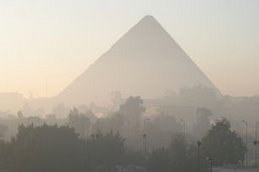
Daily Photo - Pyramids at Giza


The pyramids of Giza seen from the Meridien Pyramids hotel in Cairo.

Monday, February 16, 2009

Travel: The Faiyum oasis

Al Ahram Weekly (Amira El-Naqeeb)

Good travel article which looks at many of the main features of the Faiyum oasis, from the world's oldest paved road to the lovely site of Dimeh. With photos.

For me Fayoum has always been a destination at arm's reach, and I won't hesitate to drop by for a one-day trip whenever there's a chance. My visits had one of two purposes. I would either make for Wadi Al-Rayyan, a protected area, for quick landscape refreshment, enjoying the little bit of everything the scenery provides, be it the solitude of the desert, the breeze of the greenery or the purity of the water running through the verdant landscape. Or, I would visit the rural part of Fayoum and watch the fishermen spreading their nets in Lake Qaroun, walk in the fields or play with a herd of sheep. I never knew there was a mystical part of Fayoum yet to be discovered. Places where time stood still.

Egypt's largest oasis, Fayoum, is located only 80km from Cairo. My guide and co-adventurer on this trip was desert veteran and the owner of Desert Adventures safari company, Hani Amr, with whom I share a passion for the desert -- which I am sure is my natural habitat. Also accompanying us was Klas Lindberg, a Swedish friend and freelance photographer, and Am Ahmed, a driver and a guide in his own right. Our plan was to explore some long-abandoned relics.