Tuesday, June 30, 2009

Update re hunt for Cleopatra

Dominican Today

The attorney-turned-archaeologist Kathleen Martinez, who’s proud to proclaim that her work is part of a larger effort by a Dominican-Egyptian team, today said that her search for Cleopatra’s tomb continues and is convinced she’ll soon find it.

She said her search in the region, kilometers west of the ancient port city of Alexandria, has lasted four years in 4 to 5-month periods, and in addition to the Egyptian queen, expects to find at her side the mummified body 50 of her lover, Marc Antony. “Important evidence of a royal tomb was found and I affirm that it’s the tomb of Cleopatra and Marc Anthony.

Martinez also affirms that given the scope and sheer numbers of tombs, her team has found Egypt’s largest cemetery. “It’s the largest cemetery found in Egypt, with its artifacts, a series of 40 to 45 tombs cut into the bedrock 35 meters deep, with tunnels and passageways.”

The archaeologist, interviewed by Huchi Lora on Channel 11, said the digs had to be recently suspended given the extreme summer temperatures and more so from the dangerous conditions they bring about. “The appearance of snakes and scorpions to the surface in the summer season, with 40 plus centigrade temperatures, makes it impossible and risky to continue the excavation.”

See the above page for the full story.

Profit, not learning, drives 'Tutankhamun'

SFGate (Kenneth Baker)

With photos.

Among people with a professional interest in the arts, "Tutankhamun and the Golden Age of the Pharaohs," which opens today at the M.H. de Young Memorial Museum, will merely deepen the tarnish on the reputation of the Fine Arts Museums of San Francisco.

Although FAMSF curator Renee Dreyfus has swapped out four objects presented at other venues for four of her own choosing, the show in bulk comes here prepackaged by National Geographic and Arts and Exhibitions International, a subsidiary of corporate impresario AEG Worldwide, which also owns the San Francisco Examiner.

Critics have hammered every art museum that has hosted "Tutankhamun." (A parallel exhibition, "Tutankhamun, the Golden King and the Great Pharaohs" - same size, same sources, same organizers - opens today at the Children's Museum of Indianapolis.) But here, as elsewhere - except Dallas, where attendance fell about 40 percent short of projections - a vast audience probably will eat it up, even at $27.50 a head for general admission.

Why?

Therein lies a mystery to eclipse the unanswered questions represented by many of the objects on view.

See the above page for full details.

Eight artefacts returned by Switzerland

Egypt State Information Service

Egypt will receive on 26/6/2009 eight archaeological artifacts that were smuggled outside the country in 2002, said an expert in a released statement on Thursday 25/6/2009.

The antiquities have been stolen from the storehouse of Cairo University in Maadi district, a Cairo suburb, said Dr Zahi Hawwas, the Secretary General of the Supreme Council of Antiquities (SCA).

The eight pieces, dating back to the pre-history era, include stone utensils, he added.

The story started when a Swiss bought these artifacts from an antiquities dealer in the United States in 2005. When he came to know that they were stolen from Egypt he contacted the Egyptian embassy in Bern and expressed his willingness to give them back to Egypt.

Book Review: Philae and the End of Ancient Egyptian Religio

Bryn Mawr Classical Review (Reviewed by Robert B. Gozzoli)

J. H. F. Dijkstra, Philae and the End of Ancient Egyptian Religion: A Regional Study of Religious Transformation (298-642 CE). Orientalia Lovaniensia Analecta, 173. Leuven: Peeters, 2008.

The book under analysis here is the revised PhD dissertation of the author, originally submitted in 2005 at the University of Groningen, under the title of Religious Encounters on the Southern Egyptian Frontier in Late Antiquity (p. x).1 For readers such as myself, an Egyptologist by formation with a small background in Coptic studies, this book is certainly a welcome contribution for it is a comprehensive analysis of the religious and social developments at Philae and in the First Cataract zone. The chronological boundaries are defined by the withdrawal of Egypt's southern border to Elephantine in 298 AD by Diocletian and the Arab conquest of Egypt. Within this scope, various sources are analysed and comprehensively studied in order to give a picture of how ancient Egyptian religion and the ''new'' religion merged in daily life. The book is set up by these initial questions: "What happened to the cults at Philae in the Late Antiquity? And what was the role played by Christianity on the island? Was Philae an exceptional case?" (p. 14).

For Philae, one of the few established dates for the fate of ancient Egyptian religion is 537 CE, as Justinian ordered the closure of the temples. Dijkstra offers two relevant texts. The first is the petition written by Diodorus in Antinoopolis on behalf of the councilors of Omboi against a man nicknamed as the 'Eater of Raw Meat' (ὠμοφάγος), the so called Blemmyan incident (circa 567 CE). The accused man is blamed for neglecting the taught Christian doctrine and renewing pagan sanctuaries of Philae with the help of the Blemmyes.2 The second text is Procopius' Persian Wars, which states that the temple of Isis was finally closed in 535-537 CE (pp. 11-14), following Emperor Justinian's order. Dijkstra's sees the two documents not necessarily contradicting each other, for Procopius is describing imperial policies while the petition reflects a particular moment of local history. Dijkstra's main thesis is that the negative picture of a rising Christianity fighting against the old religion is fundamentally erroneous, as the ancient Egyptian cults were already dying by themselves, without external intervention.3

Setting his book on such terms, Dijkstra structures it in three parts: Part I is about the developments of Christianity in the First Cataract region during the fourth century CE; Part II is about the survival of the ancient Egyptian cults; and the final part is about Christianity in the region during the sixth century CE.

While the first and second chapters of Part I (pp. 45-119) deal with published historical sources such as the Appion petition and the Patermouthis archive, both of which provide a glimpse of the life of the Christian Community during the fifth century CE, the most interesting and fundamental part is the summary of archaeological fieldwork at Elephantine which makes the third chapter (pp. 85-118).

See the above page for the entire review.

Mummy returns to Belfast display

BBC News, Northern Ireland ()

The Egyptian mummy - a source of fascination for children since she came to Belfast in 1834 - had been in storage as the Ulster Museum went through a major refurbishment over a period of nearly three years.

But she has returned to her home at the corner of Belfast's Botanic Park and will be ready to receive visitors when the new-look museum opens in October.

The mummy has always been a major draw for the museum.

But curators dismissed as "urban myth" a popular story that the mummy once contracted a bad case of nits from the children of Belfast and ended up under glass to protect herself.

"She dates from 660 BC and was the daughter of a priest living in Thebes in the Valley of the Kings," said Dr Jim McGreevy, head curator at National Museums Northern Ireland.

Secrets of daily life among the great pyramids of Giza

Columbus Dispatch (Doug Caruso)

The Egyptians who built the giant pyramids on the Giza Plateau 4,500 years ago ate dense bread, choice cuts of meat and preserved fish.

They slept in military-style barracks and belonged to work gangs with names such as the "Drunkards of Menkaure."

Archaeologist Mark Lehner knows these details because he spent the past two decades digging them up from their lost city.

Nearby are the pyramids and the Great Sphinx, icons most people associate with Egyptian archaeology. But Lehner likens those to what someone might find someday if they dig up the National Mall in Washington, D.C.

"What would you know about their diet or the economy or a crisis in the economy or how much they changed in 300 years since George Washington unless you dig the outlying parts of D.C.?" he asked.

His team's treasures -- grain mills, animal bones and pieces of clay seals -- are found in bakeries, barracks and the homes of scribes.


See the above page for the full story.

Travel: Discover Siwa Oasis

The Press and Journal (Emily Beament)

THERE’S more to Egypt than the Pyramids of Giza – the only surviving wonder of the ancient world – and a trip deep into the western desert reveals one of its lesser known treasures.

A three-hour drive south from the coastal town of Marsa Matruh, and 350 miles south-west of bustling Cairo, Siwa Oasis is a dust-coloured settlement surrounded by date palms and olive groves which appears to have changed little in centuries.

But the “oasis of a million palm trees” is more than a patch of green in the middle of an expanse of sandy desert.

It boasts several ancient ruins, including the Temple of the Oracle consulted by Alexander the Great and its own “mountain of the dead”, with tombs dating back to Roman and ancient Egyptian times.

Climbing that mountain, Gebel al-Mawta, gives a great view of the surrounding town, and there’s a chance to see inside and gain a glimpse of wall paintings which have been preserved for centuries.

Constant excavations have stripped away layers of the mountain, and the remains of bones are scattered around the entrances to what is left of the tombs themselves.

Less ancient, but equally ruined, is the strange old town of Shali, in the centre of Siwa, a multi-layered pile of what look like melted buildings.

And they are: three days of heavy rain in 1926 melted the salt blocks that form much of the building material and forced the townspeople to rebuild in the surrounding area.

The palm trees which give the city its name and character are so important to the area that they cannot be chopped down to make way for new development – so houses are built around them.

As a result, our hotel had several trees protruding through the dining-room and up into the terrace, where they cast a welcome shadow from the sun and provided a handy source of freshly picked dates.

Meals could be enjoyed Western-style at a table with chairs or Bedouin-style on cushions around low tables, and the food was typically north African, with hummus, feta, olives and baba ganoush just some of the options.

See the above page for the full story.

Travel: Q&A re two women traveling in Cairo

The Record

Q. My 30-year-old daughter and a woman friend are travel- ling to Cairo in July. Any safety concerns they should be aware of? Also, any suggestions on places to stay? She says she can get a room for $15 -- how safe is that?

A. Generally speaking, Cairo is a safe city, especially in heavily touristed areas. Women should take the same precautions they would when visiting any urban area: Don't walk alone at night, leave flashy jewelry at home, don't go off with strangers, have the hotel summon taxis, etc.

See the above for the rest of the advice.

Travel: St Catherine's Monastery, Sinai

Billings Gazette (Elizabeth McNamer)

St. Catherine's Monastery is an Orthodox monastery on the Sinai peninsula at the foot of Mount Sinai in Egypt.

It is one of the oldest Christian monasteries in the world.

The Book of Exodus tells the story of the Israelites making a journey under Moses out of Egypt across the Red Sea through the Sinai desert to the Promised Land. It took 40 years.

We are told that Moses ascended a mountain in the desert, where he received the Ten Commandments. Where that mountain is, nobody knows. But massive Mount Horeb dominates the area (its highest peak is called Mount Sinai), and this has long been held to be Moses' mountain.
At its foot, Moses is supposed to have first experienced God in a burning bush.

"God called to him from within the bush, 'Moses! Moses!' And Moses said, 'Here I am.' 'Do not come any closer,' God said.

" 'Take off your sandals, for the place where you are standing is holy ground.' Then he said, 'I am the God of your father, the God of Abraham, the God of Isaac and the God of Jacob.' At this, Moses hid his face, because he was afraid to look at God."

Jews, Christians and Muslims revere Mount Horeb as the place where God handed down the law.

Christian hermits began to gather around this mount in the wilderness in the middle of the third century.

Many of them lived in caves or built small huts and spent their days in prayer and silence. Often, they were attacked and killed by the Bedouin tribes.

When St. Helena, mother of the Emperor Constantine, journeyed to the Holy Land in the early fourth century, she ordered a chapel to be built there. It soon became a popular place of pilgrimage.

Egeria, a Spanish nun, writes about it in her diary: "There is a fine garden and plenty of water."

In 557, Emperor Justinian built a magnificent church and surrounded it by a large wall to protect the monks. Their cells were built along the inner side of the wall.

When Mohammed came on the scene in the seventh century, the monastery was allowed to go on its course. A document signed by the Prophet Mohammed himself, the Actiname (Holy Testament), exempted the Christian monks of St. Catherine's from the usual taxes and military service and commanded that Muslims provide the community with every help.

The monastery now houses a mosque.

When the Byzantine Emperor Leo ordered all icons destroyed in the seventh century, St. Catherine's was so remote that the icons there survived. The magnificent collection of early icons - more than 2,000 of them - can still be seen there today.

When Napoleon conquered Egypt in 1798, he placed St. Catherine's under his protection.

See the above page for the full story.

Exhibition: Indiana unveils Tutankhamun treasures

Inside Indiana Business

Over 130 treasures from the tomb of the “Boy King” and other important rulers from 2,000 years of ancient Egyptian history will be on exhibit at The Children's Museum. The exhibit will feature striking objects from some of the most important rulers throughout 2,000 years of ancient Egyptian history, from the 4th Dynasty into the Late Period (about 2600 B.C. – 660 B.C.), many of which have never visited the United States.

Four galleries devoted to King Tut will correspond to the four rooms of his nearly intact tomb where the treasures were discovered by British explorer Howard Carter in 1922. Legendary artifacts from the antechamber, the annex, the treasury and the burial chamber will include Tutankhamun’s golden sandals, jewelry, furniture, weaponry and statuary. This blockbuster exhibit will also feature the largest image of King Tut ever found — a 10-foot statue that may have originally stood at his mortuary temple and retains much of its original paint, one of four gold and precious-stone-inlaid canopic jars and CT scans of Tut’s mummy.

See the above page for more details.

Cairo Museum slideshow

WLFI

Note: To view the slideshow, click Play. There are 44 photos in this gallery, although links to the first 18 are shown.

The Egyptian Museum in Cairo houses thousands of items and thousands of years of history. From statues to mummies it is “the” place to see the artifacts of ancient Egypt…including the treasures discovered in Tut’s tomb.

Video: David Rohl in the Eastern Desert

My Space

Video by David Rohl of the Eastern Desert Survey trip. There's no voice-over or explanatin. it consists of romantic music, pretty sunsets, footage of four wheel drives, rock art and survey members.

Nice to see that excellent Pan Arab Tours are getting a good plug!

Just over four minutes long.

Thanks to the Friends of the Petrie for a great evening

I enjoyed the summer party held by the Friends of the Petrie Museum of Egyptian Archaeology on Friday night, and it was great to catch up with so many old friends and to meet some new ones. Thanks to Jan Picton for inviting me to take up position behind the bar.

Behind the bar I was definitely the thorn between two wonderful roses - thanks very much to both John and John for keeping me so wonderfully entertained! It was also great to see Lucia, Jean (with whom I was at the Gilf a couple of years ago on a terrific trip), Tass (it was fabulous to see you again) and some of the gang from the Bloomsbury Summer School. A very happy hello too to people who are new to me - Lara, who gave me some brilliant catering tips, Carol, with whom I chatted about Coptic studies whilst filling canapes, Sarah who has a way of carrying tables into elevators which defies description and Abeida (sorry about the guess-spelling) who has a wonderful and completely addictive laugh. I shan't be missing another partyheld by the Friends of the Petrie again!

Daily Photo by Rick Menges


Head from a female sphinx
Middle Kingdom
Brooklyn Museum

There are details and a video about this lovely item on
a dedicated page on the Brooklyn Museum's website

Copyright Rick Menges, with my thanks


Friday, June 26, 2009

More re discoveries at Saqqara

drhawass.com

Minister of Culture, Farouk Hosni, announced today that Egyptian archaeologists, performing routine conservation work at the southern side of Saqqara’s step pyramid (2687-2668 BC), have stumbled upon what is believed to be a deep hole full of the remains of animals and birds. The mission has also found that the hole’s floor is covered with a layer of plaster.

Dr. Zahi Hawass, Secretary General of the Supreme Council of Antiquities (SCA), has stated that the mission unearthed a large quantity of golden fragments during their restoration work at the southern tomb of Djoser’s pyramid. These may have been used by the ancient Egyptians of the Late Period to decorate wooden sarcophagi or to cover carttonage. Thirty granite blocks were also discovered, each weighing five tons. These blocks, Dr. Hawass explained, belonged to the granite sarcophagus that once housed Djoser’s wooden sarcophagus - the final resting place of the king’s mummy.

While cleaning the internal corridors of the pyramid, the mission has also found limestone blocks bearing the names of King Djoser's daughters, as well as wooden instruments, remains of wooden statues, bone fragments, the remains of a mummy, and different sizes of clay vessels.

Learning Middle Egyptian with GlyphStudy

Talking Pyramids (Vincent Brown)

Thanks very much to Vincent for this excellent summary of the current state of play with the GlyphStudy Middle Egyptian group. I've been away and had somewhat lost track of what was due to happen when:

The Yahoo group GlyphStudy is running three new Middle Egyptian study groups, each starting in July. One of the groups will be using James Hoch’s Middle Egyptian Grammar, another will use James Allen’s Middle Egyptian: An introduction to the Language and Culture of Hieroglyphs, and the third group will be using How to Read Egyptian Hieroglyphs: A Step-by-Step Guide to Teach Yourself, Revised Edition by Mark Collier and Bill Manley

The three groups are open to anyone who wishes to participate, the only requirement is that you have the text book for that course and that you sign up for a Yahoo account and subscribe to GlyphStudy. Yahoo accounts are free and so is the subscription to GlyphStudy.

See Vincent's post, above, for the details.

The Mysterious Osiris Shaft of Giza

drhawass.com

With photos.

In 1945, the Egyptian archaeologist Abdel Moneim Abu Bakr came across a water-filled shaft inside a small tunnel that runs north-south under the causeway of Khafre at Giza. He explored it sufficiently to learn that it incorporated a number of chambers, but he never excavated or published it. For many years, the shaft had served as a swimming hole and as a source of drinking water for local workmen - it was filled with groundwater to such a high level that no archaeologist was able to excavate it.

The shaft's purpose remained a mystery, although many New Age enthusiasts learned of the it and spread rumors that it hid a secret network of tunnels leading to the Great Pyramid or perhaps to the Sphinx. In the summer of 1999, I decided that it was time to take on the challenge of excavating this shaft to determine its true function and put the speculation to rest.

It was a great challenge to reduce the water level in the shaft to a point where we could work inside. The high water table in the area was the source of the problem. We asked an engineer named Esmail Osman to bring in the machinery needed to pump the water out. Working inside the shaft while the equipment was running was one of the greatest challenges of my life as an archaeologist. The constant noise made it difficult to think, and the machinery was so loud that I almost lost my hearing! We were very worried that pumping out the water would destabilize the shaft, possibly causing it to collapse. I insisted that plaster strips marked with the date be placed across even the smallest crack in the walls. If the cracks began to expand, the plaster would break, and we would know to begin structural interventions right away.

What we discovered as we pumped out the water and excavated the shaft was truly amazing.

See the above page for more.

Saving the Serapeum

drhawass.com

With photographs.
The Saqqara plateau served as a burial site to the ancient Egyptians for over three thousand years. It is home to pyramids, private tombs and temples, and is even the burial place of sacred animals. The most famous of the animals buried at Saqqara were the Apis bulls. For over a thousand years these bulls were laid to rest in the darkness of the Serapeum, a massive gallery of tunnels and niches carved into the rock below Saqqara.

The story of the discovery of the Serapeum is as exciting as any Hollywood movie. The Greek writer Strabo, who lived in the First Century BC, described a road of lonely windswept sphinxes, some half submerged in the sand, stretching out across Saqqara to a temple of the god Serapis. Nearly two thousand years later a young man named Auguste Mariette was sent to Egypt by the Louvre to buy manuscripts for the museum’s collection. On a visit to Saqqara he noticed a sphinx emerging from the sand. Suddenly the words of Strabo entered his mind and he realised that if he followed the row of sphinxes he would find the long lost Serapeum. At that moment he decided to ignore his instructions from the French Government and, quietly, and almost secretly, begin his excavations. As work continued he discovered Greek statues marking the path. Then, after having informed the French government of his discovery, he asked for the funds to continue his important work.

His request was successful and for four years his team continued to excavate, uncovering more of the secrets of the Serapeum as they worked. The row of sphinxes led to the remains of two pylons. In turn, these had originally led to a temple, of which virtually nothing now remained. However, they found that one of the chambers in the temple led to a vast subterranean vault. Here Mariette knew that he would find the sacred tombs of the Apis bulls.

From the ancient evidence we know that there was only ever one Apis bull at a time and that each bull was associated with the king when alive and with the god Osiris after death. In the Ptolemaic Period the cult of the Apis was combined with that of a variety of Greek gods; it was then known as the cult of Serapis. The mothers of the Apis bulls were also viewed as gods; these were associated with Isis and buried in North Saqqara.

The bulls were buried at the Serapeum for over one thousand years, from the Eighteenth Dynasty to the Ptolemaic Period, amid great mourning and ceremony. During this long period of time there were three major stages of architectural development.

See the above page for the full story.

Saving the West Bank temples in Luxor

Luxor News Blog (Jane Akshar)

Good news about the problems of the rising of the water table and destruction of the monuments. The problems is that with the building of the Aswan Dam water is now available to the farmer all year round. The temples were built taking into account they would be flooded 3 months of the year and bone dry for the other 9 months. The farmer would have one crop a year, he would sow his seed as the waters of the inundation receded and the yearly crop would grow and be harvested.

Now water is available all year round. The farmer flood irrigates his field and can crop 2 to 3 times a year. This has risen the water table and the temple foundations how sit in water all year round. This is decaying the stone and sand stone becomes sand again.


See the above page for Jane's complete post.

200 years of the Description de l'Egypte

Al Ahram Weekly (David Tresilian)

THE MAGNIFICENT setting of the église du D¤me at Les Invalides in Paris is the backdrop for a small exhibition, running until September 2009, designed to celebrate the bicentenary of the publication of the first volumes of the Description de l'Egypte, the famous account of Egypt drawn up by French scientists during the military campaign mounted by Napoleon Bonaparte in the country from 1798 to 1801.

Occupying a space to the left of the main entrance to the church, which was built by Jules Hardouin-Mansart in the late 17th century to glorify the rule of Louis XIV, the exhibition has been placed only a few metres from Napoleon's tomb. The latter, a five- metre high structure in red quartzite, has occupied the open crypt beneath the dome since the French emperor's remains were installed in the church in 1840, and it is surrounded by the names of some of his more outstanding victories, among them at the battles of Marengo, Austerlitz and Wagram, as well as, in 1798, over the Egyptian mamlukes at the Battle of the Pyramids.

As the notes to the exhibition point out, there is something fitting about the location chosen, if only because of Napoleon's personal involvement in the production and publication of the Description de l'Egypte. Originally commissioned in 1802 by Napoleon himself, who saw the work as a fitting memorial to his military expedition in Egypt and wanted it to appear in 1809 to mark the tenth anniversary of his rule, the complete work did not appear until 20 years later when a second edition was completed in 1829, though the first volumes did appear on time and bear the date 1809.

A vast work of description and illustration undertaken by some 160 scholars taken to Egypt by Napoleon in 1798 together with his military forces, the Description consists of nine folio volumes of text, together with a large-format introductory volume. The text volumes contain some 7,000 pages of material by 43 authors on every aspect of Egypt, ancient and modern. Added to this are a further dozen volumes of illustrations, which contain some 836 sheets of engraved illustrations, 60 or so in colour, and required the work of 200 engravers and 62 illustrators, 46 of whom made drawings in Egypt as part of the original military expedition.


See the above page for the full story.

More re discovery that Lady Hor is actually a man

Newsday (Erik Badia)

With a photograph of the upper section of the mummy.
Egyptologists from the Brooklyn Museum and doctors from North Shore University Hospital learned Tuesday through a CT scan that a 2,500-year-old mummy previously thought to be a woman - and named Lady Hor - actually was a man.

Dr. Jesse Chusid said that while the mummy's body wrap of linen covered in plaster, called cartonnage, bore the shape of a woman, the body within had the anatomy of a man.

When Lady Hor's image appeared on the screen, "we knew almost immediately that it was not a woman," Chusid said. "You can actually see there are the pelvic organs of a male."

The discovery was made after Chusid, a radiologist, and Dr. Amgad Makaryus, director of cardiac CT and MRI at the Manhasset hospital, performed a 64-slice computed tomography, or CT scan, on the mummy.

The revelation was startling for those from the Brooklyn Museum, as the mummy for decades was believed to be female.

"The re-gendering is a big deal to us," said Edward Bleiberg, the museum's curator of Egyptian art. He explained that the lack of a traditional male beard on the cartonnage had led him and other Egyptologists to believe that he was a she.

Exhibition: Sculpture Portraits of Nefertiti at Hermitage

Russia IC

The State Hermitage Museum opened the exhibtion “The Beautiful Has Come. Portrait Masterpieces from Egyptian Museum in Berlin” on 23 June.

The exhibits displayed at the exhibition were taken away from Germany during World War Two and were kept in the State Hermitage Museum till 1958, when they were returned to the Egyptian Museum in Berlin.

The highlights of the exposition are three sculptured heads created in the mid 14th century BC in the studio of Thutmose: Head of Young Nefertiti (sandstone, colouring); Head of Nefertiti in Middle Age (granodiorite), and Head of Tsarevna, Daughter of Akhenaten and Nefertiti (sandstone), as well as Head of Amasis (greywacke), created in the mid 6th century BC.


Exhibition: More re Tutankhamun in San Francisco

SF Examiner (Steven Winn)

Tutankhamun in the present day

Gold, gold and more gold. Ornate jewelry studded with jewels and desert glass. Alabaster and faience. Delicate perfume vases and charming model boats. Game boards and thrones. Footstools and figurines. The mummy of Tut himself, sealed inside three nested coffins, which were in turn tucked inside four gorgeously etched and gilded wooden shrines. Affirmed by some 5,398 objects in all, the legend of the Golden King, the Egyptian Boy King, was born.

Today, the better part of a century later, it’s hard to overestimate the impact of Carter’s discovery. In launching a global fascination with Tutankhamun, and by extension with the grand arc of ancient Egyptian civilization, this great find ignited imaginations everywhere. It led to everything from serious scholarship to hieroglyphic-print miniskirts, a fresh appreciation of Egyptian artistry to the 1937 Three Stooges short “We Want Our Mummy.” It gave us CAT scans of Tut’s remains and a backstory for “Raiders of the Lost Ark.”

Never mind the pop-culture myths and madness about a curse of King Tut that have flourished through the years. Tut’s great, unexpected gift to the modern world is a renewed reverence for history itself; a hunger to comprehend the web of social, economic and spiritual belief systems that evolved and endured for centuries; and an awestruck sense of connection to a distant and fully formed world.

It all began with the marvels that Carter uncovered and, in a period of 10 years, revealed to the public. From the breathless early press reports to the blockbuster exhibition of Tut artifacts that toured North America in the late 1970s, luxury and splendor were the predominant draws. San Franciscans lined up in record-breaking numbers to see the famous gold coffin and death mask that headlined “The Treasures of Tutankhamun” in that show’s 1979 run at the de Young Museum.

But there was always much more to the story and meaning of King Tut than those 55 objects could convey. Now, exactly 30 years later, in a resonant and adroitly timed second act, “Tutankhamun and the Golden Age of the Pharaohs” arrives at the de Young to advance and deepen this beguiling Egyptian narrative.


And Tutankhamun in the past

SF Examiner (Steven Winn)

Thirty years ago, when the first major collection of King Tut artifacts conquered North America, San Francisco was the touring show’s gold standard. The 1,367,000 visitors who thronged the de Young Museum from June to October 1979 set the attendance record for the seven U.S. cities graced by “The Treasures of Tutankhamun.”

People stood in line all night for advance tickets, as if the show were a museum-world version of “Star Wars.” Miniature gold coffins and Egyptian-look jewelry sold out in shops around town. Faux pharaonic dress and tomb-decor parties flourished. KFRC gave Steve Martin’s goofy-funky “King Tut” song plenty of airplay.

But the “Tutmania” that swept the Bay Area that summer almost didn’t happen.

Excluded from the original touring schedule, San Francisco put on a last-ditch, full-court press to bring the exhibition to Golden Gate Park. A delegation headed by arts patrons Cyril Magnin and Walter Newman, and Fine Arts Museums director Ian White, flew to Cairo to plead The City’s case.

The San Franciscans had several things to offer. One was money — a major donation to the Cairo Egyptian Antiquities Museum. The other was an Egyptian frieze the de Young was about to buy from a Parisian dealer. After learning that it had first been taken from Egypt illegally by the British Museum, White promised to return the frieze to Cairo. With a handshake from Egyptian President Anwar Sadat, the deal to bring Tut to San Francisco was done.

That ’79 show was a watershed event. For both serious and casual art lovers, it was the first in a wave of blockbuster exhibits that would transform the museum-going experience in the decades to come. Unprecedented popular attention, timed ticket sales, gusher gift shop sales and a flood of new members all became part of the way art museums connected to the public, raised revenue and funded new ventures. Subsequent huge shows devoted to Picasso, Monet or the collection of St. Petersburg’s Hermitage Museum had the ancient Egyptian Boy King to thank as an advance man.

Travel: "Intermediate Map" of Egypt for drivers

Zawya

Thanks to Ben Morales-Correa for posting the above news item on this Egypt Then and Now blog.

NAVTEQ, the leading global provider of digital map, traffic and location data for in-vehicle, portable, wireless and enterprise solutions, has announced release of its first map for Egypt. With this Intermediate Map of Egypt, drivers will have access to approximately 50,000 km of roads and more than 42,000 POIs referenced to the map to enhance the functionality of navigation systems.

Egypt has a very complex road network, strong tourism industry and is one of the region’s most populous nations, with an estimated population of 78.3 million inhabitants. The Intermediate Map of Egypt has been designed to meet the evolving needs of the growing user base.

Intermediate Maps are a separate class of map data provided by NAVTEQ to support customers who are interested in introducing LBS and navigation applications in emerging markets.

“With the recent announcement that the Egyptian government has lifted its ban on GPS mobile phones and navigation systems, we expect to see rapid growth in demand for navigation and LBS solutions” stated Frank Pauli, Vice President EMEA Map and Content Products, NAVTEQ. “The availability of an Intermediate Map for Egypt will deliver a significant competitive advantage to NAVTEQ customers as it allows easy and fast integration with a variety of applications and solutions.”

One man's view of Zahi Hawass

SF Examiner (Steven Winn)

It’s never a good idea to keep Zahi Hawass waiting.

“You’re three minutes late,” the celebrated Egyptian archaeologist told a group of San Francisco visitors one very warm April morning at Saqqara, an ancient burial city site dominated by the world’s oldest pyramid (circa 2700 B.C.).

Hawass was standing in full Egyptian sunlight, shielded only by one of the battered, sweat-stained leather hats that have become his trademark costume pieces in public and on numerous History Channel, Discovery Channel and National Geographic TV special appearances. Hawass didn’t smile as he led his guests to the opening of a nearby cave. He rarely does.

Inside the cave, Hawass pointed out a touchingly beautiful wall carving that he believes represents a young Tutankhamun with his wet nurse, Maya, their faces close together and arms intertwined.

“Look at this beautiful young boy,” Hawass said, his steely gaze widening and his voice taking on a cadence both tender and urgent. “He looks about the age of 9. Look at his face. The cobra is in the forehead, protecting him, and Maya is putting her hand out to him in love and affection, like a mother and child. And look — he’s holding the sign of the ahkh [the hieroglyphic character for eternal life]. It’s amazing.”

That was an altogether fitting introduction to Hawass, 62, who has marshaled his passion for the ancient Egyptian world into a one-man force to promote, preserve and protect his native country’s cultural treasures. As secretary general of the Egyptian Supreme Council of Antiquities, a lofty title perfectly suited to his outsized personality, Hawass combines no-nonsense determination, a deep knowledge of his subject and a canny flair for attention-getting publicity and its attendant revenue streams.

If he sometimes comes off as a kind of self-styled archaeological “rocks star,” enamored with the Emmy Award and photograph of himself with Celine Dion that adorn his Cairo office, the sense of purposeful mission is unmistakable. Everything he does — the TV gigs; the current Tutankhamun show he co-curated with David P. Silverman; the audaciously bold, press-baiting claims of forthcoming discoveries that will “reveal the mysteries” of millennia past — serves an ambitious, far-sighted agenda.


See the above page for the full story.


Exhibition: Mubarak sends greeting message to Egypt's "Sunken Treasures Exhibition" in Japan

Egypt State Information Service

President Hosni Mubarak sent a message of greetings to "Egypt's Sunken Treasures Exhibition" to be opened by Egyptian ambassador to Japan Walid Abdel-Naser in Yokohama city.

In his message, Mubarak hoped that the exhibition would help the Japanese people get more acquainted with the Egyptian civilization, along with boosting Egyptian-Japanese ties in the various fields, Ambassador Abdel-Naser said in statements.

The exhibition will coincide with celebrations marking the 150 th anniversary of the opening Yokohama Port and the 130 th anniversary of publishing the Asahi Shimbun newspaper.

The opening ceremony of the exhibition, to be held from June 27 through September 23, will be attended by Yokohama Mayor Hiroshi Nakada.

It is organized by the Supreme Council of Antiquities (SCA), the Asahi Shumbun newspaper, Japan's TBS television network and the Egyptian embassy in Tokyo and its information and tourism offices.

The exhibition includes 489 pieces salvaged from the Mediterranean Sea in Alexandria.

The artifacts include some gigantic stone statues each up to 5 meters tall and weighing 6 tons.The pieces, dating back to different historical periods, focuses on the Ptolemaic Dynasty (305-30 BCE).
They were fished out by Egyptian archeologists in association with a European Institute of Submarine Archeology mission working in Alexandria since the early 1990s.

The Egyptian embassy in Tokyo will organize an Egyptian tourist week in Yokohama city from June 30 through July 5 on the sidelines of the exhibition.

Exhibition video: Egypt Comes to Indy

WishTV

King Tut and all the magic of the Pharaohs of Egypt will go on display Saturday at the Indianapolis Children's Museum.

On Thursday, 24-Hour News 8 will air a documentary that may surprise you and the high definition images will impress. Not only will you see the monuments and tombs, but News 8 also wanted to give you a taste of a modern city in an ancient land.

Click on the video player to watch the complete story.

Trivia: Eating ancient Egyptian

Marinij.com

A bit of trivia. The British Museum always has a special menu to complement its standard offerings to tie in with its key exhibition at any one time. In the U.S. the de Young Museum is offering a special menu for Tutankhamun:

For the Tut exhibit, look for a pyramid of greens, a Red Sea fish stew, chicken tagine, lamb and beef kefta and toasted lentil soup on the menu.

And if you fancy giving it a bash yourself click here for a recipe for obelisk breadsticks from the Washington Post.

If the idea of cooking ancient Egyptian type food appeals, the British Museum sells a book on cooking in ancient Egyptian style: Food Fit For Pharaohs by Michelle Berriedale-Johnson.

Finally, if you don't want to eat it or cook it but would like to know more about ancient Egyptian food and drink, you might like to look at Egyptian Food and Drink by Hilary Wilson (Shire Egyptology), available from various online retailers.

New Book: The Pharaohs

The University of Manchester
The Pharaohs by Dr Joyce Tyldesley, Quercus History

Egypt was the best place to live in the ancient world, according to ‘The Pharaohs’, a new book that gives a full but straightforward and colourful account of life there from 3100 BC to 30 BC.
Isis, Queen of the Gods

“The River Nile flooded every year, making the land very fertile, so there was always food,” author Dr Joyce Tyldesley explains.

“The peasants were worked hard but they didn’t have a bad life. Women had better rights than other civilizations – they could own property, live alone, raise children by themselves. The elite lived luxurious lives; they had country estates complete with bathrooms, and well-decorated tombs.

“The ancient Egyptians pitied people who lived in other lands.”

They had some problems – low level diseases such as bilharzia (a worm that lives in the gut, making the host feel unwell if not seriously ill) and respiratory problems from breathing in sand and fire smoke from cooking and lighting were common. Many women died in childbirth.

And the Pharaohs themselves, despite being semi divine, the country’s high priest, leader of the army and head of the civil service, faced many thorny political battles to lead or even just survive. At least two were murdered by ambitious wives and sons, one prostituted his daughter and another was proclaimed a heretic and his reign erased from official history.

See the above page for the full story.

Daily Photo by Rick Menges


12-ton granite Sphinx of Ramesses II
from the
University of Pennsylvania Museum of Archaeology and Anthropology

Copyright: Rick Menges. With my thanks.


Thursday, June 25, 2009

Archaeological discovery in Saqqara

Egypt State Information Service

Culture Minister Farouk Hosni said on 23/6/2009 that a group of Egyptian archaeologists have unearthed a number of ushabtis - an ushabti is a funerary figurine placed in a tomb as a substitute for the deceased, should he/she be called upon to do manual labor in the afterlife - and remains of animal bones and birds inside a hole near the Pyramid of Djoser in Saqqara.

The Supreme Council of Antiquities team was originally rehabilitating the southern front of the step pyramid when they came upon this crevice, said SCA Secretary General Zahi Hawwas in a statement issued Tuesday. They also found a layer of cement inside the hole, Hawwas added.

Golden shells were discovered in the southern tomb, the SCA official said, believing ancient Egyptians could have used them to decorate wooden caskets or to place on top of car tonnages (material composing Egyptian funerary masks). Hawwas said that the SCA group unearthed 30 granite blocs that, put together,

Samir Abdel-Raouf, the head of the team, said they found adobe bricks bearing the names of Djoser's daughters and his different titles along the corridor, noting that all pieces are now being renovated to form a coffin in which the wooden casket is placed with the mummy of King Djoser inside.

Egyptian Archaeologists Discover 3,500-Year-Old Tomb

Al Ahram Weekly

(With photo)

During excavation work at the Tombs of the Nobles on Luxor's West Bank an Egyptian archaeological mission has stumbled upon what it believes is the tomb of Amen-Em-Epet, Supervisor of Hunters during the reign of the monotheistic Pharaoh Akhnaten, reports Nevine El-Aref

The rock hewn 18th Dynasty tomb consists of an open courtyard and two halls, one square, the other rectangular. It has a deep shaft where the mission unearthed the remains of mummies, funerary seals and fragments of pottery vessels. In the court, says Mustafa Waziri, director-general of Luxor's West Bank inspectorate, another shaft was discovered containing a well preserved mummy that may belong to the tomb's owner.

The walls of the tomb had been covered with a black substance, and it had clearly been reused on a number of occasions. Yet when a section of the wall was cleaned, says Waziri, it revealed beautiful decorations.


Bloomberg

Egyptian archaeologists digging in a necropolis at Luxor where the Pharaohs buried their dead have found a tomb dating back 3,500 years ago that belonged to an official known as the Supervisor of Hunters.

The tomb of the supervisor, known as Amun-em-Opet in ancient Egyptian, dates back to the so-called 18th dynasty of Egyptian Pharaohs between 1570-1315 B.C., the Cairo-based Culture Ministry said in an e-mailed statement today. The west bank necropolis where it was found is called Dra Abu el-Naga.

Two other undecorated tombs were also found northwest of the tomb of Amun-em-Opet in which the names of the Supervisor of the Cattle of Amun and the Royal Messenger and Supervisor of the Palace were found, the statement said.

eTurboNews (Hazel Heyer)

An Egyptian archaeological mission led by Dr. Zahi Hawass, secretary general of the Supreme Council of Antiquities (SCA), discovered an 18th Dynasty tomb (1570-1315 BC) in the necropolis of Dra Abu el-Naga, on Luxor's west bank. Hawass said the newly discovered tomb belongs to the supervisor of the hunters Amun-em-Opet, and the tomb dates to shortly before the reign of King Akhenaten (1372-1355 BC).

Hawass added that the entrances to two further undecorated tombs have also been found to the northwest of the burial ground.Seven funerary seals bearing the name of Amenhotep-Ben-Nefer, the shepherd of the cattle of Amun, were found in the courtyard of the first tomb; while seals bearing the name of Eke, the royal messenger and supervisor/ care-taker of the palace were found in the courtyard of the second. Furthermore, fragmented remains of unidentified mummies have also been found, as well as a collection of Ushabti figures made of burned clay and faience.

The artifacts of life

USC News (Carl Marziali)

USC’s first pilgrims to a temple of high-energy physics will be seeking answers to worldly questions about ancient commerce.

Archaeologist Lynn Swartz Dodd of USC College and her students are taking trade artifacts from Egypt to the Argonne National Laboratory’s Advanced Photon Source, home of the most powerful X-rays in the country.

The group may be the first from USC to secure precious “beam time” at the celebrated particle accelerator, according to Gene Bickers, vice provost for undergraduate programs. The researchers will spend a week in July at the sprawling complex near Chicago.

By peering past the corroded metal on the artifacts’ surfaces and deep into their cores, Dodd and her team hope to discover the makeup and structure of the finds, which range from a series of bronze axes and swords to exquisitely forged miniature bronze-gold figurines of unknown age.

The answers may help tell the story of ancient Mediterranean trading life, which largely revolved around palatial centers.

The rulers of such palatial centers sent each other loads of gifts to “grease the wheels of trade,” Dodd said.

“(The X-ray) is a way in to understand how things operated and how trade politics, resources, moved in the ancient world. It’s a story of power and money.”

The X-ray analysis should provide clues to some basic questions. How were the figurines made? Was the technology behind the swords and axes tightly controlled or did multiple centers have access to it? If one palace owned a technology, could archaeologists try to measure its influence and wealth by searching for artifacts made the same way at other dig sites?

Unlike traditional sampling methods, X-ray analysis will not destroy or disturb the artifacts.

See the above page for the full story.
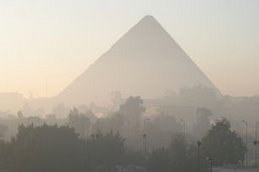
Razing the City of the Dead to breathe new life into Cairo

The National (Matt Bradley)

The Egyptian government is studying plans to move the historic Cairo cemetery of Arafa – a neighbourhood in which residents include both the living and the dead – to a location outside the Egyptian capital.

The proposed plan would turn 6,000 hectares of cemetery known as the City of the Dead, which is used as informal housing by tens of thousands of people, into a large public park.

While officials from Egypt’s ministry of housing say the plan would answer the capital’s gaping need for green space, critics of the project, particularly the living residents of Arafa who have made their homes on and among centuries-old graves, contend that the city’s plan will deprive them of hundreds of thousands of their living spaces among the dead.

But in a country where monuments to the long deceased loom as large in the public consciousness as they do on the urban skyline, it is the welfare and final wishes of the dead that elicits as much concern as their living neighbours.

“We’ve heard a lot but where are they taking the people? Lots of tombs are still being built and lots of permits are still being given. It would be impossible for them to demolish this area and build a park,” said one elderly woman, who lives with her husband and one of her daughters in a one-room apartment here that adjoins a private mausoleum. Like many of those interviewed, she refused to identify herself for fear of retribution from government officials.

“Of course I would say no. We’ve been living here for years. It’s a quiet and nice area. Why would they want to move us?”

The answer, said Mostafa Kamal Madbouly, the chairman of the general organisation for physical planning in the ministry of housing, utilities and urban development, should be obvious to anyone who has visited Egypt’s capital.

Brooklyn Museum Mummies CT Scan Project on Twitter

Brooklyn Museum on Twitter

Well, all power to them for embracing the latest fads.

Four human mummies from the Brooklyn Museum's renowned Egyptian collection will undergo computed tomography or CT scanning at North Shore University Hospital on Long Island on June 23. Throughout the day, curatorial and conservation staff will be utilizing Twitter, the free social networking and micro-blogging service, to send updates on the proceedings direct to the Brooklyn Museum Twitter feed. Follow @brooklynmuseum on Twitter: http://twitter.com/brooklynmuseum

The Brooklyn Museum collection of ancient Egyptian art, considered one of the finest in the United States, includes mummified remains of several animals and eleven humans. Through the CT scanning, Brooklyn Museum curators hope to learn more about each of the four mummies and the ancient civilization in which they lived. Each mummy underwent a preliminary examination in the Museum's Conservation Laboratory to assess their stability and general condition in order to determine if the CT scan would yield significant additional information.

The Mummies that will undergo CT scanning are a Royal Prince, Count of Thebes, who is more three thousand years old; the Lady Hor on view in her elaborately painted cartonnage since 1993, some two thousand years old; Thothirdes, over 2,500 years and; and a mummy about which little is known, that dates back to the first century C. E.

Contact:
Sally Williams, Public Information Officer, (718) 501-6330,
sally.williams@brooklynmuseum.org
Adam Husted, Media Relations Manager (718) 501-6331,
adam.husted@brooklynmuseum.org

NY hospital test reveals mummy is a man

newsday.com

It turns out one of four ancient Egyptian mummies thought for centuries to be a woman is actually a man.

North Shore University Hospital in Manhasset examined the mummies belonging to the Brooklyn Museum on Tuesday. A CAT scan revealed that one of the mummies, named "Lady Hor," was actually a man.

Researchers conducted the scans with hopes of gaining further knowledge about their identities, cause of death, and ancient funerary practices.

WCAX

Researchers hope to gain further knowledge about their identities, cause of death, and ancient funerary practices.

Egyptian art curator Dr. Edward Bleiberg says the bodies embalmed for burial by the ancient Egyptians have been packed to survive the 18-mile trip during rush hour.

The mummies range in age from more than 3,000 years old to just over 1700 years old.

Bleiberg said a 2007 hospital scan of a mummy showed the man was 30 years older than estimated and had died from an infected gallstone.

Reconstructing the face of Meresamun

Archaeology Magazine (Eti Bonn-Muller)

With photographs/illustrations

She was more than just a pretty face. The ancient Egyptian Meresamun, who lived around 800 B.C., was a working girl, a priestess-musician who served Amun, the preeminent deity of Thebes. Her mummified remains, sealed 2,800 years ago in a skintight coffin of cartonnage (layers of linen and plaster), were examined by researchers at the University of Chicago's Oriental Institute in September 2008 using the latest in CT scanning technology, a "256-slice" machine that produced startlingly vivid images. For months, she has since been the immensely popular subject of the Oriental Institute Museum's exhibition, The Life of Meresamun: A Temple Singer in Ancient Egypt.

Now, the headline-making CT images have helped two individuals--each working separately with 3-D STL (stereolithography) images of Meresamun's skull produced from the scans, but using different techniques--reconstruct Meresamun's face.

Predynastic pottery at Cincinnati Art Museum

examiner.com

Nearly 6,000 years ago; 4,000 years before the birth of Christ; 1,000 years before the first Egyptian ruler came to power over all of Egypt, there were societies living near the Nile. These early cultures are now referred to as being pre-dynastic and the phases or time-periods as Naqada I, II and III, (also spelled Nagada), named for the area of Egypt where many artifacts were found. Nomadic hunters were beginning to settle and cultivate the land and to create functional items suited to a new lifestyle. Added to the use of stone was work in metal, and the crafts of basketry, pottery, weaving, and the tanning of animal hides.

Naqada I was a time when crocodiles and rhinos, giraffes and elephants roamed the land. In this setting an early Egyptian sat down before a fire to create a piece of art we marvel at today. For him, he is merely creating a beaker, possibly for trade, possibly on commission, we cannot know; but for us, finding it so many thousands of years later, it is a trace of history, a glimpse into a past we can only envision through the various clues unintentionally left for us.

On permanent display in the Cincinnati Art Museum is the earthenware beaker fashioned by hand from rich Nile silt by that pre-dynastic Egyptian. The piece was shaped by smoothing together coils of this clay then dried in the sun, the very same activity many of us experienced in elementary school art class. It was given a wash of red ochre, a pigment made from iron rich red clay and one of the first pigments used by humans. It was fired over open flames as the kiln had not yet been invented. The darkened areas were created using a technique that allowed soot to accumulate on the pot's upper surface during the firing.

More free Internet publications from the Oriental Institute

Oriental Institute

Eleven more Egyptological titles are provided online by the OI, and are available exclusively online

MISC. The Culture of Ancient Egypt. By John A. Wilson. Oriental Institute Essay. Phoenix Edition 1956. Kindly note that this title was first published under the title The Burden of Egypt: An Interpretation of Ancient Egyptian Culture (1951).
http://oi.uchicago.edu/research/pubs/catalog/misc/culture.html

MISC. Kingship and the Gods: A Study of Ancient Near Eastern Religion as the Integration of Society and Nature. By Henri Frankfort, with a new Preface by Samuel Noah Kramer. Oriental Institute Essay. 1948
http://oi.uchicago.edu/research/pubs/catalog/misc/kingship.html

MISC. Most Ancient Egypt. By William C. Hayes, edited by Keith C. Seele. 1965
http://oi.uchicago.edu/research/pubs/catalog/misc/most_ancient.html

MISC. Ancient Egyptian Paintings Selected, Copied, and Described, Volume III: Descriptive Text. By Nina M. Davies with the editorial assistance of Alan H. Gardiner. 1936
http://oi.uchicago.edu/research/pubs/catalog/misc/paintings3.html

MISC. Quseir Al-Qadim 1978: Preliminary Report. By D. S. Whitcomb and J. H. Johnson. 1979
http://oi.uchicago.edu/research/pubs/catalog/misc/quseir.html

MISC. When Egypt Ruled the East. By George Steindorff and Keith C.
Seele, revised by Keith C. Seele. 1957
http://oi.uchicago.edu/research/pubs/catalog/misc/when_egypt.html

MISC. Ancient Textiles from Nubia: Meroitic, X-Group, and Christian Fabrics from Ballana and Qustul. By Christa C. Mayer Thurman and Bruce Williams. 1979
http://oi.uchicago.edu/research/pubs/catalog/misc/textiles.html

OIP 3. The Edwin Smith Surgical Papyrus, Volume 1: Hieroglyphic Transliteration, Translation, and Commentary. By J. H. Breasted.
Oriental Institute Publications 3. 1930
http://oi.uchicago.edu/research/pubs/catalog/oip/oip3.html

OIP 4. The Edwin Smith Surgical Papyrus, Volume 2: Facsimile Plates and Line for Line Hieroglyphic Transliteration. By J. H. Breasted.
Oriental Institute Publications 4. 1930
http://oi.uchicago.edu/research/pubs/catalog/oip/oip4.html

OIP 17. Paleolithic Man and the Nile-Faiyum Divide in Nubia and Upper
Egypt: A Study of the Region during Pliocene and Pleistocene Times. By K. S. Sandford and W. J. Arkell. Oriental Institute Publications 17, Prehistoric Survey of Egypt and Western Asia II. 1933
http://oi.uchicago.edu/research/pubs/catalog/oip/oip17.html

OIP 34. The Egyptian Coffin Texts 1: Texts of Spells 1-75. By Adriaan de Buck. Oriental Institute Publications 34. 1935
http://oi.uchicago.edu/research/pubs/catalog/oip/oip34.html


Scan for 2000 year old mummy of child

The Age (Richard Macey)

LIKE an expectant father, Michael Turner paced the floor anxiously yesterday.

A few metres away the mummy of an Egyptian child who died, aged about seven 2000 years ago, was undergoing one of the most thorough examinations modern medicine can provide.

For the senior curator at the University of Sydney's Nicholson Museum, the answer to a mystery was about to be revealed.

"Is it a boy?" Mr Turner wondered aloud. "Is it a girl?"

Collected in the 1850s by Sir Charles Nicholson, one of the university's founders, the mummy has been held by the museum for almost 150 years.

The mask covering the face is that of a girl. But a name on papyrus rolls that came with the mummy, thought to be from Thebes, has been translated as Horus. "That's a boy's name," said Mr Turner.

Mummy dealers in the 1800s, he noted, frequently mixed artefacts up for sale, so there was no guarantee that the mask or the name really belonged to the mummy.

ABC News

A 2,000-year-old mystery was solved today when an ancient Egyptian child's mummy was CT-scanned in Sydney in a ground-breaking collision of history and science.

The mummy, named Horus after the ancient Egyptian god, is believed to date from the Graeco-Roman period.

It has been held in the collection of the University of Sydney's Nicholson Museum for nearly one-and-a-half centuries.

Until today, its sex and age have been anyone's guess.

"I'm amazed to actually discover that it is a seven-year-old male," senior curator Michael Turner said.

"For 140 years we thought it was a girl!"

The university holds three mummies, two adults and a child, as well as numerous mummified animals.

While x-rays have long been used to scan mummies, the latest CT imaging technology will reveal much more about the seven-year-old child and his life that has previously remained unknown.

"We can look at the teeth, we can fly through the body to see what is still inside," says Janet Davey, a forensic Egyptologist from the Victorian Institute of Forensic Medicine.


Exhibition: A Nubian King’s Burial Chamber

NCAAA Museum

This exhibition presents the world’s only fully accurate recreation of a Nubian burial interior.

Created around the legacy of the late 25th Dynasty ruler King Aspelta (600-580 BC) whose excavation records were locally available, the presentation features nearly fifty 2,600-year-old objects from Aspelta’s tomb or times, including such ancient artifacts as pyramid furnishings from the chapel, and jars related to mummification. In the mix are protective amulets, as well as alabaster containers for the scented oils with which the dead were anointed.

In the recreated burial chamber—which has been inscribed with four chapters from the Egyptian Book of the Dead—is a remarkable cast of Aspelta’s huge sarcophagus. Inside it is the King’s outer coffin. Ringing the room are the spell-binding cycle of relief paintings celebrating the daily resurrection of the king. A nearby related auxiliary display focuses on iron-making in ancient Nubia.


examiner.com

The National Center of African American Artists located at 300 Walnut Avenue in Boston's Roxbury section commemorates these black pharaohs. In the only permanent exhibit at the center is the recreated tomb of the Nubian Pharaoh Aspelta. For $4.00 admission you can walk into a tomb housed in a majestic, if dilapidated, mansion in one of Roxbury's prettiest pocket neighborhoods.

The Center also hosts traveling and temporary exhibits, but Aspelta's tomb alone is worth the price of admission.

The Latest Underwater Discoveries

Archaeology Magazine

This is a global look at underwater archaeology but it includes a page entitled "Min of the Desert" (Red Sea, Egypt) re a reconstruction of a ship from the time of Hapshepsut.

In recent years, for-profit underwater salvors have captured the public imagination, garnering breathless headlines announcing their recovery of "treasure" ships. But there's much more to the world of nautical exploration than the giddy promise of gold coins. Every field season, underwater archaeologists make extraordinary discoveries that expand our vision of humanity's past.

On the following pages, we highlight just a few of these ongoing underwater archaeology projects, from the recovery of a sixth-century B.C. Phoenician shipwreck, where excavators found a cargo that included elephant tusks and amber, to work on a 19th-century vessel in Oklahoma's Red River that has given archaeologists their first look at early steamship design.

Exhibition: Out of the vaults

Huliq.com

Royal Ontario Museum, Toronto runs an exhibition named 'Out of the Vaults: Ancient Egyptian Book of the Dead' until October 18, 2009.

Journey to the afterlife through the mystical Book of the Dead of Amen-em-hat. Books of the Dead are funerary manuscripts created by Ancient Egyptians during their lifetime, containing instructions to help the deceased in the afterlife.

Video - Unearthing ancient tombs

ABC7 Local

Thanks very much to Kat for sending me this link and pointing me to the other videos provided on the site. It is one of ten videos available on the ABC7News Tutankhamun page at the moment.

When Dr. Zahi Hawass became Secretary General of Egyptian Antiquities he realized that all the major discoveries in the Valley of the Kings had been made by archeologists from outside Egypt.

He began training Egyptians in the methods of modern archeology -- cultivating a sense of national pride in the discovery and preservation of Egypt's treasures.

But make no mistake, archeology is backbreaking work. Unearthing and restoring a tomb begins with the careful removal of sand and rocks accumulated over more than 4,000 years.

Hawass: "You know, I'm so happy that I'm excavating now in the Valley of the Kings. First of all, we are working three locations now. The first is behind the tomb of King Tut. And we found an area of how the ancient Egyptian redirected the flood. When the flood comes up to the valley, they redirected then it will not disturb the tomb. And we found in this area, graffiti written year nine of one of the names of the kings, Cartouches of kings, we found scene of Queen giving offering. And now we are working in front of the tomb of King Tut, and actually we are demolishing Mustafa Azir's office. Mustafa is the director of the West Bank and he used all his life to sit in this office. We are demolishing it today because I really do believe that the tomb of Nefertiti is there. Why? This is the tomb of King Tut cave 62, and there in this side cave 55 of Egnahton. And here, the most recent tomb we found of Keya, the mother of Tut Ankh Amun. And the other third site is working in the West Valley, or they call it the Valley of the Monkeys. We are excavating there because there is a tomb of I, and Amenhaten III, and I really do believe that the tomb of the wife of Tut Ankh Amun, Ahnkisinbhatun, or Ankhisinamun, who married I after the death of King Tut should be there, and this why I'm an archaeologist and I did major discoveries in my life."

Sixty-three tombs of ancient Egyptian nobles have been opened in the Valley of the Kings. King Tut's was the 62nd discovered and the only tomb to date not pillaged by grave robbers.

More re Hosni campaign for UNESCO

Al Ahram Weekly (Nevine el-Aref)

It seems that the curse of the Pharaohs has hit Minister of Culture Farouk Hosni's election campaign to direct UNESCO. A week after facing severe criticism from foreign and Egyptian intellectuals following the apology he published in the French newspaper Le Monde regretting his comment last year on burning Israeli books, Hosni has found himself once more in the eye of a storm.

During a visit to Paris to meet with intellectuals and top officials to discuss his UNESCO election campaign Hosni announced that Egypt's National Centre for Translation (NCT) will publish Arabic translations of novels by the Israeli writers David Grossman and Amos Oz.

Exhibition: King tut returns to San Francisco

Inside Bay Area (Pat Craig)

Back in 1979, Tutmania was akin to Beatlemania. That's when the "Tutafacts," 55 items from King Tutankhamun's tomb, toured America with the blessings of the Egyptian authorities.

Other than a brief visit by a handful to Tut items in 1960 to the Palace of the Legion of Honor, it was the first time anything from the 1923 discovery and opening of the tomb of the Boy King Tutankhamun had come to San Francisco.

But people were ready — teased by pictures in countless books, Steve Martin's novelty song tribute to the Pharaoh, and tasteful and tasteless souvenirs (including a T-shirt emblazoned with "Keep your hands off my tuts") — and by the time it was over, more than 8 million people across the country viewed the exhibition.

There is less Tut buzz today for the return of the exhibit, which opens Saturday in San Francisco's de Young Museum, where it played to crazed crowds and long lines three decades ago.

Why there is less buzz can be tied to any number of reasons, primarily that 1973 marked the first major exhibit of Tut artifacts in the United States. In addition, people had much less access to media 30 years ago — today you can get thousands of hits on an Internet search for King Tut. There was no Internet to speak of in 1979, when people had to go to ticket outlets in person and crowd control was less of a science.

Daily Photo by Bob Partridge


Temple of Edfu

Copyright Bob Partridge, Editor of Ancient Egypt Magazine,
with my thanks


Tuesday, June 16, 2009

Blog update

I am off to Wales for a week or so and will not be able to update the blog. Apologies! I'll post all the backdated news items on my return.

All the best
Andie

Monday, June 15, 2009

Royals in the lab

Al Ahram Weekly (Nevine El-Aref)

It's all go at Al Ahram this week.

A SECOND facility for testing the DNA and the lineage of ancient Egyptian royal mummies is ready to go into operation, Nevine El-Aref reports.

The laboratory is similar to the one set up two years ago at the Egyptian Museum where the mummy of Queen Hatshepsut was identified. The new lab was inaugurated last Sunday in the Faculty of Medicine at Cairo University.

Sally Reda, one of the five scientists who will be working at the laboratory, said that one of the purposes of the facility would be independently to reproduce the results obtained in the first lab. A crucial element of DNA testing, she explained, was that an independent replication of the DNA results of the mummies was different from when applied to living people. "Mummies are very old and very fragile," Reda pointed out. "This necessitates extraction and multiplication before testing."

The DNA samples will be taken from the mummies by entering the same puncture hole from a number of different angles with a bone marrow biopsy needle, a less invasive technique than that used by previous researchers.

At the opening ceremony Zahi Hawass, secretary-general of the Supreme Council of Antiquities (SCA), told reporters that it was of prime importance not to use the same lab to analyse the DNA of living and dead people as there could be confusion over the results.

"I used to be against the DNA tests for mummies as it was carried out by foreigners and the mix of DNA of the dead and the living could lead to incorrect and inaccurate results," Hawass told reporters. "We cannot trust results from one lab, so we have established another to compare both results and get precise data."

See the above for more.

Exhibition: Taking a shot at archaeology

Al Ahram Weekly (Nevine El-Aref)

A photography exhibition highlighting more than a century of archaeological cooperation between Europe and Egypt was inaugurated last Thursday at the Egyptian Museum. Nevine El-Aref went along

From the beginning of the 19th century, archaeology in Egypt has enticed a multitude of European travellers and academics. These pioneers rediscovered the main characteristics of history from the ancient Egyptian to modern eras, and thus contributed to establishing strong scientific links not only between the nations of Europe and Egypt but also between those nations themselves.

To illustrate this early and long lasting common interest and cooperation, the Supreme Council of Antiquities (SCA) and the European Commission in Egypt are holding a two-month- long photography exhibition at the Egyptian Museum entitled: "Europe-Egypt: A long lasting Archaeological Cooperation".

In the temporary exhibition gallery on the museum's first floor, a collection of 40 photographs recreates in images some of the shared projects operated by European and Egyptian researchers. These photographs have been presented for the exhibition by 16 European countries. They are organised around six subjects illustrating the main aspects of European activities in the field of archaeology: background, training, cooperation, excavations, restoration and valorisation.

The exhibition focuses on the main practices prevailing nowadays among Egyptologists.


Pagans, atheists and nature worshippers

Al Ahram Weekly (Jill Kamil)

While walking through Wadi Digla with a group of friends we got to talking about pagans, and found that we were not in agreement, writes Jill Kamil

Wadi Digla is a dried-out river bed lying to the east of the Cairo suburb of Maadi. It was declared a nature reserve some years ago, and is frequented by nature lovers and those who want to take exercise far from the madding crowd. For my group of friends it is also an opportunity to walk together to discuss matters of mutual interest.

On a recent occasion we got to talking about paganism. As an Egyptologist I naturally associate the word "pagan" with polytheism, the worship of many gods before the introduction of the divine or "revealed" religions: Judaism, Christianity and Islam. Characteristic of pagan traditions, I presented, is the presence of a living mythology that explained natural phenomena and religious practice.

However, a friend claimed that paganism referred to atheists and agnostics. A third asked, rhetorically, what of Buddhism, Hinduism, Confucianism and the Bahaai faith, surely they are not pagan, or are they? When I pursued the conversation with others that evening, I heard the remark that the Old Testament of the Bible (the Hebrew Scriptures) contained references to pagans as those communities surrounding the Hebrews, and they included Babylonians, Canaanites, and Philistines.

In fact, everyone I spoke to seemed to have a different definition of the word "pagan", and at some gatherings, as the argument became more and more heated, I realised that while opinions differed, most of my compatriots remained convinced that their meaning of the word was the correct one.


See the above page for the full story.

Competition for UNESCO heats up

Al Ahram Weekly (Nevine El-Aref)

Culture Minister Farouk Hosni, Egypt's candidate for the post of UNESCO's director- general, was in the spotlight last week as his campaign for the post came under scrutiny in foreign and Egyptian newspapers. Days ahead of the closing of UNESCO leadership nominations a group of well known French and German intellectuals raised objections to his candidacy, pointing to a comment he made last year in parliament. When asked by an MP about the presence of Israeli books in Egyptian libraries, Hosni responded by saying that he would burn such books if any were found.

Nobel Peace Prize Laureate Elie Wiesel, director of Holocaust documentary Claude Lanzmann and writer Bernard Henri-Levy used the French newspaper Le Monde to call on the international community to block Hosni's candidacy. They described him as a racist and inciter of hate.

Olaf Zimmermann, chief executive of the German Council of Culture, also announced his concern over Hosni's candidacy. He was quoted in the Times online as saying that "someone who failed to respect the diversity of the world's cultures should not be allowed to turn global cultural and education policy".

Hosni responded in Le Monde with an apology, saying he regretted his comments, which were uttered in the heat of the moment.


See the above page for the full story.

Travel: The Sinai Stones

Al Ahram Weekly (Amira El-Naqeeb)

I've met many mountains and many deserts, yet the South Sinai Mountains -- especially at Saint Catherine -- have a unique power of channelling spirituality. The hike was a tailor-made trek to explore the area of Wadi Jebal, which is known among the Bedouins of St Catherine as the High Mountains area, and lies northwest of Saint Catherine Monastery. The hike involved walking through different valleys and vineyards, as well as visiting some mountains. The area is mostly inhabited by Al-Jebalia tribe, who came to Sinai almost 1,500 years ago.

Ahmed Assem, who is researching human development in Sinai, said that 200 soldiers where summoned to St Catherine by the Byzantine Emperor Justinian (who ruled between 483-565 AD), and were charged with serving and guarding the Monastery of St Catherine. These soldiers, mostly from southeastern Europe, are the ancestors of Al-Jebalia.

The Greek Orthodox monastery enclosing the Chapel of the Burning Bush was built at the site where Moses is supposed to have seen the burning bush; the living bush on the grounds is purportedly the original. The site is sacred to Judaism, Christianity and Islam. Assem suggested that the rocks scattered around the valley are remains of rooms built by Roman monks who sought the spirituality of the mountains to spend their days in prayer and seclusion -- a practice followed by many monks until today.

From Wadi Jebal and Rehibet Nada, and then down to Imesakha trail is the path that Al-Jebalia used to take on foot to Al-Tor city. This route was originally used by Byzantine monks between the fourth and seventh centuries to reach the port in Al-Tor, called Raithu at the time.


See the above page for the full story.

Death of a village

Times Online, UK (James Hilder)

Just outside the Valley of the Kings a set of ancient tombs has created a very modern controversy.

Western archaeologists accuse the Egyptian Government of forcibly displacing thousands of people from a unique local community to open up the site as a new tourist attraction, while the authorities say that the villagers have damaged tombs and stolen mummies.

The village of Qurna, on the outskirts of Luxor, arose more than a century ago when farmers on the banks of the Nile fled seasonal flooding and moved into the shelter of pharaonic tombs that dot the rocky bluffs above the river. People built elaborate houses of mud brick and wood around the caves and, with the advent of tourism, made a living showing visitors their in-house tombs and selling souvenirs.

But five years ago President Mubarak decided that Luxor was becoming a slum, overrun with hawkers and unauthorised buildings that were obscuring and damaging its ancient treasures. He appointed a former army general, Samir Farrag, to clean up Luxor.

“One of the first orders of the President was to transfer the people of Qurna,” said General Farrag, now the city’s governor. So arose the village of New Qurna, a grid of pink and cream concrete terraces farther into the desert, lacking the character of its predecessor but provided with running water, a post office, schools and sewerage for the 3,000 families moved there.

Most families did not go willingly and they complain that the tiny modern houses have broken up traditional, sprawling households and squeezed them into stifling boxes with facilities scarcely better than those of their former primitive homes. “They just wanted us out. There’s no benefit for us to be here,” said Umm Mohammed Tayyeb, a mother of six, who complained that the water ran so infrequently that she had resorted to storing it in large earthenware urns, as she had done in the old village.


See the above page for more.

Exhibition: World of the Pharaohs

Arkansas Arts Centre

Thanks to William Peck for letting me know that the Arkansas Arts Centre website has been updated with details of the upcoming exhibition.

September 25 , 2009 – July 5, 2010

Ancient Egypt and its art continues to inspire the world, just as it has fascinated travelers from all over the globe for millennia. World of the Pharaohs: Treasures of Egypt Revealed explores the long-vanished world of ancient Egypt. On view at the Arkansas Arts Center from September 25, 2009 through July 5, 2010, the exhibition features more than 200 magnificent objects including mummies, a majestic colossus of Ramses the Great, jewelry, statues, intricate art and funerary artifacts. The objects, which span 3,000 years of dynastic history, tell the story of not just how the Egyptians died, but how they lived! A visit to World of the Pharaohs: The Treasures of Egypt Revealed is a rare opportunity to explore the mystery of one of the world’s greatest civilizations.

There is also a dedicated section devoted to the exhibition where tickets can be purchased and objects from the exhibition viewed at:
http://pharaoh.arkarts.com/


The anonymous Egyptologist

Al Ahram Weekly (Zahi Hawass)

Hawass is again defending his position using his Al Ahram Weekly column:

When we announced our discoveries at the temple site of Taposiris Magna near Alexandria four weeks ago, an Egyptologist who chose to remain anonymous began to criticise our work. He said that I was always making sensationalised announcements of my discoveries. I do not understand the reasoning behind his statement, but I suspect that he might be envious.

Martinez and I simply stated that we were currently searching for the tomb of Cleopatra and Mark Antony. We never claimed to have discovered the royal tomb. We informed the media of the results of our ongoing work of the past three years, such as finding an alabaster head of Cleopatra, the headless statue of a king, coins stamped with the face of a queen, a stone mask that could possibly represent the Roman leader, Mark Antony, and a temple foundation deposit proving that the temple was constructed during the reign of Ptolemy IV. We also announced the discoveries that we made as we began excavating tombs outside the temple.

Critics like this anonymous Egyptologist have implied that the repeated media announcements lack any significant new information, making it difficult for the academic community to take the excavation seriously. I believe that in their resentment, these critics are blinded as to what is old and what is new information. Perhaps it is difficult for them to know the difference.


See the above page for the full story.

Fustat pottery

Leiden Journal of Pottery Studies

For those with access to academic libraries the current issue of the Leiden Journal of Pottery Studies (54, 2008) has the following article:

A new ethnoarchaeological documentation project at the Fustat pottery workshops, Egypt (K. Duistermaat and N.C.F. Groot).

The full table of contents is on the above page.

Daily Photo by Bob Partridge


Temple of Edfu

Copyright Bob Partridge, Editor of Ancient Egypt Magazine,
with my thanks


Friday, June 12, 2009

Siwa - An Oasis Like No Other

Egypt Today (Erika Sherk)

There is no place in Egypt like Siwa. Tourists and residents alike are well acquainted with the chi-chi five-star resorts on the North Coast, the chill-out beach camps on the Red Sea and the environmentally-friendly ecolodges everywhere, but while these all have their charms, Siwa is above and beyond in its own category. The ancient, isolated oasis in the middle of the Great Sand Sea attracted Alexander the Great in his day and is now becoming a cherished destination for travelers willing to leave the beaten path and traverse the desert.

Unlike other journeys, where the distance traveled is just a slog with a destination, the ride to Siwa is half the fun. From Cairo it takes about 10 hours by bus. If you’re lucky enough to have your own ride, it can take anywhere from seven to 11 hours. Quite a range, you might say, but there is so much to do on the way. Fling yourself into the sea when the car gets too hot, walk the beautifully kept rows of graves at the Commonwealth War Memorial at El-Alamein and spend a half-hour perusing the market stalls at Marsa Matruh. Then rest easy as the desert landscape speeds past on the highway from Matruh to Siwa (keeping an eye out for unmarked speed bumps), and prepare your eyes for the sudden profusion of green palm trees rising out of the endless sand.

Even if you’re a veteran oasis visitor, Siwa will likely get you excited. It’s nothing like its counterparts in Egypt. This one feels, for the most part, untouched by time. The tiny town, the quiet dirt streets nearly devoid of cars, the Siwan toddlers walking quietly everywhere hand-in-hand and the donkey-driven agriculture are all a wonderful balm to a stressed-out soul. Get ready to drive about 10 kilometers per hour around town to fit the pace.

See the above page for the full story.

Mummy face reconstruction

The Western Star

Christian Corbet knows she died young, although he doesn’t know how she perished.
The forensic artist is working on a mystery nearly 3,000 years old — an Egyptian mummy. The remains are part of the Royal Ontario Museum’s collection of Egyptian artifacts.

She was interred around the 21st dynasty and unearthed in the early 1900s at the site of Deir el Bahri and brought to Canada soon after that.

The University of Western Ontario was asked to do CT scans and laser scans to generate an accurate image of her bones and skull so a model could be generated.

The skull was digitally imaged, and the information put into a computer. It was then modeled in resin and plastic at a special lab in Toronto.

As the forensic artist in residence for the university, Corbet, who lives in Massey Drive, was called upon to reveal what the young woman’s face looked like.

He said the reconstruction isn’t complete without the artistic part of the procedure. For him the artistic portion is what he enjoys and the most exciting part of the process is opening her eyes.


See the above page for more.

Description of the Mummification Museum

Luxor News Blog (Janke Akshar)

This is excellent. Jane was asked by the Director of the Mummification Museum, Mohamed Shet, to help him with the translation into English of a description he had written about the museum. Jane has posted the translations onto her blog, above.

45th Anniversary of the CPE

Serwis Nauka w Polsce

The achievements of the largest and oldest existing prehistoric archaeological expedition, that's backbone is made up of Polish and American archaeologists, was the main theme of a conference in Warsaw. The meeting was arranged by the Pre and protohistory committee of the Polish Academy of Sciences (PAN). The Combined Prehistoric Expedition was formed, in 1964, as a form of rescuing Nubian heritage that was endangered by the construction of the Aswan Dam. During its 45 years of existence it has continuously been running excavation works in north-east African countries such as Egypt, Sudan and Ethiopia.

CPE gets its name from its international character. The committees aims, besides the main Polish-American body are to engage specialists from a over a dozen countries from three continents. Besides archaeologists, the Expeditions works were supported by experts in scientific fields such as anthropology, geology, biology and even astronomy. The results of the works have been published in many books, and scientific studies.

From the very beginning the Combined Prehistoric Expedition has been tightly connected with PAN's Archaeology and Ethnology Institute. The institute operates as an archaeological mission in Egypt.

The first presentation at the conference was by Dr Jacek Kabaciński. He spoke about the Expeditions history, the way it operates. He proved in his speech, that Nubia despite what previous archaeologists said, was a place of vast development of ancient cultures, and thanks to them ancient Egypt and Sudan evolved. It also turned out that north - eastern Africa was one of the oldest production centers of ceramic pottery, and one of the first places to breed cattle.

Prof. Romuald Schild, a long term director of the Expedition, spoke about the Neolithic cult center made of megaliths in Nabta Playa. This big Ceremonial Center was built 7000 years ago in the southern zone of the Western Dessert in Egypt, near to the Gebel Nabta mountain. The results of the Expeditions surveys proved that in the past, the desserts climate used to be more humid than it is today. The very dry and harsh dessert used to be a savannah that was inhabited by shepherd tribes from the late stone age. They were the people who built the Ceremonial Center, that was a main center of cult.

Off Topic - Archtools

Archtools, UK

Just a quick note to say that I recently bought some archaeological equipment from the Archtools website and the service was great. Online purchasing experiences are extremely variable, and it was a relief to find a site that is not only clearly organized but which delivered my items only a day after I placed my order.

Daily Photo by Bob Partridge


Temple of Edfu


Copyright Bob Partridge, Editor of Ancient Egypt Magazine,
with my thanks

Thursday, June 11, 2009

Exhibition: To Live Forever breaks attendance record

Columbus Dispatch

In the last week of presenting "To Live Forever: Egyptian Treasures From the Brooklyn Museum," the Columbus Museum of Art broke its attendance record -- with 18,586 visitors for June 1-7.

The museum, at 480 E. Broad St., offered free admission to the exhibit Friday through Sunday, during the Columbus Arts Festival. Regular admission cost $5 to $10.

The previous attendance record was 17,345 -- set during the last week of "In Monet's Garden: The Lure of Giverny" in January 2008.

Journal: Archaeometry Vol 51/3

Wiley InterScience

The latest issue of the journal Archaeometry has an article which may be of interest:

A MULTI-ANALYTICAL APPROACH FOR THE CHARACTERIZATION OF COMMODITIES IN A CERAMIC JAR FROM ANTINOE (EGYPT)* (p 480-494)
E. RIBECHINI, M. P. COLOMBINI, G. GIACHI, F. MODUGNO, P. PALLECCHI

As usual you will either need access to an academic resource to access the full version or you will need to download it for a fee at the above address. Here's the abstract:

This paper describes a multi-analytical chemical study performed on the original, almost totally conserved, content of a small ceramic jar from the Antinoe archaeological site (fifth to seventh centuries ad, Roman Egypt) and now belonging to the archaeological collection of the Istituto Papirologico 'Girolamo Vitelli' (Florence, Italy). Scanning electron microscopy with an energy-dispersive X-ray spectrometer (SEM–EDX), Fourier transformed infrared spectroscopy (FTIR) and X-ray diffraction (XRD) were all used to characterize the inorganic components of the archaeological material. The organic substances were analysed using FTIR, direct exposure mass spectrometry (DE–MS) and gas chromatography – mass spectrometry (GC–MS). The inorganic component essentially consisted of halite (NaCl). Among the NaCl crystals, lamellar elements were identified. They were chemically characterized by carbonato-apatite and showed a concentric morphology typical of the scales of small fish. The most prevalent organic constituents of the sample were monocarboxylic acids, α,ω-dicarboxylic acids, and cholesterol and its oxidation products. The organic material composition was consistent with the occurrence of lipids of animal origin. In addition, diterpenes related to pine pitch were also identified. The overall results suggest that the material recovered in the small ceramic jar found in Antinoe is a residue of fish-based pickles such as garum, muria, allex and liquamen, which were commonly used in Roman times.

Travel: A hiking tour of Egyptian sites

Los Angeles Times (Kathryn Wilkens)

Most time-strapped visitors take a bus to the pyramids, but we were on a walking tour. Our group of 14, along with our guide, Egyptologist Inas Hassan, set out from the hotel, continuing uphill past the Great Pyramid of Khufu and the Pyramid of Khafre to a panoramic viewpoint. A long downhill stroll past the Pyramid of Menkaure brought us face-to-face with the inscrutable Sphinx. My lifelong dream of seeing the pyramids was fulfilled in a morning's walk.

We walked an easy two or three miles that day and averaged five to six a day. Because of the flat terrain along the Nile, the walks were not strenuous, and any reasonably fit person should be able to do them.

That afternoon, we took a motor coach to the site of the Giza Pyramids' precursor, the Step Pyramid of Djoser at Saqqara, completed in the 27th century BC. In the distance, we saw the Bent Pyramid, so called because the angle of slope changes halfway up, and the Red Pyramid. Amazingly, discoveries are still being made. In November, it was announced that a 4,300-year-old pyramid base had been unearthed at Saqqara, bringing to 118 the number of Egypt's pyramids.

The rest of our walks in Cairo were urban hikes. We trekked through the Citadel of Saladin and the Mosque of Muhammad Ali; through the Egyptian Museum and the bustling alleyways of the Khan el Khalili bazaar, where a bomb exploded in February, killing a French tourist.

We saw security police throughout the city and, like other groups, we were accompanied by a guard wherever we walked. The unsmiling guards dressed in suits and made little effort to conceal the automatic weapons under their jackets.

See the above page for more. The tour went beyond Cairo to various Nile sites.

L'Egitto mai visto

Trentino Corriere

Thanks again to Pierfranco Dotti for the above link.

Vien da pensare, seguendo la straordinaria mostra al castello del Buonconsiglio di Trento «Egitto mai visto», che il passaggio nell'aldilà all'epoca, a differenza di oggi, doveva essere una consolazione. O per lo meno, l'attenzione che veniva data all'allestimento del corredo dei morti - soprattutto a chi se lo poteva permettere - era senz'altro di conforto per affrontare la morte.

Perché attraversando le numerose sale dell'allestimento che si svolge su tre piani del Castello e che espone oltre 800 reperti provenienti sia dalla collezione privata dell'ufficiale austroungarico Taddeo Tonelli conservata nei depositi del Museo provinciale, sia dagli scavi di Ernesto Schiaparelli, direttore del Museo Egizio dal 1894 fino al 1928, troviamo una quantità tale di gioielli, statuette, oggetti di uso personale da far pensare ad un passaggio nel mondo degli inferi pieno di comfort.

Ma è per noi vivi, che la mostra diventa un piacere per gli occhi a cominciare dalla prima sala che ci introduce fisicamente in un paesaggio simile a quello della campagna di scavi che Schiaparelli realizzò dal 1905 al 1913 tra le città di Assiut e Gebelein: si tratta un'area vivace dal punto di visto commerciale, una porta verso la frontiera meridionale dell'Egitto, ricca di materie prime e abitata dai nubiani, come scrive nel catalogo Elvira D'Amicone curatrice della mostra con Massimiliana Pozzi Battaglia.

See the above page for the full story.

Archaeology Magazine Cover Survey

Archaeology Magazine / Voici

Archaeology Magazine are planning an Egyptology special issue, and will be posting more details soon. In the meantime they are asking for feedback about the magazine cover options - you can vote at the above page for the cover that you most like the look of.

Speaking for myself, if I see another picture of Nefertiti in the near future the remaining threads of sanity that I pride myself on retaining may abandon me completely. I am all Nefertiti'd out for the time being! I guess that it's one of the hazards of running a blog like this :-)

Daily Photo by Bob Partridge


Temple of Edfu


Copyright Bob Partridge, Editor of Ancient Egypt Magazine,
with my thanks


Wednesday, June 10, 2009

Daily Photo by Bob Partridge

Today's blog will be late, if I get the chance to do it at all. Here's another lovely shot of Edfu from Bob to tide you over.


Copyright Bob Partridge, Editor of Ancient Egypt Magazine,
with my thanks


Tuesday, June 09, 2009

Online publication of more OI titles

The Oriental Institute of the University of Chicago has announced the online publication of fifteen Egyptology titles, free of charge.

MISC. The Burden of Egypt: An Interpretation of Ancient Egyptian Culture. By John A. Wilson. Oriental Institute Essay. 1951
http://oi.uchicago.edu/research/pubs/catalog/misc/burden.html

MISC. Quseir al-Qadim 1980: Preliminary Report. By Donald S. Whitcomb and Janet H. Johnson. American Research Center in Egypt Reports 7. 1982
http://oi.uchicago.edu/research/pubs/catalog/misc/quseir_1980.html

SAOC 33. Late Ramesside Letters. By Edward F. Wente. Studies in Ancient Oriental Civilization 33. 1967
http://oi.uchicago.edu/research/pubs/catalog/saoc/saoc33.html

SAOC 34. A Study of the Ba Concept in Ancient Egyptian Texts. By Louis V. Zabkar. Studies in Ancient Oriental Civilization 34. 1968
http://oi.uchicago.edu/research/pubs/catalog/saoc/saoc34.html

SAOC 35. Studies in Honor of John A. Wilson. Edited by E. B. Hauser.
Studies in Ancient Oriental Civilization 35. 1969. Kindly note that this volume is also available in print.
http://oi.uchicago.edu/research/pubs/catalog/saoc/saoc35.html

SAOC 39. Studies in Honor of George R. Hughes, January 12, 1977.
Edited by Janet H. Johnson and Edward F. Wente. Studies in Ancient Oriental Civilization 39. 1976. Kindly note that this volume is also available in print.
http://oi.uchicago.edu/research/pubs/catalog/saoc/saoc39.html

SAOC 40. Ancient Egyptian Coregencies. By William J. Murnane. Studies in Ancient Oriental Civilization 40. 1977
http://oi.uchicago.edu/research/pubs/catalog/saoc/saoc40.html

SAOC 47. Essays in Ancient Civilization Presented to Helene J. Kantor.
Edited by Albert Leonard Jr. and Bruce B. Williams. Studies in Ancient Oriental Civilization 47. 1989. Kindly note that this volume is also available in print.
http://oi.uchicago.edu/research/pubs/catalog/saoc/saoc47.html

SAOC 48. Egyptian Phyles in the Old Kingdom: The Evolution of a System of Social Organization. By Ann Macy Roth. Studies in Ancient Oriental Civilization 48. 1991
http://oi.uchicago.edu/research/pubs/catalog/saoc/saoc48.html

SAOC 51. Life in a Multi-Cultural Society: Egypt from Cambyses to Constantine and Beyond. Edited by Janet Johnson. Studies in Ancient Oriental Civilization 51. 1992. Kindly note that this volume was already available; the replacement PDF file is created from a better scan.
http://oi.uchicago.edu/research/pubs/catalog/saoc/saoc51.html

SAOC 52. A Late Period Hieratic Wisdom Text (P. Brooklyn 47.218.135).
By Richard Jasnow. Studies in Ancient Oriental Civilization 52. 1992.
Kindly note that this volume is also available in print.
http://oi.uchicago.edu/research/pubs/catalog/saoc/saoc52.html

SAOC 55. For His Ka: Essays Offered in Memory of Klaus Baer. Edited by D. P. Silverman. Studies in Ancient Oriental Civilization 55. 1994
http://oi.uchicago.edu/research/pubs/catalog/saoc/saoc55.html

SAOC 56. Portrait Mummies from Roman Egypt (I-IV Centuries A.D.) with a Catalog of Portrait Mummies in Egyptian Museums. By Lorelei H.
Corcoran . Studies in Ancient Oriental Civilization 56. 1995
http://oi.uchicago.edu/research/pubs/catalog/saoc/saoc56.html

SAOC 57. The Presentation of Maat: Ritual and Legitimacy in Ancient Egypt. By Emily Teeter. Studies in Ancient Oriental Civilization 57. 1997
http://oi.uchicago.edu/research/pubs/catalog/saoc/saoc57.html

SAOC 58. Gold of Praise: Studies on Ancient Egypt in Honor of Edward F. Wente. Edited by Emily Teeter and John A. Larson. Studies in Ancient Oriental Civilization 58. 2000. Kindly note that this volume is also available in print.
http://oi.uchicago.edu/research/pubs/catalog/saoc/saoc58.html

Annual Reports
Oriental Institute 2003-2004 Annual Report. Edited by Gil J. Stein.
Chicago: The Oriental Institute, 2004.
http://oi.uchicago.edu/research/pubs/ar/03-04/

Oriental Institute 2004-2005 Annual Report. Edited by Gil J. Stein.
Chicago: The Oriental Institute, 2005.
http://oi.uchicago.edu/research/pubs/ar/04-05/

Oriental Institute 2005-2006 Annual Report. Edited by Gil J. Stein.
Chicago: The Oriental Institute, 2006.
http://oi.uchicago.edu/research/pubs/ar/05-06/

Oriental Institute 2006-2007 Annual Report. Edited by Gil J. Stein.
Chicago: The Oriental Institute, 2007.
http://oi.uchicago.edu/research/pubs/ar/06-07/

Oriental Institute 2007-2008 Annual Report. Edited by Gil J. Stein.
Chicago: The Oriental Institute, 2008.
http://oi.uchicago.edu/research/pubs/ar/07-08/

Weekly workshops at the Rosicrucian museum

The Scribe blog

This new addition to our weekend workshop series is all about mummies! The workshop was created to take full advantage of the Rosicrucian Egyptian Museum’s four resident human mummies, who provide us with a wealth of information about ancient Egypt.

Part archaeology and part CSI, the workshop currently focuses on all of the information that can be derived from the scientific study of mummies. Participants will be led on a walking tour of our mummy collection, which will illustrate the many techniques that have been used to study these mummies, including forensic anthropology, x-ray and CT scanning, digital imaging, and chemical analysis.

You will get to know all of these four human mummies and exactly what we have learned about each of them. Their stories are fascinating, from the suspicious bone fractures on a 28-year-old woman to the mysterious mummy that arrived at the museum, unwrapped and quite unexpected, in a coffin that did not belong to him.


See the above page for more.

Excavations at Amheida

New York University

I don't usually bother with lecture announcements because EEF do a much better job of aggregating all the information on their weekly newsletter but this announcement actually has some useful details about the subject matter.

Amheida is a vast archaeological site on the western edge of Dakhla Oasis in Egypt. A team of researchers led by Dr. Roger Bagnall, Director of the Institute for the Study of the Ancient World at NYU, began the Amheida Project in 2001 with an intensive investigation and survey of the site.

One of the most spectacular discoveries, near the centre of the town in Area 2, is the house of Serenus, who was part of the city council in the middle of the 4th century. The structure contains fifteen rooms, one of which was painted with classical wall scenes. On the northern wall, to the left of the doorway, a mythological scene depicts the legend of Perseus rescuing the beautiful Andromeda who is about to be devoured by a sea-monster, while to the right of the door is the Homeric scene of the Return of Odysseus to Ithaca, from his long voyage which brought him to Egyptian shores.

The site at Amheida will be part of a long-term scheme for the Dakhla Oasis Project. Please join us for a presentation and discussion on Amheida and its archaeological significance.


The lecture is in New York on the 17th June. See the above link for full details.

Ancient Egypt Magazine June/July 2009

Ancient Egypt Magazine

The June/July 2009 issue of “Ancient Egypt” magazine (published in the U.K.) is now available.

This issue is also available as an electronic version which can be found at the web site www.ancientegyptmagazine.com This may be useful for anyone with a broadband connection who may have difficulty in getting hold of a paper copy of the magazine, or who might want to see a copy before subscribing.

Subscribing to the magazine is now cheaper than buying copies in newsagents and you can make sure you don’t miss an issue!

Most of this issue seems to be “News from Egypt” with a number of articles bringing the very latest news.

Contents of this issue include;

News from Egypt and the World of Egyptology: In the largest ever ‘News from the Editor’ and our regular ‘From our Egypt Correspondent’ all the latest news and information including reports on new work in the Valley of the Kings, at the Mortuary temple of Amenhotep III and at Karnak, as well as new discoveries at Dahshur, Saqqara and Giza.

The Mosque of Abu Hagag: AE has been reporting on the on-going restoration of this mosque, at the heart of the temple of Luxor. The work is almost complete and this article looks at the work on the fabric of the building and the challenges the restorers faced, following the damage in a major fire a few years ago.

Dental Health and Dentistry in ancient Egypt: Today, good dental health and visits to the dentist are normal, but things were not always so. Roger Forshaw looks at how the rich and poor of ancient Egypt looked after (or in most cases, did not look after) their teeth.

KV63 Update: the 2009 Season: AE is delighted to bring you its fifth report on the discovery of, and the contents, of tomb KV63 discovered in the Valley of the Kings in 2005. This makes the articles in AE the most comprehensive on this important discovery so far published. Roxanne Wilson looks at the coffins, their contents and their restoration as well as some of the intriguing and unique objects discovered in the many storage jars found in the tomb.

The Headrests from the Tomb of Tutankhamun: Jan Summers Duffy looks at the history of headrests and in particular at the many and splendid examples found in the Tomb of Tutankhamun.

The Egypt Exploration Society: In the third of a series of articles on the history and work of the Egypt Exploration Society, Dr. Penny Wilson looks at the history and findings of the Delta Survey.

King Tutankhamun’s Trumpets: Maggie Lyons describes the trumpets of Tutankhamun and how their notes have crossed the millennia and can still be heard today.

PerMesut: in our regular feature for younger readers, Hilary Wilson looks at ancient Egyptian floors.

Net Fishing: our regular look at Egyptology on the Web, tracing the history of ancient Egypt. This issue Victor Blunden looks at the Ramesside kings.

Coming articles include:-
Articles on the geology of Egypt and on travelling the Eastern Deserts of Egypt and articles on the origins and development of mummification

New Books featured in the June issue
Egypt (1001 photos).
Pharaonic Inscriptions from the Southern Eastern Desert of Egypt, by Russell Rothe, William Miller and George Rapp.
Art Across the Ages: Ancient Egypt, by Kelly Campbell Hinshaw..
The Secrets of the Great Pyramid, by Jean-Pierre Houdin and Bob Brier.
Insight Guides: Egypt.
The Ancient Egyptians: Their Lives and their World, by Angela McDonald.
Discovery at Rosetta, by Jonathan Downs.
Holding Egypt: tracing the reception of the “Description de l’Egypte” in nineteenth century Great Britain, by Andrew Bednarski.
The Chapel of Ptahhotep: Scene details, by Yvonne Harpur and Paolo Scremin.
Golden Shrine, Goddess Queen: Egypt’s Anointing Mysteries, by Alison Roberts.
Books of Breathing (Vol IV of the catalogue of the Books of the Dead and other religious texts in the British Museum), by Francois-Rene Herbin.
In the House of Muhammad Ali: A family Album, by Hassan Hassan.

Plus full Egyptology Society listings and UK lectures from June to August 2009 and listings of exhibitions and Egyptological events.

Previous book reviews can all be seen on the magazine’s web site:
www.ancientegyptmagazine.com

New ferries in service in Luxor

Luxor News Blog (Jane Akshar)

The Nile separates Luxor into East and West, one side with the monuments and small local hotels and the other the airport, railway station, 5* hotels and MacDonald’s. So at some point in your stay you have to cross from one side to the other. There is a bridge south of town but it is a good 9km away so a more convenient solution is to use a boat. The local water taxis/motor boats are cheap and easily obtainable but a more authentic experience is to use the local ferry. It is ridiculously cheap, only 1LE (very approximately 20 cents or 15p). You catch it just by Luxor temple.

They have just put a number of new boats into service but there are still the same people using it, even the friendly little tissue seller. He works the boats selling small packets of tissues.


See the above page for the full story, with some great photographs.

Construction methods in Ancient Egypt

La Repubblica Torino (article)
La Repubblica Torino (photographs)

Thanks to Pierfranco Dotti for the above link, which has an article about a project to try to reconstruct ancient Egyptian methods of construction. It is accompanied by photographs of the project in action.

Trasportare enormi blocchi di granito, pesanti fino a dieci tonnellate, attraverso una lunga galleria in salita: le tecniche di costruzione degli antichi egizi sono da oggi un po’ meno misteriose. Grazie a una simulazione con un macchinario del Politecnico, la prima simulazione al mondo, gli esperti di tecniche delle costruzioni hanno dimostrato che è possibile. E non solo, con la tecnica dell’argano spagnolo e dell’attorcigliamento delle funi, è sufficiente la forza di un solo uomo per il trasporto di ogni enorme blocco lungo la galleria.

La «macchina di corti bastoni» che Erodoto cita nelle Storie è dunque esistita davvero, ed è stata ricostruita a grandezza naturale e utilizzata per la prima volta in una simulazione nel dipartimento di ingegneria strutturale e geotecnica, in collaborazione con Iveco che ha finanziato parte dell’esperimento.

Lungo dieci metri, il modello moderno della macchina è capace di spostare fino a cinque tonnellate. Questa versione è stata presentata al Comitato scientifico della Fondazione del Museo egizio e agli esperti nei giorni scorsi, durante il convegno nazionale di «Egittologia e papirologia».

See the above page for the full story.

Obama's tour of the pyramids

drhawass.com

I haven't watched it but if you're interested in President Obama's tour of the pyramids at Giza, Hawass has posted a video of the occasion on his site at the above address.

Daily Photo by Bob Partridge

I am alternating between Rick Menges and Bob Partridge on a weekly basis because their photographs are so very different and all so interesting! I have lots of both so I should be able to keep going for a long time. I've also found some more that were kindly provided by Tony Marson lurking in a dark corner of Outlook, so there is going to be a great mix of really good photographs to come in the next couple of months.

This week we are with Bob at Edfu. If you want to find out about Edfu Su Bayfield's Egypt Monuments site as usual provides a good summary. If you want to find out about the work being carried out at Edfu do have a look at the Tell Edfu Project website, where you can download excellent newsletters from 2005, with photographs, plans and descriptions of the work. Their next season will be winter 2009.


Copyright Bob Partridge, Editor of Ancient Egypt Magazine,
with my thanks

Friday, June 05, 2009

Co-ordination with UNESCO to protect Luxor

Egypt State Information Service

Prime Minister Dr. Ahmed Nazif asserted that Egypt is keen to benefit from UNESCO's expertise in maintaining the special nature of the Egyptian city of Luxor.

The government is now examining a UNESCO offer to declare Hassan Fathy village a heritage park, Nazif said.

Nazif's remarks came at a meeting he held in his Smart Village office with a number of ministers to review a comprehensive plan to develop the city of Luxor.

A beacon's rebirth

Al Ahram Weekly (Nevine El-Aref)

Can Alexandria's ancient lighthouse, considered to be one of the seven wonders of the ancient world, be rebuilt to shine as it did before? Nevine El-Aref poses the question

Since its construction between 285 and 246 BC on the island of Pharos off the Eastern Cape (which was connected to the mainland by means of a man-made dyke seven stadions long and hence known as the Heptastadion -- thus giving Alexandria city a double harbour) the lighthouse built by the Greek architect Sastrotus of Cnidus during the reign of Ptolemy II has been famous one way or another. After it had ceased to be a beacon of light indicating the harbour to homecoming sailors, it remained in universal memory as one of the seven wonders of the ancient world. Now there is talk of recreating this epitome of a landmark.

The ancient Alexandria lighthouse played an important role in guiding sailors and navigators across the Mediterranean. In its day it also captured the imagination of the known world, and soon became the symbol of Alexandria. Soon after it was built, the building itself acquired the name of the island. The relationship between the name and the function became so ingrained that the word "pharos" is the root of the word "lighthouse" in several languages.

For nearly 15 centuries the Pharos continued to guide seafarers approaching the coast of Egypt into the city harbour. It was the prototype of many such buildings, and was classified by Antipater of Sidon on his list of ancient wonders. It was a propaganda tool demonstrating the power and strength of the Greeks who ruled Egypt.

See the above page for the full story.

Hyksos Palace Excavated at Tell el-Dab'a

BiblePlaces Blog (Todd Bolen)

Unfortunately you cannot link on individual stories on this blog so you will need to page down to the post on 31st May 2009 for this story on the above page.

Discoveries from excavations at Tell el-Dab'a, the Hyksos capital in Egypt, were announced recently in a press release from the University of Vienna, but the article was only available in German. Joe Lauer has received and passed along a statement from the press office in English, which is given below. Photos of the cuneiform tablet, horse burial, and archaeologist are linked at the bottom of this page.

See the above page for the full English translation.

Original German version at:
http://public.univie.ac.at/index.php?id=6576&no_cache=1&tx_ttnews[tt_news]=9759

Egyptian museum opens exhibit

eTurboNews (Hazel Heyer)

Dr. Zahi Hawass, secretary general of the Supreme Council of Antiquities (SCA) inaugurated a photo exhibition dubbed Europe-Egypt: A long-lasting Archaeological Cooperation in Hall 44 at the Egyptian Museum marking continued efforts with the European Union in promoting and preserving archeology.

Under the auspices of Farouk Hosni, the Egyptian minister of culture, the event was launched before the press and dignitaries at the gardens of the Egyptian museum across the specified hall. Hawass explains the exhibition will highlight formidable cooperation between Egypt and Europe in the field of archaeology since the early 19th century until today.

The SCA chair also added the exhibition redraws in image some of the joint projects undertaken by European and Egyptian researchers. It displays about 40 pictures presented by 16 European countries and organized around six subjects illustrating the main aspects of European activities in the field of archaeology including excavations, restoration, training, cooperation and valuation. The committee staged the exhibition together with the delegation of the European Commission in Egypt, the European embassies and institutes.


See the above page for more.

Tutankhamun to visit New York

Suite101 (Stan Parchin)
The New York Times reported on June 3, 2009 that an expanded version of Tutankhamun and the Golden Age of the Pharaohs will appear in the 60,000-square-foot basement of the newspaper's former mid-Manhattan location in Spring 2010.

Daily Photo by Rick Menges


Nefertiti, Amarna Period, painted limestone
Brooklyn Museum

Copyright Rick Menges, with my thanks


Thursday, June 04, 2009

EES News Update 4

http://www.ees.ac.uk/home/EESeNewsletter4.pdf

I was running around like the proverbial headless chicken yesterday and as well as making a complete mess for the formatting of the EES newsletter I forgot to post the URL for the PDF version, where you can see it complete with proper formatting and photographs! Please find it at the above address.

Journal of Near Eastern Studies April 2009

Chicago Journals

The recent issue includes a couple of book reviews on Egyptian subjects that might be of interest, listed below, but the entire table of contents is shown on the above page.

Sabine Schrenk, Textiles in Situ: Their Find Spots in Egypt and Neighbouring Countries in the First Millennium CE
(Robert D. Biggs)

Ellen Fowles Morris, The Architecture of Imperialism: Military Bases and the Evolution of Foreign Policy in Egypt’s New Kingdom
(Eugene Cruz‐Uribe)

Christophe Thiers and Youri Volokhine, Ermant I: les cryptes du temple ptolémaïque
(Eugene Cruz‐Uribe)

Frédéric Servajean, Les formules des transformations du Livre des Morts à la lumière d’une théorie de la performativité, XVIIIe–XXe dynasties
(Stephen Quirke)

Annie Gasse, Catalogue des ostraca littéraires de Deir al‐Médîna. Vol. 5. Nos 1775–1873 et 1156
(Richard Jasnow)

Sofia Häggman, Directing Deir el‐Medina: The External Administration of the Necropolis
(Leonard Lesko)

Travel: Sprawling Luxor and a Nile cruise

Pittsburgh Post-Gazette (Elizabeth Downer)

How do you top birthday celebrations trekking to see tigers in Nepal, scuba-diving off the Fiji islands, taking bullfighting lessons with a matador in Colombia or sojourning among rug makers in the Medina of Fez?

This was the question as another big birthday loomed. Thinking back on the memories of my best birthdays, they all involved mind-opening adventures with my kids. But now that we've evolved into a large blended family of far-flung parents, children and grandchildren, putting such a trip together would be more of a challenge.
Egypt turned out to be the place to go.

I had been there more than 25 years ago with an alumni group. We had toured the sites between Luxor and Aswan aboard a luxury "hotel boat," then a relatively novel way to cruise the Nile River. I had vowed to return someday with my family.

This time we were looking for something more intimate, a boat that would accommodate just the six seasoned travelers in our party. The Royal Cleopatra, a 100-year-old "sandal," or wooden sailboat, with two larger cabins and one small cabin, fit the bill.

With advice about the best time of year to travel, visas and the accomodation selected.


Pittsburgh Post-Gazette (Elizabeth Downer)

No visit to Egypt is complete without time in Luxor, home to Ancient Egypt's Golden Age. Egypt's seat of power from 2,100 to 750 BC, Luxor is sometimes referred to as "the world's largest open-air museum."

During the height of the dynastic era called The New Kingdom, the city's population reached 1 million. For those key 400 years -- from 1567 to 1085 BC -- Egypt's power and wealth, and its tremendous cultural achievements, were unrivaled throughout the world.

Everything about life in Ancient Egypt rotated around religion. Take government. The pharaoh was the ruler, but also was held to be a living god. And the ruling caste was populated by powerful, learned priests whose roles expanded well beyond religion as we think of it. They served as doctors, architects, astronomers, policy makers, and more.

Karnak Temple is arguably antiquity's greatest shrine. It covers more than 100 acres, and took more than 1,300 years to build. The celebrated centerpiece of Karnak, the so-called Hypostyle Hall, alone takes up 60,000 square feet. It contains 134 stone columns, each 80 feet tall and 33 feet in diameter. The sight of gigantic stone slabs forming the ceiling of this hall held our little band in awe as we stood below them and tried to imagine ancient engineers tackling the challenge of placing them so perfectly.

Karnak comprised a stunning array of temples, chapels, pylons and obelisks. Eighty thousand men worked there as priests, guards, administrators, servants and laborers. Buried under sand in the dry Egyptian climate for more than 1,000 years, it is among those sites along the Nile that have miraculously survived more or less intact. Even bright colors found on temple columns and walls date from the original construction more than 3,000 years ago.

A mile-long path, once lined on both sides by uninterrupted rows of sphinx statues, leads to Karnak's satellite site, Luxor Temple. While smaller and more compact than Karnak, Luxor Temple is no less majestic.

See the above pages for the full story.

Exhibition: Una réplica de la tumba de Tutankhamon

Europa Press

With thanks to Amigos de la Egiptologia for highlighting this story. More about the replica of the tomb of Tutankhamun which will be on display in Barcelona, Spain.

El faraón del Antiguo Egipto Tutankhamon tendrá desde el 6 de junio una segunda morada en el Museu Marítim de Barcelona, donde una exposición rememora el descubrimiento de su tumba --hace 90 años, a manos de Howard Carter-- con réplicas exactas de unas 500 piezas del ajuar, entre ellas, el ataúd interior de oro macizo y 110 kilos de peso.

Según dijo hoy el arquitecto de la exposición, Rainer Verbizh, la "ventaja" de organizar una exposición con copias es que no hay que protegerlas con vitrinas y el público, emulando a los descubridores, las puede casi tocar y observar de muy cerca.

El egiptólogo Martin Von Falck también defendió el valor de la copia, ya que los originales están demasiado dispersos por el mundo y demasiado frágiles como para reunirlos: como mucho se hubiesen podido juntar medio centenar de objetos, algo que no da una percepción integral del tesoro, formado por 5.389 piezas, indicó Von Falck.

Un centenar de especialistas han confeccionado las reproducciones, valiéndose de los 2.800 negativos de cristal que el fotógrafo Harry Burton hizo para documentar la disposición de los objetos, y otras tantas de las piezas originales, que están repartidas en varios museos.

La muestra 'Tutankhamon. La tomba i els seus tresors' es especialmente didáctica, ya que todos los objetos están por duplicado: una vez en su disposición original, contextualizados, y la segunda expuestos para que el visitante, dotado de audioguía, observe todas sus particularidades.

See the above page for the full story.

Trivia / Video: Souvenirs in Cairo of Obama as Tutankhamun

YouTube / Reuters

A bazaar in Egypt is selling Obama-themed memorabilia heralding Obama as the new King Tutankhamun ahead of the U.S. president's upcoming visit.

See the above page for the video.

Daily Photo by Rick Menges


Fragment, Brooklyn Museum


Copyright Rick Menges, with my thanks


Wednesday, June 03, 2009

Sphinx Update Report

drhawass.com

With photos.

Minister of Culture Farouk Hosni received a technical and ecological report on the health of the Great Sphinx at Giza, which asserted that the Sphinx and surrounding bedrock are safe, and that the groundwater in the area in front of it has not affected any part of its body.

Dr. Zahi Hawass, Secretary General of the Supreme Council of Antiquities (SCA) said that the scientific studies carried out by the Ecology and Engineering Center revealed that the groundwater in front of the sphinx is potable water, found at a depth of 4,8 metres below ground
a level which has not changed since ancient times. He asserted that within two months, the water in front of the Sphinx will be pumped out within the framework of a 2 million LE project being carried out by the Archeological Engineering Centre at Cairo University (AEC).

Dr. Hafez Abdel Azim, head of the AEC, explained that the movement and level of the subterranean water under the Valley Temple of Khafre are stable, and that seven experimental wells have been dug in front of the Sphinx to study the rate of movement of the groundwater. He also said that 260 cubic meters of water are pumped out every hour through drainage tubes, and that the water in front of the sphinx has been reduced to 70 percent of its original volume. 33 monitoring points, established to inspect the movement of the body of the Sphinx and the surrounding bedrock over the last month, have proved that they are steady.

Dr. Hawass explained that a comprehensive two-year study on the sources of the underground water will be carried out in collaboration with the UNDP, the AEC and other Egyptian experts. A fund of 40 million LE has been established for this project, which should prevent future groundwater problems.

Wooden coffins and ushabti figurines found in Dahshur

drhawass.com

Press Release

Four anthropoid wooden coffins, three wooden canopic jars, and four ushabti boxes have been unearthed inside an unidentified burial shaft located in the northern area of the Ramesside tomb of Ta in the Dahshur Necropolis, south of Giza plateau.

[One of the coffins found by the Waseda University team]
One of the coffins found by the Waseda University team
Minister of Culture Farouk Hosni announced that this discovery was made by a Japanese mission from the Institute of Egyptology at Waseda University.

Dr. Zahi Hawass, Secretary General of the Supreme Council of Antiquities (SCA) said that although these coffins are empty now, due to looting by tomb raiders in antiquity, their original features remain intact.

He continued that preliminary study of these coffins has dated them to the Ramesside Era or the Late Period. The coffins are divided into two sets, each consisting of multiple coffins covered in black resin and decorated with yellow inscriptions. The two sets belong to two persons, previously unknown, called Tutpashu and Iriseraa.

Dr. Sakuji Yoshimura, head of the Japanese mission, said that the first set bears the images of its owner and various ancient Egyptian gods, while the other is decorated more simply.

The names of both persons are written on the canopic jars (image) and ushabti boxes, which contain at least 38 partly broken wooden statuettes.

Yoshimura pointed out that all the objects have been removed to the site galleries for immediate restoration.

The Waseda University mission has uncovered a number of tombs, coffins, burials, and statues since beginning excavation in this area 15 years ago. Some of these objects may currently be seen on tour in Japan, in a special exhibition celebrating Waseda University’s 40th year of archaeological work in Egypt.

Egypt opens second DNA laboratory

chinaview.cn

Cairo University inaugurated a new DNA lab to find clues of mummies' family links here on Monday.

The lab is the second of its kind in Egypt. The first one was established at the Egyptian Museum two years ago, said Dr. Hossam Kamel, president of the university.

Dr. Kamel and Dr. Zahi Hawas, Secretary General of the Supreme Council of Antiquities were present at the inauguration.

"It is very important not to use the same lab to analyze the DNA of living and dead people as there may be confusion in the results," Dr Hawas said.

"I used to be against the DNA tests for mummies, because it was done by foreigners, and the mix of DNA of the dead and the alive could lead to inaccurate results," he said.

"We can not trust results from one lab, so we established another to make comparison and get precise data," he added.


See the above page for more.

DNA test to discover Tutankhamun's parentage?

Google/AFP

Egyptian researchers are using DNA tests to discover the lineage of pharaoh king Tutankhamun, whose ancestry remains a mystery to Egyptologists, antiquities chief Zahi Hawass said on Monday.

The young king, whose mummy was found in a gold and turquoise sarcophagus by English archaeologist Howard Carter in 1922, ruled Egypt between 1333 and 1324 BC.

His ancestry has been as much a source of speculation as his abrupt end.

"Until now, we don't know who his father was. Was it Akhenaten or Amenhotep III," Hawass told reporters at a press conference.

The antiquities chief said the testing would be done with help from experts at Cairo University's faculty of medicine and would also include X-raying and the reconstruction of possible relatives' features.

The testing will mostly be done in the Valley of the Kings in Upper Egypt, where pharaonic royalty was mummified, Hawass said.

Egypt's antiquities council opposed previous efforts to test the mummies because they were undertaken by "foreigners" and the tests were to be done in laboratories "not specialising in mummies," he said.

The result will be announced in February, he said.

EES Newsletter 4

Dear friends,

The Spring field season in Egypt has finished and all our teams have now returned to their respective bases in the UK and elsewhere. This seems like a good opportunity to let you know what the Society has been up to therefore!

Fieldwork

Three teams worked in the field this spring as part of The Society’s Delta Survey. Firstly, Jeffrey and Patricia Spencer spent a short season of surface and geomagnetic survey at Yetwal wa Yuksur in the Northern Delta, close to the site of their previous work at Tell el Balamun (subject of a fascinating seminar at Doughty Mews in February – photos are here). As many of you will know Patricia agreed to keep us all informed of her work throughout the season via short updates sent from her phone via text message, and longer updates sent by e-mail to the London office. These all appeared on a specially created page of updates (http://deltasurvey.tumblr.com/) which received almost 500 page views in just over two weeks, which suggests that many of you were keeping well informed of developments! Indeed, feedback received was very positive and we are hoping to repeat the exercise for other projects in future.


Penelope Wilson’s work at Sais continued during March and April and on 4 April Penny held an open-day at the site for an enthusiastic group of EES members led by the Society’s Cairo representative, Mrs Faten Saleh (photos). Penny has now installed information panels – in both English and Arabic – at the team’s magazine in the centre of the village of Sa el-Hagar, so that visitors and locals can get a better idea of the archaeology in the area and the work of the project. The magazine also doubled as a museum for the purposes of the open-day and members were treated to an exclusive viewing of the finds, and team-members were on hand to answer questions and explain the material that has been discovered.


Joanne Rowland’s work at Gebel Ramla continued in April and May this year, and was very successful, with numerous discoveries of very early date (Palaeolithic to Neolithic) being made. Jo also made use of the facility to send updates to our Delta news page by text message and these now appear above Patricia’s posts. Jo’s season this year received funding as a project of the Amelia Edwards Group, members of which heard an early report on her work at a special event at Doughty Mews on 21 May (see below).


Another of the Amelia Edwards Projects, the Karnak Land and Waterscapes Survey, was led in the field during March and April by Angus Graham. Members’ donations allowed Angus to continue the study of ceramic material with the aim of shedding further light on the possibility that the temples of Karnak were built on an island. The significance of the project’s findings is clearly recognised by other teams in the area now, with the result that Angus has also looked at a variety of other issues connected with the relationship between the river and archaeological sites in the East and West, and the team’s interpretations are already causing us to revise our understanding of the development of the region’s monuments.


Pamela Rose led a final season of study of the material excavated at Qasr Ibrim and now kept at Shellal. This incredibly rich site has yielded a vast quantity of material of many different kinds, the significance of much of which is yet to be realized. To illustrate the point Mr Joost Hagen, a doctoral student at the University of Leiden, recently gave a lecture to members at Doughty Mews on a series of Coptic and Arabic documents discovered by the Society at the site in 1972. It is very gratifying to think that material uncovered by the Society over such a period of long time can still yield fascinating ‘new’ results. The Society’s contribution to Nubian studies was recognized recently by the award of a medal from the National Corporation of Antiquities and Museums of Sudan in recognition of its contribution to the UNESCO rescue campaign half a century ago. See here for further details.

Lastly, Janine Bourriau and Peter French have spent a season at the Society’s house at Saqqara studying and recording the remaining ceramic material from the Society’s excavations at the Anubieion, in preparation for publication.


Excavation Fund Projects

In addition to the above, three projects which received financial support from the Society’s Excavation Fund in 2009, undertook their work in the first few months of 2009 at, respectively, Ismant el-Kharab (directed by Olaf Kaper), The Panehsy church at Tell el-Amarna (Gillian Pyke), Sesebi (Kate Spence) and Tell Basta (Daniela Rosenow).


The Directors of all the Society’s Excavation Fund and Amelia Edwards Projects will all be presenting the results of their work at our annual conference, ‘New Explorations’ at SOAS on 20-21 June (see here for full details). Tickets are still available for this event (priced at £65 for members, and £75 for non-members) and you are urged to apply as soon as possible in order to avoid missing out. Please contact the Society or use the application form here.


For this event only we have a *special offer for students*: we are now offering tickets at £30 for EES student members and £35 for non-members. This offer applies only while tickets are still available so again, for those of you who are students, please do get in touch to reserve your ticket as soon as you can or use the application form here.


Amelia Edwards Evening

As mentioned above the Amelia Edwards Group members were invited to a special event at Doughty Mews on 21 May as a thank you for their generous support of the first round of projects. The donors were given the opportunity to talk to staff, the Treasurer, Paul Cove, Project Directors and others about the Society’s work and to contribute their own ideas for the Society’s future work. Angus Graham, Jo Rowland and Chris Naunton each gave short presentations, and we were very glad of the opportunity to thank the Group members in person and delighted by the feedback we received. Photos of the event are here.


A wonderful addition to the collections

Earlier the same day Professor Kenneth Kitchen had visited Doughty Mews to hand over a painting by Amelia Edwards which he has generously agreed to donate to the Society. This scene of an unnamed pharaonic site by moonlight had been passed to Professor Kitchen by Miss Rosalind Moss (of Porter and Moss) in 1970. We are very grateful to Professor Kitchen for this most generous donation which represents very significant contribution to the Society’s collections, and a highly appropriate one in light of the celebration of the first round of Amelia Edwards Projects that evening. As we are now entertaining more visitors to Doughty Mews than ever before we are hoping to find the resources to refurbish parts of the premises in the next few years and to display this and other paintings in the Society’s collection so that visitors can see more of this wonderful material.


Interview with Professor Kitchen now online

Professor Kitchen had of course been the first interviewee of the Society’s Oral History Project and, as promised in the last e-newsletter, a short video clip from the interview is now available online, here. You are all warmly encouraged to watch the clip and to let us have your thoughts and comments either by posting them to the Youtube page or by e-mailing them to the Society. We are very much hoping to make more footage of this kind available online in due course and would value your thoughts while the next clips are still in preparation


Events

The Society has as usual been very busy hosting events in the last few months. A round-up of lectures and seminars etc. held in the early part of the year was posted on our news page in March and since then we have held a seminar on ancient Egypt in Museums (an encore performance from Ashley Cooke and Karen Exell arranged due to popular demand), and another on the First Intermediate Period led by Glenn Godenho.


Furthermore, on 26 March 2009, the Supreme Council of Antiquities and the EES hosted a day of short presentations and discussions about the problems and priorities for future archaeological work in the Nile Delta at the British Council in Cairo. The workshop was attended by 54 participants of many nationalities who contributed to lively and wide-ranging discussions. A report was posted on the Society’s news page here.


Photos from this and all our recent events are available here.


Forthcoming events include a recently arranged lecture which we have not previously advertised in either paper or e-newsletters:


· Beheira Survey: New light on old discoveries in the Western Delta of Egypt

By Mohamed M Kenawy.

The lecture will take place at 6.30 pm on Wednesday 3 June, at Doughty Mews (full address below).

Mr Kenawi is a PhD student at the University of Siena & University of Trento, Italy.

Entry is free of charge but numbers are limited to 30 so application for tickets as normal is required (please contact the Society to reserve your place or use the application form here). We look forward to seeing some of you there!


eBay

The second auction of duplicate Egyptology books on eBay finished on 15 May. Again, most of the items in the sale attracted a good number of bids and the Society stands to raise well over £1,000 which will be put towards the purchase of new books for the library. We have no plans at present to sell as many books in one go as in the last two sales, however we will be using eBay on a semi-regular basis in future, in the first instance by re-listing the books that were left unsold at the end of the last sale – at lower prices in most cases! Bidding on these items is open already so please do take another look at the Society’s profile at eBay.


Thanks as always!

We have added some 400 e-mail addresses to our database since the last e-newsletter was sent which is very encouraging. We hope you all enjoy this issue as much as the previous ones!

Many thanks also to those of you who have taken the time and trouble to write to us with your thoughts and comments on our various activities in the last few months - your encouragement is very much appreciated. Our ‘New Explorations’ conference this summer gives us an opportunity to showcase the fieldwork and research we have been able to undertake this year despite the withdrawal of the British Academy grant and we would be very keen to know what think of the work; to those of you who are able to attend this or any of our other events in London and elsewhere please do come and say ‘hello’ and share your thoughts, and for those of you who aren’t, please feel free to drop us a line – we’d love to hear from you!


Best wishes,

The EES team.


The Egypt Exploration Society
3 Doughty Mews
London WC1N 2PG
Tel. +44 (0)20 7242 2266
www.ees.ac.uk

Registered Charity No.212384. A limited company registered in England No.25816


New Book: Hatshepsut, de reina a faraón de Egipto

Tendencias21 (Francisco J. Martín Valentín and Teresa Bedman )

Announcement and commentary by the authors.

Acabamos de publicar un nuevo libro con el título 'Hatshepsut, de reina a Faraón de Egipto' en el que se ofrece un nuevo perfil biográfico de esta apasionante reina de Egipto a la luz de nuestras investigaciones en Deir El Bahari y en la TT 353 del Mayordomo de Amón Sen-en-Mut
Hatshepsut, de reina a faraón de Egipto

Nuestro conocimiento de la antigua ciudad de Tebas viene de muy lejos.

Muchos años de viajes continuados a Luxor, y la exploración asídua de sus templos y de sus tumbas, hicieron de nosotros dos investigadores que dedicaron mucho de su tiempo y de sus esfuerzos a conocer sobre el terreno a los personajes que protagonizaron la historia de Egipto en su gran capital del sur, durante la dinastía XVIII, en el Imperio Nuevo.

Entre todos los reyes y dioses que desfilaban ante nuestros ojos por los muros de los templos tebanos, siempre se fijó de un modo especial en nuestra retina la imagen de una enérgica mujer de delicada apariencia: La reina Hatshepsut.

La reina Hatshepsut siempre nos había parecido una figura mítica del antiguo Egipto. El atractivo que ejerce su personalidad nos impactó profundamente desde el momento en que entramos en contacto con el gran Imen Dyeser-Dyeseru, su templo de Millones de Años, elevado en el circo de Deir El Bahari, en Luxor occidental.

Después, viajamos para conocer el Egipto Medio y la antigua ciudad de Abu (Elefantina), junto a la actual Assuán; también se nos revelo allí la presencia de la gran reina. El Espeos Artemidos de Batn el Baquera, las canteras de Assuán, y los templos de la isla Elefantina, nos acercaron de nuevo a la historia de la misteriosa mujer que gobernó Egipto como faraón durante veintidós años.

Finalmente, la oportunidad que el destino nos brindó un día del mes de diciembre de 1999 para trabajar en Deir El Bahari a lo largo de ocho campañas anuales, durante los años 2003 al 2008, ambos inclusive, confirmó que la atracción que sentíamos por la historia de esta magnífica mujer, estaba justificada.

Cuando comenzamos a excavar en el interior del hipogeo TT 353 del Mayordomo de Amón Sen-en-Mut, algo trascendente se reveló a nosotros: En su interior se hallaban claves muy importantes que permitían comprender la intrahistoria de ambos personajes: La reina faraón y el Mayordomo de Amón, preceptor de la hija de aquélla, la princesa Neferu-Ra.


See the above page for more.

Ramesses to go to Grand Museum

drhawass.com

Press Release

After decision, indecision and decision the red granite statue of Ramses II will move ahead to its new location at the court of the Grand Egyptian Museum, overlooking giza plateau, on August 25. Culture minister Faouk Hosni announced yesterday. Such decision came after the completion of all studies required to guarantee the safety of the statue transportation and the construction of the trucks that would load the statue during its strip from Babul Hadid to the Grand Egyptian Museum. Such transportation is also coincide with a massive development work to be implemented at Ramses Square.

Dr. Zahi Hawass secretary general of the Supreme Council of Antiquities said that the statue will be transported at six o'clock in the morning of 25th August as one piece inside and iron cage covered from inside with foam. He added that the technique used in lifting the statue will be similar to the one used by ancient Egyptians in lifting the pyramid's blocks.

Abdel Hamid Qutb head of the engineering department in the SCA said that the expected time to transport the statue will last for 13 hours as the speed of the trucks will range from 15 to 20 km but on bridges the speed will be reduced to the half.

At the Grand Egyptian Museum, the statue will be better protected as the environmental conditions there are more suitable.

The red granite statue of Ramses II was found in 1882 at the Great Temple of Ptah at Mit-Rahina. In 1955, the statue was transported to Bab Al-Hadid (now Ramses Square), where it was restored and reassembled by inserting huge iron bars inside the body. It soon became one of Cairo's most famous landmarks, providing a backdrop for several famous Egyptian movie scenes.

Shutting out the neighbourhood

Living in Egypt blog (Maryanne Stroud Gabbani)

With photographs.

I've been a little less than thrilled with the Supreme Council for Antiquities for a while, and last night I got even more reason not to be impressed. I heard from a fairly reliable source that they'd decided to go forward with the wall that they've been talking about for a while in this part of the desert and are starting out with building it in the Abu Sir area, specifically from the pyramids of Abu Sir to just a bit beyond the Sun Temple. I actually understand the building of the wall in Giza, although they didn't have to make it so ugly. There is a densely populated area surrounding the plateau there, but down here the desert is bordered by large houses and gardens belonging to people who are keeping people out of the desert quite effectively. We've had to negotiate a close by access, which if the story is true, will no longer be available after the summer.

So what's the problem other than the fact that I wll probably be inconvenienced? One of the problems is the fact that the edge of the desert that will be closed off by the wall is where the local kids play football (soccer to you, Mericans) in the afternoons. There aren't any open spaces for a football field for these kids. Sure, they are better off than city kids in many ways having much, much more space and less pollution, but it seems pretty raw that a government that can't seem to upgrade the electric power, provide enough telephone lines, provide running water, sewage and trash collection to the people out here has money to toss away on a wall that isn't really going to do anything but make life difficult.


See the above page for the full story.

Tutankhamun continues to tour the U.S.

Egypt State Information Service

Prime Minister Ahmed Nazif approved the transfer of the exhibition of "Tutankhamun The Golden King and The Great Pharaohs" which showcases more than 130 artifacts, from Atlanta Civic Center to the Children's Museum of Indianapolis, Culture Minister Farouk Hosni said on Monday 01/06/2009.

He said the exhibition is on a tour of seven US cities from November 2008 until December 2012. The revenues for the exhibition amount to 30 million dollars, he said.

“Tutankhamen The Golden King and the Great Pharaohs” is a new exhibition that made its North American debut in Atlanta to record-setting attendance. The blockbuster exhibition continues onto Indianapolis in late June 2009 and Toronto in November 2009.

The exhibition features 50 objects from the tomb of Tutankhamen including the gold sandals that adorned the mummies feet and a beautifully adorned canopic jar that mummified his internal organs.

David Rohl online

davidrohl.com

Thanks to Jane Akshar for posting the above link on her Luxor News blog. David Rohl's theories have attracted a great deal of controversy but if you are interested in his work he has posted some of his articles on the above website.

New Book: The Pharaohs of Ancient Egypt

Waldmann Press

Press release. Another Sphinx theory.

On April 30, 2009, American historian and author Steven Mueller revealed his fascinating theory regarding the origin of the Great Sphinx, following the release of his most recent book, The Pharaohs of Ancient Egypt.

Questions surrounding the Sphinx have long baffled generations of tourists and scholars alike. Why was it built, what does it symbolize, and most importantly, who built it? Following years of research, Mueller says he believes the Sphinx was the work of a little-known pharaoh.

Traditionally, it has been held that Khafre, a king of the Fourth Dynasty whose pyramid sits behind the Sphinx, built the monument in his own likeness. Mueller believes, however, that the monument was created more than four and a half thousand years ago by Djedefre, Khafre’s half-brother and the son of Khufu, the builder of the Great Pyramid of Giza.

“In 2004 an Egyptologist by the name of Vassil Dobrev proposed a similar theory that I found intriguing, and though I agree with him that the Sphinx was likely built by Khufu’s son Djedefre, I believe Dobrev may have overlooked something very important,” says Mueller. While both Dobrev and Mueller’s theories are alike in asserting that the pharaoh Djedefre may have constructed the Sphinx, the two disagree on virtually everything else. Unlike Dobrev, who believes that the Sphinx is a likeness of Khufu, Mueller suggests something entirely different. He argues that Djedefre, who succeeded Khufu, originally built the Sphinx in his own image, identifying himself with the sun god Ra, in order to solidify his claim to the throne. Mueller points out the fact that Djedefre was the first pharaoh to insert the name of Ra into his own cartouche, suggesting that the king may have wanted to appear god-like to his people.

Mueller’s theory goes on to assert that following Djedefre’s death, the pharaoh’s half-brother and successor, Khafre, likely altered the appearance of the existing monument. “There is some evidence to suggest that there was no love lost between the two brothers, and following Djedefre’s death, it is quite likely that Khafre re-carved the face of the Sphinx in his own likeness. If one examines the Sphinx closely is it quite evident that the head of the monument is far too small in proportion to its body. This was likely caused by the fact that Khafre’s workers were forced to chip away at the statue in order to make it more closely resemble the features of their new king,” says Mueller. “This is the first time that anyone has proposed this. I’m firmly convinced that this is how the Sphinx obtained its face as we know it today. It’s as if the pieces of a centuries-old puzzle finally fit into place. The more I think about it, it’s really quite exciting.”

Daily Photograph by Rick Menges

Rick has been kind enough to share photographs which he took recently in the Brooklyn Museum. For the next few days I will be posting photographs from his collection.


"Bird Lady", Brooklyn Museum

There's a description of the famous Predynastic figurine, including a video
showing presenter Michelle Maryk and curator Edward Bleiberg discussing it
on the Brooklyn Museum website.

Copyright Rick Menges, with my thanks


Tuesday, June 02, 2009

Stolen Egyptian Artifacts Found at Auction House

Real Clear Arts (Judith H. Dobrzynski)

Well, that was quick: The U.S. Immigration and Customs Enforcement announced today that it has recovered seven of the eight ancient Egyptian artifacts that were stolen from the Bijbels Museum in Amsterdam in the middle of the afternoon on July 29, 2007. The Art Loss Register found them at a Manhattan auction house when it perused sale-catalogue galleys circulated to ALR (the usual practice). It called Customs, which had been asked by the Dutch police to help.

One earthenware piece, Shabti of Ptah-Irdisu, 1300-1200 BCE, picture at right, is still missing.

When I called Christopher A. Marinello, ALR's executive director, he declined to name the auction house, but he said that it was one of the big two -- Christie's and Sotheby's. He called the case a "textbook" example of what should happen in art thefts because everyone -- Customs, ALR, the Dutch police, the auction house and the consigner -- cooperated.

ARTINFO

Thanks to considerable help from the Art Loss Register (ALR) of New York, the U.S. Immigration and Customs Enforcement agency has recovered seven of the eight ancient Egyptian artifacts that were stolen in 2007 from the Bijbels Museum in Amsterdam.

The ALR, an organization that maintains a database of stolen works of art, discovered the artifacts at an unidentified Manhattan auction house (allegedly one of the biggies) and then called Customs, which had been asked by the Dutch police to help. The auction house then turned the items over to the ALR and the immigration and customs agency. Of the eight items stolen, seven have been recovered. The eighth is an earthenware Shabti figure covered in hieroglyphic markings. The ALR declined to give the value the items and said the auction catalogue did not yet carry estimates.

Also on Suite101 (Stan Parchin) and Art Daily with photograph.

Getty Conservation Institute Receives Award

Suite101 (Stan Parchin)

The Getty Conservation Institute (GCI) received the Distinguished Award for the Advancement of the Field of Conservation from the American Institute of Conservation (AIC) at the organization's annual meeting on May 20, 2009 in Century City, California.

The GCI was recognized for its support of professional development initiatives and more than 20 field projects in Los Angeles, Egypt, Tunisia, China and other locations around the world.

Oriental Institute Annual Reports online

The Oriental Institute

On May 29th, 2009 the OI added three new Annual Reports to the list of those available online. On May 13th, 2009 the OI added two new Annual Reports to the list of those available online.

Oriental Institute Annual Report forms a truly extraordinary record of the development of an institution over time. It is unparalleled by any other organization. Each Annual Report includes updates on the activities of each of the academic projects of the OI, each of the academically oriented faculty and staff, and from each of the administrative and research support units of the organization. It also includes the rosters of members and donors.

The 1991-92 and 1992-93 Annual Reports formed the core of the very first iteration of the Oriental Institute's web presence when it debuted in April 1994.

As of today, there are seventeen volumes available online, including the most recent, which appeared in Autumn 2008. Those who wish to have the paper version of the Annual Report delivered to them can become members of the Oriental Institute.

KMT Spring 2009

KMT (John Rauchert)

French-Egyptian Excavations at the Opet Temple, Karnak by Multiple Authors

Mounument closeup: The Temple of Khonsu, Karnak by Dennis Forbes

Under the Disk & Crescent: Use of Khonsu-Related Elements in a Tutankhamen Pectoral
by Earl L. Ertman

History of the Tomb of Ramose (TT55) Revealed in the Workmanship of Its Reliefs
by Arielle Kosloff

Photo Essay: The Oases of Egypt’s Western Desert by Aidan Dodson & Dyan Hilton

Ancient Egyptian Table Manners by Sonia Focke

Ancient Egypt & the Hawaiian Language by Donald P. Ryan

Plus “Nile Currents” & “For the Record,” as well as reviews of: The Twice Born and Seer of Egypt by Pauline Gedge; The Heretic Queen: A Novel by Michelle Moran; Lords of the Two Lands, Book One: Re Ascending by Chaz Desowl; and Cleopatra and Egypt by Sally-Ann Ashton

Book Review: Aegyptiaca on the Island of Crete in Their Chronological Context: A Critical Review

Rosetta (Reviewed by Marsia Sfakianou Bealby)

Jacqueline Phillips, Aegyptiaca on the Island of Crete in Their Chronological Context: A Critical Review. Volume I and II (Contributions to the Chronology of the Eastern Mediterranean XVIII. Bietak, M. and H. Hunger [eds]). Verlag der Österreichischen Akademie der Wissenschaften (Austrian Academy of Sciences Press). December 2008.

Nearly seventy years have passed since young and enthusiastic J. D. S. Pendlebury, pioneer in Aegean/Egyptian relations, first studied artefacts of Egyptian origin found in Minoan and Helladic contexts. Pendlebury’s Aegyptiaca was a catalogue of Egyptian finds discovered on mainland Greece, Crete and the Aegean Islands, dating to Dynasty XXVI and earlier.[1] Despite being quite concise in format, and in perpetual need of updating and re-evaluation of its material, this significant work has inspired generations of researchers.[2]

In terms of Aegeo-Egyptian connections, Pendlebury’s Aegyptiaca has been the spark to start a fire of archaeological research in the twentieth century. In its own turn, Jacqueline Phillips’s recently published book, Aegyptiaca on the Island of Crete in Their Chronological Context: A Critical Review, is meant to keep this fire alive and brighter than ever.

The present study, which consists of two volumes, is based on the re-visited and updated PhD thesis of the author, submitted in 1991 to the University of Toronto.[3] Developed with care and commitment, it provides a catalogue of all known Egyptian and indigenous ‘Egyptianising’ material found in Bronze Age Minoan contexts, and also those without archaeological context, dating to Dynasty XX and earlier.

Upcoming auctions

Sothebys, New York
4th June 2009

Christies, New York
3rd June 2009

Upcoming auctions which include Egyptian antiquities amongst the items for sale.

Exhibition: Egitto mai visto

ANSAmed (Claudia Tomatis)

A world preview of two collections that have never been seen before is being inaugurated in Trento. The exhibition entitled 'Egitto mai visto' (Unseen Egypt) will be open to the public from saturday May 30 until November 8 at the Buonconsiglio Castle in Trento.

The collections include mummies of a man, a woman, a gat, two fish and a small crocodile. The bulk of the collection comes from items kept in storage at the Egyptian Museum in Turin, the most important such museum outside Cairo. The two human mummies from the First Intermediate Period (2100-1900 BC) in fact come from Turin. They were discovered at the beginning of the twentieth century during excavations by the archaeologist Ernesto Schiaparelli in Assiut and Gebelein. Both mummies are in a good condition and underwent analyses and cleaning for the exhibition.

The male mummy is enclosed in a tree trunk with a staff, a symbol of prestige, in the sarcophagus. The female mummy is that of Neb-em-Khis, the wife of one of the heads of the province. The latter were important military figures when central Pharaonic power was struck by crisis.

Daily Photo by Bob Partridge


House at Gurna,West Bank, Luxor

Copyright Bob Partridge, Editor of Ancient Egypt Magazine


Monday, June 01, 2009

Interruption to normal service

Apologies for the interruption to normal service. It has been a surprisingly busy few days! The blog will be resumed either this evening or tomorrow morning.

Kind regards
Andie