Egypt in Spectacular Cross-Section by Stephen Biesty and Stewart Ross (Oxford) is aimed at readers from age 7-11 yrs. The Guardian's Education review is as follows: "At the time of Rameses II, a young boy takes a boat trip with his father down the River Nile. Together they journey to Amun-Ra's temple at Karnak, to the Valley of the Kings, and, via a step pyramid, make their way to the Nile delta and Rameses' palace at Piramesse. Cutaway illustrations slice through the detailed scenes to reveal how the sites were constructed, occupied and used. Chunks of text give background information about life and customs in ancient Egypt, while the tiny figures engaged in their day-to-day tasks provide human interest and occasional humour". See the above URL on The Guardian website for more.
Wednesday, November 09, 2005


Glories of Ancient Egypt exhibition, Daytona Beach
"One of the season’s most anticipated cultural events is the opening of the Glories of Ancient Egypt exhibition at the Museum of Arts & Sciences. Considered one of the finest collections of its kind in the world, Glories of Ancient Egypt features more than 200 works of art from Boston’s Museum of Fine Arts. Mummies, reliefs, coffins and artifacts dating back close to 4000 B.C. will be a part of the exhibit which will cap the museum’s 50th anniversary in grand style. The exhibition contains objects from a period of more than 4,200 years including the Predynastic Period, (ca. 3850-2960 B.C.), Old Kingdom (2575-2100 B.C.), and First Intermediate Period (2100-2061 B.C.). The exhibition will be on display throughout the winter season from November 18 through May 7, 2006". This is the complete item on the Travel Video website.
More information about the exhibition can be found at: www.mummiesindaytonabeach.com (dedicated website) and the museum's home page: http://moas.org/. Ticket prices and opening times, together with a really very nice looking virtual gallery (scrolls automatically, click on it to stop it) can be found on the following page, but be warned that even on broadband it does take a few seconds to load: http://mummiesindaytonabeach.com/exhibit.cfm
Tuesday, November 08, 2005
Restoration of Amenhotep Tomb
http://www.algomhuria.net.eg/gazette/2/
Hassan Saadallah reports as follows: "A Japanese team have completed the first phase of the restoration of the Tomb of Amenhotep III of the 18th Dynasty.This first phase included cleaning the tomb and photographing the walls with their engravings of the King and the gods. Other work involved repairing some of the engravings that were damaged and strengthening the walls and columns. Meanwhile, the fungi and bacteria on the walls were killed by the team, using chemicals that would not harm the engravings.
By taking X-rays of the monument, the Japanese members of the team were able to pinpoint the constituents of the paints used by the Pharaohs to colour their engravings, including the pigments orpiment (used to make a yellow colour), hematite (for white) and arsmeti (for orange).
Hassan Saadallah reports as follows: "A Japanese team have completed the first phase of the restoration of the Tomb of Amenhotep III of the 18th Dynasty.This first phase included cleaning the tomb and photographing the walls with their engravings of the King and the gods. Other work involved repairing some of the engravings that were damaged and strengthening the walls and columns. Meanwhile, the fungi and bacteria on the walls were killed by the team, using chemicals that would not harm the engravings.
By taking X-rays of the monument, the Japanese members of the team were able to pinpoint the constituents of the paints used by the Pharaohs to colour their engravings, including the pigments orpiment (used to make a yellow colour), hematite (for white) and arsmeti (for orange).
The tomb, located in the Valley of the Kings in Luxor, consists of a long corridor with three halls. The corridor descends steeply to a well surrounded by gods. There is also a room with two square pillars, descending to 21 small rooms with damaged engravings. Meanwhile, there is a burial chamber with columns. It also contains parts of a broken coffin. Some of the rooms were looted in the era of King Ramses IX. There is a papyrus in existence which records the confessions and names of the thieves" .
This is the complete item on the Egyptian Gazette website.
Ramesseum Update
http://touregypt.net/TEBlog/luxornews/?p=107
Jane Akshar has updated her Luxor Blog with a piece about Christian Le Blanc's work and plans at the Ramesseum, including current excavations, a plan to move the public entrance, and future restoration work. See more at the above URL.
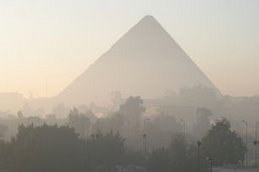
Securing the Pyramids
"Egypt's President Hosni Mubarak will inaugurate early next year the plan to electronically secure the Pyramids Plateau, implemented over the past 3 years by the Ministry of Culture in cooperation with the National Security Agency.Minister of Culture Farouk Hosni said that the project cost LE 55 million, and includes the establishment of a 15-km fence around the plateau, to protect it from unplanned buildings. The fence is entirely away from the panorama of the pyramids, and does not have a negative impact on the aesthetic scenery of the Plateau. Zahi Hawas Secretary General of the Supreme Council of Antiquities (SCA) said that the plan includes providing the area with about 20 electronic gates to regulate and control visits from the security point of view".
This is the complete news item on the State Information Service website. Also shown on the Arabic News website at:
Problems at Swaffham Museum
"A £384,000 improvement scheme for Swaffham Museum has run into a further delay because of structural problems at the town hall. The scheme, which should transform the museum's displays, including that on famous Egyptologist Howard Carter, was originally intended to have been completed by now". Carter spent most of his childhood in Swaffham (Norfolk, UK) before taking up the opportunity offered to him, via local collectors Lord and Lady Amherst, to go to Egypt as a trainee tracer, at the age of seventeen.
For more details about the museum see the Kings Lynn Today website above. For more about Howard Carter, see the online feature at Ancient Egypt Magazine:
EEF News Digest
http://www.geocities.com/TimesSquare/Alley/4482/EEFNEWS.html
The EEF's weekly news digest, which is the best list around for lectures, digitized publications, and exhibitions, as well as providing a roundup of the week's Egyptology news, is now online at the above address.
The EEF's weekly news digest, which is the best list around for lectures, digitized publications, and exhibitions, as well as providing a roundup of the week's Egyptology news, is now online at the above address.
Egypt wants to attract more Brazilian tourists
http://www.anba.com.br/ingles/noticia.php?id=9111
"Egypt wants to attract more Brazilian tourists. To the Egyptian minister of Tourism, Ahmed Al Maghrabi, it is necessary to develop actions for the promotion of visits between the countries. In an interview to ANBA, he stated that it is essential to simplify trips, through the creation of direct flights, or agreements between airlines. Tourism employs 1 million people in the Arab country and has a turnover of US$ 6.3 billion a year".
"Egypt wants to attract more Brazilian tourists. To the Egyptian minister of Tourism, Ahmed Al Maghrabi, it is necessary to develop actions for the promotion of visits between the countries. In an interview to ANBA, he stated that it is essential to simplify trips, through the creation of direct flights, or agreements between airlines. Tourism employs 1 million people in the Arab country and has a turnover of US$ 6.3 billion a year".
Monday, November 07, 2005
Ancient art, modern crime
An article looking at the way in which museums acquire ancient artwork, and the impacts that the troubles at the Getty museum are having on the way in which people think about provenance: "The bad old days of Indiana Jones-style museum acquisition no longer fly. Countries have laws regarding the exportation of artwork, and what's legal in one country may not be in another. And even if it's legal, it may not be ethical. Many in the art world say the media blitz surrounding the Italian charges makes this a defining moment. From here on, says Thomas Hoving, former director of the Metropolitan Museum of Art, it will be more difficult for museums to have questionable items in their collections".
Mysterious case of death on the Nile, 4,000 years ago
"Archaeologists have begun to piece together the story of a mysterious massacre more than 4,000 years ago in the former royal city of Mendes, which flourished for 20 centuries on a low mound overlooking the green fields and papyrus marshes of the Nile delta north of Cairo. Donald Redford of Pennsylvania State University had begun to excavate the foundations of a huge temple linked to Rameses II, the pharaoh traditionally linked to the biblical story of Moses, when he found an earlier structure destroyed by fire, and evidence of a grisly episode of death on the Nile, he told a Bloomsbury Academy conference in London on Saturday".
See the Guardian Unlimited website, above, for more.
Culture 101 - Sack 'em
http://www.egypttoday.com/article.aspx?ArticleID=6030
Sorry this is a bit late - I hadn't noticed that the Egypt Today website had been updated: "Chaos and progress do battle at the Supreme Council for Antiquities". You will need to scroll down to see this piece. It mainly concerns the problems at the Egyptian Museum in Cairo, but it also mentions a forthcoming documentary aimed at correcting popular misconceptions about ancient Egypt, and looks in brief at plans for Rosetta how the museum project there will be funded.
Sorry this is a bit late - I hadn't noticed that the Egypt Today website had been updated: "Chaos and progress do battle at the Supreme Council for Antiquities". You will need to scroll down to see this piece. It mainly concerns the problems at the Egyptian Museum in Cairo, but it also mentions a forthcoming documentary aimed at correcting popular misconceptions about ancient Egypt, and looks in brief at plans for Rosetta how the museum project there will be funded.
Egyptian antiquities in Spain
http://www.sis.gov.eg/En/EgyptOnline/
"Minister of Culture Farouk Hosni approved to display Egyptian antiquities at the Arts Centre Museum in the Spanish capital Madrid under the title The Pharaohs. Two similar exhibitions of the Egyptian antiquities in Italy and Paris have scored quite a success. Hosni said 120 pieces of antiquities will be put on display in Madrid and that Egypt will receive one million and 330,000 euros in return. Insurance for the antiquities against theft, acts of terrorism, quakes etc... is put at $ 220,890,000, Secretary General of the Supreme Council for Antiquities Dr. Zahi Hawas said". This is the complete item on the State Information Service website.
"Minister of Culture Farouk Hosni approved to display Egyptian antiquities at the Arts Centre Museum in the Spanish capital Madrid under the title The Pharaohs. Two similar exhibitions of the Egyptian antiquities in Italy and Paris have scored quite a success. Hosni said 120 pieces of antiquities will be put on display in Madrid and that Egypt will receive one million and 330,000 euros in return. Insurance for the antiquities against theft, acts of terrorism, quakes etc... is put at $ 220,890,000, Secretary General of the Supreme Council for Antiquities Dr. Zahi Hawas said". This is the complete item on the State Information Service website.
Excavations in the Valley - the tombs
http://www.algomhuria.net.eg/gazette/5/
The Egyptian Gazette website, which was last updated on Wednesday appears to be back up and running. They are running part 1 of a piece by Zahi Hawass, in his usual slot. As usual, the whole item is reproduced here:
The Egyptian Gazette website, which was last updated on Wednesday appears to be back up and running. They are running part 1 of a piece by Zahi Hawass, in his usual slot. As usual, the whole item is reproduced here:
"In 1999 I took my team to Bahariya Oasis, for our first season of excavation. We were to stay for three weeks, until it was too hot to work in desert. We settled into the El Bashmo Lodge, a cottage-style hotel with a family feeling.
The first day we walked the site collecting artifacts, such as pottery shards, bones and old glass which were littered across a three hundred yards to the south of the Temple of Alexander the Great. From this survey I estimated that the cemetery could be four miles square. The next step was to dig a trench and establish boundaries of the site. The architects mapped out a grid of the entire site into ten metre squares. Each of the six hundred identical squares was then assigned a number and an archeologist. One square contained Tomb 54, to which Mansour Boriak was assigned. During this season, Tomb 54 proved to contain forty-three mummies in two burial chambers. The mummies were stacked in niches cut into the wall on mastaba (bench-like) platforms. We concluded that this tomb was used by one family over many generations.
For three weeks we had the same routine. We got up at 5:00a.m., had breakfast, and left for the site at 6:00a.m. so that we began digging at 7:00. During the day, the local workers created a cheerful atmosphere by signing and singing with each bucket of sand they carried from the tomb. The work was intense, and my team worked diligently. We had no idea what the next shovel of sand might revel.Soon the rim of sloping shafts emerged, and then a few stairs leading down about ten feet, then flat earth. We had reached the floor of another tomb and staring out at us was a beautiful golden face. It was amazing! It was as if we were seeing the mummies being reborn to life. What other discoveries did these sands".
A village like no other
A travel feature describing a life-sized reproduction pharaonic village: "Not listed in the guidebooks and travel literature, the village comes as a pleasant surprise. Situated in the heart of Cairo, the Pharaonic village is the private property of one Dr Hassan Ragab who decided to use his papyrus plantation to showcase life in an Egyptian village, as it would have been around 2000 B.C. Work on the village started in 1977. As many as 500 trees were planted on the five acres to screen the village from the city. Canals and waterways were dug through leaving a central mound of an island. The village is created on the island, which is surrounded by narrow waterways— obviously in an attempt to recreate the Nile. 'Welcome, travelers to Egypt,' a deep voice greets us as we seat ourselves on cushioned chairs on a beautiful wooden boat. This is the start of a guided tour down the 'Nile' where a woman's powerful voice escorts us through a pre-recorded commentary to the various aspects of life in ancient Egypt".
See the article on the Deccan Herald website for more.
Sunday, November 06, 2005
A visit to Memphis and Saqqara in 1897
http://snipurl.com/jlkb
"You need a lot of credulity when you go to Egypt, and a superb contempt for anything less than three thousand years old. If you don’t have these, you spoil your holiday by questioning the wonderful stones told by dragomans and you fill your hand-bag with antiques of a mere yesterday. The more one looks about the world, the more disgusted one becomes with the average globe-trotter. When he goes to Egypt – unless he happens to be a mad Egyptologist as well, and burns all the skin off the back of his neck and pants all day long under awnings up at Luxor". The Travellers in Egypt website has been updated, and is currently carrying this very enjoyable article on its home page, written by John Foster Frase and published in The Quiver Magazine in 1897. It is beautifully written and succeeds in bringing Memphis and Saqqara to life as it was in the late 1800s: "Time is a cruel cynic, and Memphis the Glorious is now about as picturesque as a brickfield. Indeed, it is uncommonly like a brickfield."
Saturday, November 05, 2005
A.V. museum showcases Egyptian display
"Lancaster Museum Art Gallery opens Saturday an Egyptian display of its own with more than a millennium's worth of sculpture, jewelry, cosmetic objects and funerary equipment - and admission is free. A Middle Kingdom coffin from about 1800 B.C. and wooden sarcophagus masks from 1500 B.C. - both older than Tut's treasures - will be on display, along with mummified falcons, wooden statuettes, bronze figurines, and headrests". See the article for more (this is Lancaster in the US, not the UK).
Africa's rock art in peril
This feature on the International Herald Tribune website is exactly the same piece that appeared in the New York Times last month, and which I posted on 10th October 2005. But for those of you who missed it, this is a piece looking at the threats to Africa's rock art, some of which is being defaced, for example, and some of which is being exported for sale overseas.
Egypt Sets Tourism Record
Ayden Nour, ETA director for U.S. and Latin America, talking about tourism in Egypt: "During 2005’s first half, Nour said an estimated 4.3 million visitors arrived in Egypt, a 14.7 percent increase over the same period in 2004. This included a 14.2 percent increase in the number of U.S. arrivals". See the article for more.
Trivia:
"Dead Egyptian Blues"
http://www.post-gazette.com/pg/05305/598373.stm
A daresay that thousands of people already know this song, but it was new to me! I found it whilst looking for something else: "Michael Smith, the great singer/songwriter from Detroit, was inspired after seeing the King Tut exhibition in 1985. From the disc Michael Smith/Love Stories". And the song goes . . .
A daresay that thousands of people already know this song, but it was new to me! I found it whilst looking for something else: "Michael Smith, the great singer/songwriter from Detroit, was inspired after seeing the King Tut exhibition in 1985. From the disc Michael Smith/Love Stories". And the song goes . . .
Oh, Mister Tut, they love the mask
But do they love you honey sweetheart don't ask
Where's those baby browns and that pearly smile
That smile that drove 'em wild by the early Nile
The rest of the lyrics are on the above web page, for anyone with the right spirit of adventure.
"If you like movies like Shrek, Ice Age and Robots – then ANKH might just be your cup of tea. A humourous Point and Click adventure game set in a 3D graphic environment with a funny and romantic story in a mystical and inspiring setting with numerous original locations and characters. Maybe Assil shouldn't have stolen the key to the Great Pyramid to celebrate a party with his friends. Then he would have never caught this curse that will erase his life within a few hours. But then he wouldn't have found the magic Ankh either, and he would have never met the woman of his dreams, this rebellious and at the same time mysterious girl, and never would these two have stumbled into the adventure of their life". See the URL for full details.
Friday, November 04, 2005
Rosetta national museum to be inaugurated in November
http://tinyurl.com/e2xwy
"Minister of Culture Farouk Hosni will inaugurate the Rosetta National Museum after refurbishing works in the second half of November. The rehabilitation operations of the museum took two years to be completed at a total cost of LE 4 million, said Dr Zahi Hawwas, the Secretary General of the Egyptian Supreme Council of Antiquities (SCA) on Wednesday. Hawwas said that the rejuvenation operation of the museum came as part of a national plan undertaken by the Ministry of Culture and the SCA with a view to creating a number of provincial and specialized museums in Egypt. The plan is aimed at shedding light on the history of Egyptian cities and their historical importance, he added. The whole project is meant to sensitize the Egyptian people to the archaeological value of Egypt, Hawwas said".
This is the complete bulletin on the State Information Service website.
Subscribe to:
Posts (Atom)