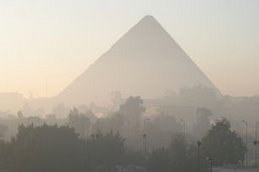
Nevine El-Aref sums up what happened on Friday 11 November on the Giza Plateau, and the loss for Egypt on that day
The "Ceremony of Love" that was scheduled to be held on the footsteps of the Great Pyramid of Khufu on 11 November, and the furore it created among Egyptologists, the public and the media, has raised questions over private functions on the Giza Plateau and meditation sessions inside the Great Pyramid, as well as the roots of misoneism -- a resistance to anything new -- in Egypt and the importance of the Khufu pyramid in New Age rituals.
It all began on 5 November when a Polish numerologist group posted on its website a call for people from all over the globe to come to the Great Pyramid of Khufu on 11 November for its so-called "Ceremony of Love".
Monday, December 05, 2011
'The Ceremony of Love' and the Giza Plateau
Al Ahram Weekly (Nevine El-Aref)


Sunday, December 04, 2011
Coptic Christian city found in Dakhleh Oasis
Ahram Online (Nevine El Aref)
Gadling (Sean McLachlan)
Council of Antiquities (SCA) stumbled on what it believes to be a Coptic settlement dating back to the 4th century AD.
Mostafa Amin, the Secretary General of the SCA, made the announcement, explaining that the newly discovered settlement consists of remains of residential houses and service buildings as well as a large Basilica with distinguished columns and a wooden alter adorned with foliage decoration and icons showing Jesus, the Virgin Mary, angels and saints.
“I am very happy with what the mission has found; because it is the first time this area was explored,” Amin told Ahram Online. He continued that this new discovery not only forms another another archaeological attraction but “will lead us to other settlements that can be dated to different eras as well.”
Gadling (Sean McLachlan)
An ancient Christian city dating to the fourth century AD has been discovered in Egypt.
Archaeologists digging at the Ain al-Sabil area of the New Valley Governorate have discovered the remains of a basilica and buildings to serve the priests. This is the first excavation at the site and researchers hope more discoveries will be made under the Egyptian sands.
Antiquities ministry replaces deposed supervisor of the Grand Egyptian Museum
Ahram Online (Nevine El aref)
After protests removed the previous supervisor of the Grand Egyptian Museum (GEM), Secretary General of the Supreme Council of Antiquities Mostafa Amin appointed Egyptologist Hussein Abdel Bassir to the post.
Abdel Bassir replaces Mohamed Abdel Maqsoud, who was resuffhled to head the Ancient Egyptian Department.
Ministry of Antiquities reinstated?
Youm 7
New ministers in Prime Minister designate Kamal el-Ganzouri’s government have started arriving at the Ministry of Planning’s headquarters in Nasr City, as a prelude to the final announcement of all the ministers.
Six new ministers arrived at the headquarters, including Deputy Minister of Education for Secondary Education Gamal el-Araby who is nominated for Minister of Education, Hussein Khaled who is nominated for Minister of Higher Education, Mohamed Ibrahim Ali nominated for Minister of Antiquities, Adel el-Adawy for Minister of Health, Adel Abdel Hamid for Minister of Justice and Abdallah Ghorab as Minister of Petroleum.
A Rare Isotope Helps Track an Ancient Water Source
New York Times
The Nubian Aquifer, the font of fabled oases in Egypt and Libya, stretches languidly across 770,000 square miles of northern Africa, a pointillist collection of underground pools of water migrating, ever so slowly, through rock and sand toward the Mediterranean Sea.
The aquifer is one of the world’s oldest. But its workings — how it flows and how quickly surface water replenishes it — have been hard to understand, in part because the tools available to study it have provided, at best, a blurry image.
Now, to solve some of the puzzles, physicists at the Department of Energy’s Argonne National Laboratory in Illinois have turned to one of the rarest particles on earth: an elusive radioactive isotope usually ricocheting around in the atmosphere at hundreds of miles an hour.
Rare Egyptian coffin identified in Torquay Museum
BBC News
With photos.
With photos.
A coffin on display at a museum in Devon is a rare 3,500-year-old Egyptian sarcophagus, it has emerged.
Torquay Museum were unaware of the coffin's significance until an expert from Bristol University identified it as one of only two in the country.
Dr Aidan Dodson, who is cataloguing the country's Egyptian artefacts, believes the coffin pre-dates the mummified boy's body it contains by 1,000 years.
He said: "It's very significant as very few coffins of that period survive."
The highly decorated sarcophagus and the mummified remains of a boy, aged between three and four, were donated to the museum in the 1950s.
But the artefacts were kept in storage for years and rarely displayed until 2007 when they were selected as the centrepiece of an Egyptian exhibition.
Colossi of Memnon to be restored
Ahram Online (Nevine El Aref)
In collaboration with the European archaeological mission, the Supreme Council of Antiquities (SCA) is undertaking a comprehensive project to restore the colossi of Memnon on Luxor’s west bank.
The project aims to return the 19.5 meters tall colossi to their original appearance when the New Kingdom’s King Amenhotep III built them to decorate the façade of his mortuary temple.
SCA secretary-general Mostafa Amin told Ahram Online that the restoration would also return all the missing pieces of the colossi, collapsed during the Roman period, to their original positions.
3-D scans recreate face of mummified child
MarketWatch
Egyptian mummies have fascinated mankind for centuries, and now modern-day 3D design software is helping Egyptologists to better see what two small mummies looked like in life, and from that, advance their understanding of ancient cultures.
Sensable announced that its Freeform(R) 3D-modeling and organic design solution helped put a face on two high-profile Egyptian mummies in displays that just opened this month. The Smithsonian's National Museum of Natural History exhibition, "External Life in Ancient Egypt," displays a new 3D-printed bust of a Freeform-designed facial reconstruction performed from the computed tomography (CT) scans of a 3-year old mummified boy.
Statue of Egyptian king Amenhotep III found
Egypt State Information Service
The State
A huge statue of King Amenhotep III has been discovered in the Upper Egyptian city of Luxor.
The 13-meter-high quartzite statue was unearthed during excavations carried out by the mission of the Supreme Council for Antiquities (SCA) in the area of King Amenhotep III Temple in Luxor’s western bank.
SCA Chief, Dr. Mustafa Ameen said the 100-ton colored statue is one of two statues that had been erected at the entrance of the temple in the area of Qurna in Luxor’s western bank.
The State
Egyptian archaeologists have unearthed a large statue of king Amenhotep III who ruled nearly 3,400 years ago and who was the grandfather of the famed boy-pharaoh Tutankhamun.
The Supreme Council of Antiquities says the latest find was made at the king's funerary temple in the southern city of Luxor.
Thursday's statement says the 44 feet (13.5 meter) tall statue is made of colored quartzite. It is composed of several large pieces that once put together will depict the king as standing.
Archaeology meets politics: Spring comes to ancient Egypt
Nature (Jo Marchant)
In a secluded stretch of desert about 300 kilometres south of Cairo, hundreds of bodies lie buried in the sand. Wrapped in linen and rolled up in stiff mats made of sticks, they are little more than bones. But their ornate plaited hair styles and simple personal possessions help to reveal details about the individuals in each grave. The bodies date from around 3,300 years ago, when the Pharaoh Akhenaten renounced Egypt's traditional polytheistic religion and moved his capital to remote Amarna, to worship just one god: the Sun disc Aten.
The cemetery offers a window on a unique episode in Egyptian history, a revolution that some see as the birth of monotheism. Barry Kemp, an archaeologist at the University of Cambridge, UK, and director of the Amarna Project, has been working with his colleagues to excavate the skeletons, and says that they are starting to reveal “an alarming picture of a stressful life”. Many Amarnans died young, with retarded growth and signs of multiple injuries. Some young men had marks where their shoulder blades had been pierced, perhaps as part of a brutal ritual.
Ashmolean Egyptian galleries re-open, refurbished
ArtInfo
Art Daily
And at BBC News there is a rather nice slideshow.
Oxford University's Ashmolean Museum has just opened a new chapter in the distant past, unveiling its new galleries dedicated to Ancient Egypt and Nubia. This £5 million ($7.7 million) refurbishment has allowed the re-housing of 40,000 artifacts collected over the last 300 years, including coffins and mummies that haven't been displayed since the Second World War.
Designed by Rick Mather Architects, the six new galleries lead visitors from Egypt's origins in the Paleolithic period to the annexation of the country by the Roman Empire after the suicide of Cleopatra in 30 BC. Liam McNamara, lead curator for the redevelopment of the new galleries, told ARTINFO UK: "We hope that by presenting the galleries in a chronological sequence we will enable our visitors to understand the great length of time that the Egyptian civilization covers — three millennia — but also the aspects of continuity and change that occurred during those 3,000 years."
Art Daily
On Saturday 26 November 2011, the Ashmolean Museum in Oxford opened six new galleries for the collections of Ancient Egypt and Nubia (present day Sudan). Building on the success of the Museum’s extension, which opened in 2009, this second phase of major redevelopment redisplays the world-renowned Egyptian collections to exhibit objects that have been in storage for decades, more than doubling the number of mummies and coffins on display. The galleries take visitors on a chronological journey covering more than 5000 years of human occupation of the Nile Valley.
The £5 million project has received lead support from Lord Sainsbury’s Linbury Trust, along with the Selz Foundation and other trusts, foundations and individuals. Rick Mather Architects have led the redesign and redisplay of the pre-existing Egypt galleries and the extension into the restored Ruskin Gallery, previously occupied by the Museum Shop. The contractor Beard has completed the construction work in the historic building. New openings link the rooms, presenting the collections under the broad themes of Egypt at its Origins; Dynastic Egypt and Nubia; Life after Death in Ancient Egypt; The Amarna ‘Revolution’; Egypt in the Age of Empires; and Egypt meets Greece and Rome.
The Ashmolean is home to some of the finest Egyptian and Nubian collections in the country, with Predynastic and Protodynastic material which ranks amongst the most significant in the world.
And at BBC News there is a rather nice slideshow.
Book Review: Living through the Dead
Bryn Mawr Classical Review (Reviewed by Kristina Killgrove)
Maureen Carroll, Jane Rempel (ed.), Living through the Dead: Burial and Commemoration in the Classical World. Studies in funerary archaeology, 5. Oxford: Oxbow Books, 2011.
This volume is the result of a conference on death and commemoration held in 2006 at the University of Sheffield. The nine papers range in period from Old Kingdom Egypt to 17th century Italy and geographically from the circum-Mediterranean to the Black Sea. Foregrounded in every contribution is the relationship between the living and the dead; this volume represents an attempt to highlight the similarities in burial practice among the diverse peoples of the classical world.
Egyptian Museum In Midst Of The Protests
India TV News
A few metres away from Tahrir Square, where protesters are gathering for the eighth day, calling for Egypt's military rulers to hand over power to civilian leaders, tourists are still flocking to Cairo Museum despite the recent unrest.
The museum remains open and tourists from around the world are continuing to visit. Maryoun Etche, a tourist from Germany said she was not afraid of being in Cairo.
Security measures taken at archaeological sites during Egyptian election
Ahram Online (Nevine El Aref)
To guard against any incidents at archaeological sites and museums in Egypt during the election, Mustafa Amin, secretary-general of the Supreme Council of Antiquities (SCA), has commissioned heads of sectors of Ancient Egyptian, Islamic and Coptic antiquities to tighten security measures. This is in collaboration with the Antiquties and Tourism Police.
Book Review: Belzoni - The Giant Archaeologists Love to Hate
New York Times (Alida Becker)
His introduction to the wonders of the ancient world could hardly have been less auspicious. While in Cairo in the summer of 1815, awaiting an audience with Mohammed Ali Pasha, Turkish viceroy of Egypt, the Italian monk-turned-peddler-turned-hydrologist-turned-circus impresario Giovanni Belzoni paid a visit to the Great Pyramid and became so tightly wedged in one of its internal passages that his guides had to forcibly extract him. It was merely the first of many indignities endured by this 6-foot-6 “giant,” whose adventures in the Nile Valley would yield some of the most imposing treasures in the British Museum. They would also earn him the undying enmity of his successors in a field that only later acquired the polish of a professional discipline — archaeology.
While granting that Belzoni may be what a colleague has called “the most notorious tomb robber Egypt has ever known,” Ivor Noël Hume, the former director of Colonial Williamsburg’s archaeological research program, also admits to a fondness for this indefatigable entrepreneur.
Online: Ancient Egyptian chariot trappings rediscovered
Nature (Jo Marchant)
Excellent five page article, with photos. Many thanks to David Krueger for the link.
Excellent five page article, with photos. Many thanks to David Krueger for the link.
The beautifully preserved leather trappings of an ancient Egyptian chariot have been rediscovered in a storeroom of the Egyptian Museum in Cairo. Researchers say that the find, which includes intact harnesses, gauntlets and a bow case, is unique, and will help them to reconstruct how such chariots were made and used.
The ancient Egyptians used chariots — typically with one or two riders and pulled by two horses — for hunting and warfare as well as in processions. They are frequently shown in ancient Egyptian art, and several examples of the wooden frames survive, including six dismantled chariots found in King Tutankhamun’s tomb, dating to around 3,300 years ago.
But researchers knew little about the leather trappings and harnesses used with such chariots, as leather decomposes quickly if any moisture is present. Barely any leather survives on the chariots from Tutankhamun’s tomb, though some fragments are known from chariots found in other tombs, such as that of Yuya and Thuya, Tutankhamun’s great-grandparents.
Exhibition: Phoenix Ancient Art to Show Early Faience
The Sacramento Bee
A spectacular exhibition of ancient art works of faience from the private collection of the Aboutaam family will be on view at Phoenix Ancient Art in New York (47 East 66th Street) from December 6th-30th, 2011. The exhibition will then be traveling to BRAFA, (57th Brussels Antiques & Fine Arts Fair, Tour & Taxis), January 21st –29th 2012. Followed by a wonderful display at Phoenix Ancient Art in Geneva (6, rue Verdaine, Geneva), Spring 2012. This private collection was originally formed by Sleiman Aboutaam and continued by his sons, Ali and Hicham.
Fans of "William," the well-loved Egyptian faience hippopotamus at the Metropolitan Museum of Art, will be pleased to see that there are three other examples of blue-green hippopotami in the show that are among the stars of the exhibition. Two date from the Middle Kingdom (dynasty 11-13); one is from the Late Period (6th-4th century B.C.), which is known as the Persian Period because it was truly international with similar works appearing from Egypt to Iran and the Levant. The hippopotamus, which looks so benign and lovable, was, in fact, a force of nature to be reckoned with, both in this life and in the next.
Exhibition: Mummy - Secrets of the Tomb
Mysunshinecoast
Queenslanders are one step closer to unlocking the secrets of ancient Egypt with tickets now on sale for Mummy: Secrets of the Tomb exhibition at Queensland Museum South Bank, announced Arts Minister Rachel Nolan.
"Mummy: Secrets of the Tomb, opening 19 April 2012 and exclusive to Brisbane, is the first and only time some of the British Museum's most precious Egyptian mummies will visit Australia," Ms Nolan said.
"This spectacular multimedia exhibition uses cutting edge medical scanning and 3D imaging to provide an insight into the once hidden mysteries of ancient Egyptian mummies.
"The exhibition features four exceptionally preserved mummies and more than 100 ancient objects.

Subscribe to:
Posts (Atom)