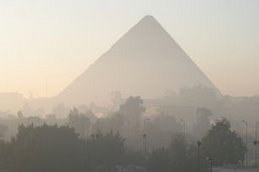
Aside from the odd camel driver lounging in the shade, nobody else is around at the pyramids and I am free to explore the world-class, UNESCO-listed heritage site on my own. The Meroë site was built as a royal cemetery for leaders of the Kushite Kingdom between about 300 BC to 300 AD. While experts believe that they can pronounce the Meroitic script correctly because of cross-references with Egyptian names, they still have not been able to translate and understand the language. This ancient culture has been able to successfully guard its mysteries for thousands of years.
I set up my tent on the outskirts of the pyramids and flop in the soft sand to marvel at the spectacular colours that only a desert sunset can provide. The setting among the dunes is sub-lime. As dusk slowly turns to night, the full moon and soft celestial light illuminate the silhouette of the pyramids in unbelievable artistic perfection. It hasn't been easy getting to Sudan, but there is no doubt left in my mind that it has been completely worth it.
Travel to Sudan definitely presents its challenges.
Sunday, February 12, 2012
Travel: Pyramids of northern Sudan
Vancouver Sun (Jules Knox)


Pyramids spotted from ISS
Nicole Stott Twitpic
NASA astronaut Nicle Stott has posted a photograph of the Giza pyramids as seen from space. You will probably need to click on the image to expand it on order to see them.
NASA astronaut Nicle Stott has posted a photograph of the Giza pyramids as seen from space. You will probably need to click on the image to expand it on order to see them.

Saturday, February 04, 2012
Oldest case of prostate cancer
This story was reported by The Portugal News back in November 2011, but seems to have been picked up only recently by other media.
Bikya Masr
An international research team in Lisbon has diagnosed the oldest case of prostate cancer in ancient Egypt and the second oldest case in the world.
Using high-resolution computerized tomography (CT) scanners, the researchers identified the cancer in a mummy subject known as M1.
“Cancer is such a hot topic these days; experts are constantly trying to probe in hopes of answering the one question- when and how did the ailment really evolve?” said Salima Ikram; member of the research team and professor of Egyptology at The American University in Cairo (AUC).
“Findings such as these bring us one step closer to finding the cause of cancer, and, ultimately, the cure to a disease that has besieged mankind for so long.”
MSNBC
A professor from American University in Cairo says discovery of prostate cancer in a 2,200-year-old mummy indicates the disease was caused by genetics, not environment.
The genetics-environment question is key to understanding cancer.
AUC professor Salima Ikram, a member of the team that studied the mummy in Portugal for two years, said Sunday the mummy was of a man who died in his forties.
She said this was the second oldest known case of prostate cancer.
"Living conditions in ancient times were very different; there were no pollutants or modified foods, which leads us to believe that the disease is not necessarily only linked to industrial factors," she said.
The Medical Daily (Christine Hsu)
The mummy was that of an adult male with a height of five feet and five inches who lived between 285BC to 230 BC and died when he was between the ages of 51 to 60-years-old, according to researchers.
Images also showed that the mummified man suffered from lumbosacral osteoarthritis and that there were several post-mortem fractures that were probably produced when the mummy was shipped to Europe.
Digital X-ray scans revealed that the mummy had been buried with crossed arms, a common pose in Ptolemaic mummies, which in the New Kingdom was often associated with royals.
M1 was buried with a cartonnage mask and bib, and had a decoratively painted veil.
Prostate cancer develops in the prostate, a walnut-sized gland in the male reproductive system, and may spread to other pelvic regions like the lumbar spine, upper arm and leg bones, the ribs, and can ultimately spread to most of the skeleton. Problems with urinating, sexual intercourse or erectile dysfunction are all likely symptoms of the disease.
More from Amara West excavations
If you are not already signed up to the Amara West blog I do sincerely recommend it - they still have a couple of weeks of the season left and update the blog regularly. Here are a sample of recent posts, all with lovely photographs.
British Museum -nice objects among archaeological puzzles
With, amongst others, a photograph of a gorgeous faience scarab base showing a beautifully etched image of the Pharaoh Menkheperra as a sphinx.
Every house in the town has so far contained a central room for domestic activity and often a separate room for making bread and grinding cereals.
Less common are fine faience artefacts, an example of which turned up this week – we recovered a small but very finely carved scarab which depicts a representation of the king as a sphinx, a classic symbol of pharaonic power, with the name Menkheperra before it. This was one of the names of Thutmose III (1479-1425 BC), popular on amulets and scarabs long after his death.
British Museum - The Town Site - half way through the season
With some really good photos
With three weeks digging left, it’s a good time to reflect on the key discoveries of the season so far in the town of Amara West. Though these have included objects, from the spectacular to the mundane, the combination of stratigraphy and architecture unearthed has allowed us to interpret the purpose of buildings – and one of our key challenges has been to work out which walls belong to which structures, and in what order they were built.
British Museum - Excavating the cemeteries
I’m currently excavating a grave (317) in Cemetery D. It extends east-west and is around 2.5 metres in length, with a rather small shaft (only about 90cm long) leading to a small burial chamber around 1.2m wide. There are no remnants of a superstructure, and the roof of the chamber has been removed by surface erosion, where a scatter of schist stones suggests the grave was looted in ancient times.
We unearthed skeletal remains and some faience and shell beads scattered in windblown sand in the burial chamber, but below this we found another skeleton, undisturbed and intact. Among the most interesting things about this burial are the plant remains found associated with it, which when studied will tell us more about how the bodies were treated for burial.
British Museum - More on the hieroglyph inscription
With photos
All this work is providing us with a better understanding of the settlement of Amara West, and helps us date and interpret the buildings, features and objects we encounter.
For example, Elisabeth’s drawings have helped confirm the reading of the royal name at the end of the eroded inscription on a sandstone doorjamb (F990) found exposed on the surface east of the town wall. The signs written in the cartouche were not readable until seen in a variety of different lights, but also with a torch during the dark hours of the early morning. We are now confident it bears the name of Ramesses II.
Saqqara Dig Diary
Saqqara.nl
Week 31 January - 2 February 2012
Week 31 January - 2 February 2012
There we are again in Cairo, after an absence of two years due to the revolution in Egypt which made work in 2011 impossible. Field director Maarten Raven and his deputy Christian Greco arrived on the 31st, and the next day visited the offices of the Ministry of Antiquities in order to sign the contract for a continuation of our work at Saqqara. We were helped very efficiently by the new head of the department of foreign missions, and spent the rest of the day in talks with Kim Duistermaat, the director of the Dutch-Flemish Institute in Cairo (always our base while we are staying in Cairo), and with the architect Nicholas Warner, who has been responsible for the overall consolidation of our site over the past ten years. Bit by bit we received the news of everything that has happened here during (and after) the revolution, a process that is still going on and will take many more years to come to a new balance. Not all news is pleasant, and Egypt has clearly become a different country.
AERA Giza Plateau blog
Aeraweb
The AERA (Ancient Egypt Research Associates) blog for the 2012 Field Season has been running for some weeks at the Giza Plateau, with four posts to date. Here's the most recent of the posts:
With two photos.
The AERA (Ancient Egypt Research Associates) blog for the 2012 Field Season has been running for some weeks at the Giza Plateau, with four posts to date. Here's the most recent of the posts:
With two photos.
Posted by Rabee Eissa, SCA archaeologist
One of the most interesting things that I noticed in my excavation, in what seems to be a storage building that dates to the Old Kingdom in Giza, is a concentration of ash. This ash surrounded circular mud brick silos that had been constructed beside each other forming an L. The ash itself was very dark, dense and soft. Thinking about the silos and the ash, I remembered my mother and her storage methods for the butter. She put the butter in a big aluminum jar and surrounded the jar with a layer of soft ash to prevent the ants from reaching the butter. My colleague Hussein Rekaby, an excavation supervisor, told me that the people in his village near Aswan still use the same idea in their construction of storage silos. They start by spreading ash horizontally, then they put clay to make the base of the silo before building the silo itself. Hanan Mahmoud, hearing Hussein’s story, told me that she exposed a layer of ash deposit under a sequence of round mud brick silos when she excavated House E to the East of Queen Khentkawes tomb at Giza. We follow some of our ancestors’ daily life behaviors and customs.
Diario Djehuty
Diario Djehuty
The Djehuty dig diary is in full swing for those of you speak Spanish, or are prepared to use a translation engine. Daily posts in January and February are accompanied by lovely photos.
There's also a summary, in English, of the 2011 season:
www.excavacionegipto.com/campana/nota_prensa11_ing.jsp.htm
There's also a summary, in English, of the 2011 season:
www.excavacionegipto.com/campana/nota_prensa11_ing.jsp.htm
Suez Museum relates the city’s history through ages
Ahram Online (Nevine El-Aref)
Following almost six years of construction the long-awaited Suez National Museum had its official inauguration while the city was marking one year of Egypt’s Revolution.
While some of Suez inhabitants were protesting before the Suez governorate building, there were others at the city’s national museum celebrating its official opening.
Stretching over 6,800 square metres on the bank of the Suez Canal stands the two-story pyramid shaped building of the Suez National museum, relating the story of the city throughout the ages.
In a gala opening on Sunday evening, Minister of State for Antiquities Mohamed Ibrahim officially inaugurated the museum. On display are 1500 artefacts from the prehistoric era to modern times.
Crocodile museum to open
Ahram Online (Nevine El-aref)
Overlooking the Aswan Nile shore, neighbouring the ancient Egyptian temple of Kom Ombo, the first ever crocodile museum in Egypt is scheduled to be opened on Tuesday.
The museum, which is dedicated to the ancient Egyptian god Sobek, displays forty mummified crocodiles, ranging from two to five metres long, as well as crocodile foetuses and eggs. Also on show is a collection of wooden and granite crocodile statues and replicas of crocodile holes in rocks.
A visitor’s centre adorned with posters will screen a documentary before entrance to the museum, as an introduction to Sobek and crocodiles in Egypt.
Object Biography #2: A label of King Djer (Acc. no. 6763a)
Manchester Museum (Campbell Price)
A really good piece, putting the label into its Abydos context. With photos and illustrations.
A really good piece, putting the label into its Abydos context. With photos and illustrations.
This small (1.8 x 1.9 cm) piece of incised bone doesn’t look like much, but it comes from one of Pharaonic Egypt’s most hallowed places. The Umm el-Qaab (Arabic for ‘Mother of Pots’) area of Abydos was the burial place of the first kings of Egypt. Abydos was sacred to later Egyptians as the cult centre of the Osiris, the god of the dead and of rebirth. Many hoped to make a pilgrimage to the site and those that did left offerings, evidenced by millions of pottery vessels – giving the area its modern Arabic name.
From as early as the Middle Kingdom (c. 2055-1650 BC), one of the early royal tombs was believed to be the actual burial place of Osiris.
New Book: Tutankhamen’s Curse
The Bolton News ()
ANCIENT Egyptian pharaoh Tutankhamen holds as much fascination for us as Madonna or Angelina Jolie, according to egyptologist Joyce Tyldesley.
The Bolton-based academic, who is regarded as a leading authority in the field, has just published her latest book on the famous pharaoh, Tutankhamen’s Curse, and is now starting work on a text about Nefertiti.
She said: “I’m interested in what makes people celebrities and why we are interested in them — people like Tutankhamen and Nefertiti were the celebrities of the ancient world.”
Dozens of conspiracy theories surround the death of the pharaoh, but Dr Tyldesley says she doubted that Tutankhamen was assassinated, as some believe. “It would have been an odd thing to do,” she said. “He had been on the throne for nearly 10 years when he died, and seemed to be doing a good job.
Exhibition / Interview: “From Nubia to Sudan”
Greek Reporter (by Zdravka Mihaylova)
Interview with Alexandros Tsakos and Henriette Hafsaas-Tsakos. With photos.
Interview with Alexandros Tsakos and Henriette Hafsaas-Tsakos. With photos.
Last October the Benaki Museum of Islamic Art inaugurated the photo exhibition ‘From Nubia to Sudan through the Eyes of the Greek-Norwegian Archaeological Mission’ (6 October 2011-19 February 2012). The photographs have been taken by Alexandros Tsakos and Henriette Hafsaas-Tsakos during the periods they were working as an archaeological team, traveling and living in Sudan. Their subjects concern the history of Sudan and its people, their religious cults, from the ancient and medieval civilizations of Nubia to modern Islamic Sudan.
Between 2003 and 2008, Alexandros has worked for the Merowe Dam Archaeological Salvage Project, at Jebel Barkal, and at Akad. He has organized the Greek Community of Khartoum Cultural Center “Ergamenis”. He has led the renovation of the Museum at Jebel Barkal, and was the contractor of UNESCO for the rehabilitation of the Permanent Exhibition of Medieval Antiquities in the Sudan National Museum. During 2007-2008 he worked extensively on the Medieval collection stored in the Sudan National Museum. He has published several articles on Medieval inscriptions from Nubia, the latest of which concerns the Christian inscriptions from the island of Sai.
Exhibition: Papyri, Mummies, Gold in Warsaw
The Warsaw Voice
A bowl retrieved from a tomb in Thebes, scarabs and other treasures of ancient Egypt unearthed during archeological digs are on show at an exhibition at the Archeological Museum in Warsaw until the end of May.
The exhibition is entitled Papyri, Mummies, Gold… Michał Tyszkiewicz and the 150th Anniversary of Polish and Lithuanian Excavations in Egypt. Count Michał Tyszkiewicz was the first Polish explorer who focused on ancient Egypt. A century and a half ago, he found gold, papyri and mummies by the River Nile. A part of his collection was lost, while 125 of the most interesting artifacts that have survived can be now seen in Warsaw.
Tyszkiewicz’s excavations took place in Karnak, Western Thebes, the Esna area, Wadi es-Sebua (Nubia) and in Saqqara. Tyszkiewicz had astonishing success. His collection of around 800 items was added to the collection of the Louvre Museum and laid the foundations for Egyptian collections at several museums in Lithuania.
Recent photos of Luxor's Avenue of Sphinxes
Luxor Times
Photos on the above page.
Photos on the above page.
After our report of the state of the Sphinx Avenue and how it was used as a rubbish dump (Read Here) and the follow up in the last printed issue of Luxor Times (Here) and the latest announcements concerning the Avenue and the partial opening in March 2012 (More details Here), There was a slow work has been going on lately in one section of the avenue which the Minister State of Antiquities, Dr. Mohammed Ibrahim said it will be excavated and not included in the opening ceremony in March.
Ottoman Cairo's ghosts hold delightful secrets
Al Ahram Weekly (Gamal Nkrumah)
Agnieszka Dobrowolska, a conservation architect, travels, often alone or in the company of her co-worker and architectural partner, her husband Jaroslaw Dobrowolski -- author of The Living Stones of Cairo -- to bring back intriguing tales of magnificent buildings that she often restores to a semblance of their original sublimity and resplendence. Together, they authored numerous works including Heliopolis: Rebirth of the City of the Sun.
The couple is off to Dongola, Sudan, later in February. Convivial and not averse to a witticism, with a light touch and a clear ear, she had spent at least 15 years in chronicling, conserving and restoring the architectural treasures of Egypt. As an architect, she never planned for a career in conservation. Ever since her Egyptian sojourn, her work and the rich architectural heritage of Egypt have moved in tandem with her life.
Moreover, she has a fine ear for conversation and a taste for the historical, and in particular constructions constituting or chronicling history.

Sunday, January 29, 2012
Long lost temple from the Meroe period found
Prague Monitor
Czech archaeologists have found a long lost temple from the Meroe period near the town of Vad Bon Naga in Sudan, Pavel Onderka, from Prague's Naprstek Museum of Asian, African and American Cultures, told journalists yesterday.
The large temple compound is situated 130 km northwards of Khartoum. European travellers saw the remains of the temple in the early 19th century but then the temple disappeared in the desert, said Onderka who leads the Czech archaeology expedition.
He said the Czech expedition revealed a signet ring with a picture of Nubian Lion god Apede-mak, a statuette of the originally Egyptian god Osiris, a stone with a Meroe hieroglyphs and parts of sandstone blocks.
Czech archaeologists have been working in the Vad Bon Naga locality for three seasons.
Red List Announced Covering At-Risk Egyptian Cultural Objects
Cultural Heritage Lawyer (Rick St Hilaire)
The International Council of Museums (ICOM) today announced that it would soon release a Red List for Egypt. Red Lists describe various types of cultural objects that are considered to be at-risk. Such lists have been created for cultural objects from Afghanistan, Cambodia, Africa, and seven other places.
Regarding Egypt, ICOM's December-January e-newsletter states:
"Following several months of preparation, ICOM is delighted to announce the official launch of a new Red List in the coming weeks. The Emergency Red List of Egyptian Cultural Objects at Risk, the 11thpublication in ICOM’s Red List series and its third Emergency Red List, is one of the tangible outcomes of ICOM’s involvement in the protection of Egyptian cultural heritage, following the events that shook the country in the past year. The List was drafted in close collaboration with members of ICOM’s International Committee for Egyptology (CIPEG), national and international experts in Egyptian art and antiquities, and the Ministry of Antiquities of Egypt."
Search for Cleopatra to be resumed, although artefacts stolen during disturbances
Dominican Today
Egypt’s new military authorities have reissued the license to Dominican archaeologist Kathleen Martinez to resume the excavations in the historic search for the tomb of Cleopatra, an investigation that has piqued the interest and obtained the support of the leaders of the United Arab Emirates.
Martinez made the announcement Friday, but also revealed the theft of many of the artifacts she had already unearthed and the “disappearance” of the excavation equipment during the year-long turmoil in Egypt.
Subscribe to:
Posts (Atom)