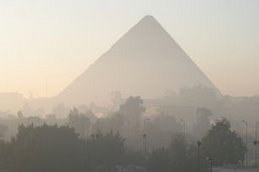
Wishing everyone a great night tonight, if you are celebrating, and a happy 2005.
All the best
Andie
Friday, December 31, 2004


Egyptology 2004 - A Review
http://weekly.ahram.org.eg/print/2004/723/heritage.htm
"From the Mediterranean bed to Kom Al-Dikka, from Akhmim to Sinai, from the Egyptian Museum in Cairo to Basle and Germany and from auction halls in Europe and America to Egypt, there were several exciting archaeological events to highlight this outstanding year." Al Ahram weekly's review of Egyptology through 2004 - the good and the bad.
"From the Mediterranean bed to Kom Al-Dikka, from Akhmim to Sinai, from the Egyptian Museum in Cairo to Basle and Germany and from auction halls in Europe and America to Egypt, there were several exciting archaeological events to highlight this outstanding year." Al Ahram weekly's review of Egyptology through 2004 - the good and the bad.
Chephren pyramid open for visitors Saturday
http://www.sis.gov.eg/online/html11/o311224g.htm
"Culture Minister Farouk Hosni will re-open the Pyramid of King Chephren in Giza as of Saturday after the completion of restoration works. In statements, Hosni said the third Pyramid of Mycerinus will be closed for a year to start necessary rejuvenations, adding 2005 will see a giant restoration project to restore King Chephren's funerary temple and the stone blocks in the area south of the temple. These steps fall within a plan by the ministry and the Supreme Council of Antiquities (SCA) which started in 1995 to preserve the Giza pyramids through regular restoration activities, said Hosni".
See the link above for more information
"Culture Minister Farouk Hosni will re-open the Pyramid of King Chephren in Giza as of Saturday after the completion of restoration works. In statements, Hosni said the third Pyramid of Mycerinus will be closed for a year to start necessary rejuvenations, adding 2005 will see a giant restoration project to restore King Chephren's funerary temple and the stone blocks in the area south of the temple. These steps fall within a plan by the ministry and the Supreme Council of Antiquities (SCA) which started in 1995 to preserve the Giza pyramids through regular restoration activities, said Hosni".
See the link above for more information
Thursday, December 30, 2004
And More on the Faiyum Granaries!
http://www.sis.gov.eg/online/html11/o291224f.htm
The only additional news contained in this item is that the granaries contained dried cereals, fruits and flax. Which cereals and fruits I hear you cry! I'll let you know if I find out.
The only additional news contained in this item is that the granaries contained dried cereals, fruits and flax. Which cereals and fruits I hear you cry! I'll let you know if I find out.
More on Faiyum Granaries, and on Suez Archaeology
http://www.sis.gov.eg/online/html11/o291224i.htm
This article contains some more information about the Faiyum Neolithic discoveries by UCLA, and also discusses archaeogy in the Suez Govenorate of Northern Egypt. As usual with the State Information Service, this is not the most lucid of descriptions, but it is more detailed than usual.
This article contains some more information about the Faiyum Neolithic discoveries by UCLA, and also discusses archaeogy in the Suez Govenorate of Northern Egypt. As usual with the State Information Service, this is not the most lucid of descriptions, but it is more detailed than usual.
Wednesday, December 29, 2004
Eight New Granaries Found in the Faiyum
http://www.reuters.com/newsArticle.jhtml?type=scienceNews&storyID=7193576
Thanks to Tony Cagle for directing my attention to this item on his blog at http://www.archaeoblog.blogspot.com/. The Faiyum Depression is a triangular depression to the southwest of Cairo, with the immense Lake Qarun at its lowest point, 45m below sea level. In prehistoric times (the Epipalaeolithic and Neolithic in particular) it was a well populated area, and excavations since the 1920s have revealed an immense amount of detail about thse occupations. The Neolithic period marks the first agricultural activitiy in the Faiyum at around 5500bc, which, together with the site of Merimde Beni Salama to the northwest of Cairo, represents the earliest known farming in Egypt. In the 1920s, and reported in their two volume 1934 report "The Desert Fayoum" Gertrude Caton Thompson and Elinor Gardiner reported fining 167 grain silos (pits sunk into the groun) in the northeast Faiyum in a zone between two sites named Kom K and Kom W. Although many other Neolithic sites have been found, until today this site has remained the only one containing granaries. This makes the above report of eight new granaries having been found even more important. I'm trying to find out more information about it, and will post if I have an update. A summary of the prehistoric period in the Faiyum and Cairo areas can be found at my other site: http://www.faiyum.historians.co.uk/html/archaeology.html
Thanks to Tony Cagle for directing my attention to this item on his blog at http://www.archaeoblog.blogspot.com/. The Faiyum Depression is a triangular depression to the southwest of Cairo, with the immense Lake Qarun at its lowest point, 45m below sea level. In prehistoric times (the Epipalaeolithic and Neolithic in particular) it was a well populated area, and excavations since the 1920s have revealed an immense amount of detail about thse occupations. The Neolithic period marks the first agricultural activitiy in the Faiyum at around 5500bc, which, together with the site of Merimde Beni Salama to the northwest of Cairo, represents the earliest known farming in Egypt. In the 1920s, and reported in their two volume 1934 report "The Desert Fayoum" Gertrude Caton Thompson and Elinor Gardiner reported fining 167 grain silos (pits sunk into the groun) in the northeast Faiyum in a zone between two sites named Kom K and Kom W. Although many other Neolithic sites have been found, until today this site has remained the only one containing granaries. This makes the above report of eight new granaries having been found even more important. I'm trying to find out more information about it, and will post if I have an update. A summary of the prehistoric period in the Faiyum and Cairo areas can be found at my other site: http://www.faiyum.historians.co.uk/html/archaeology.html
Monday, December 27, 2004
More on various items missing from Egypt's collections
http://www.egypttoday.com/article.aspx?ArticleID=1750
An overview of the problems with items going missing from the Cairo Museum and other storage facilities in Egypt. According to the article the last full invetory of the museum's basement storage was taken 71 years ago!
An overview of the problems with items going missing from the Cairo Museum and other storage facilities in Egypt. According to the article the last full invetory of the museum's basement storage was taken 71 years ago!
Odds and Ends from Egypt Today Magazine
http://www.egypttoday.com/article.aspx?ArticleID=1805
I've copied this in full, because it can be a bit awkward to find on the page:
"The Daftarkhana, or what is today known as Dar El-Kutub and the National Manuscript Center, celebrates its 175th anniversary in October. An international conference will be held in honor of the occasion and should include discussions about manuscript preservation laws and techniques.
While eating in a Zamalek restaurant, Supreme Council for Antiquities head Zahi Hawass discovered the cover of a sarcophagus dating back to the modern dynasty. The antiquity was simply lying there, and no one was able to tell him how arrived. Hawass promptly ordered the cover moved to the antiquities storerooms in Matariyya.
Twelve years after a French expedition discovered the tomb of Bet-Shoo, the SCA has finally signed off on the expeditions request to piece together the Dakhla-area antiquity. Meanwhile, another tomb was recently discovered in the most unlikely of locations: Ard El-Naam (Ostrich Land) in Ain Shams. The beautifully decorated tomb is surrounded by moist ground, leaving the SCA to research ways of opening it without ruining the delicate reliefs and drawings inside.
Water is also proving a challenge at Qenas Esna Temple, where the infiltration of underground water has the SCA planning to commission a Dutch company to tear the temple apart, raise it above the water level, then piece it back together.
Finally, the War Path of Horus has long been the subject of debate. Was it a myth, or historical fact? Only a handful of the 11 forts said to mark the ancient protective boundaries delineating Egypts territories have been discovered. Last month, three new forts believed to have been a part of the path were unearthed north of Ismailiyya, where they are thought to have marked and protected the kingdoms eastern borders. SCA officials are ecstatic, saying they believe the forts could shed new light on the military logic of the ancient Egyptian."
I've copied this in full, because it can be a bit awkward to find on the page:
"The Daftarkhana, or what is today known as Dar El-Kutub and the National Manuscript Center, celebrates its 175th anniversary in October. An international conference will be held in honor of the occasion and should include discussions about manuscript preservation laws and techniques.
While eating in a Zamalek restaurant, Supreme Council for Antiquities head Zahi Hawass discovered the cover of a sarcophagus dating back to the modern dynasty. The antiquity was simply lying there, and no one was able to tell him how arrived. Hawass promptly ordered the cover moved to the antiquities storerooms in Matariyya.
Twelve years after a French expedition discovered the tomb of Bet-Shoo, the SCA has finally signed off on the expeditions request to piece together the Dakhla-area antiquity. Meanwhile, another tomb was recently discovered in the most unlikely of locations: Ard El-Naam (Ostrich Land) in Ain Shams. The beautifully decorated tomb is surrounded by moist ground, leaving the SCA to research ways of opening it without ruining the delicate reliefs and drawings inside.
Water is also proving a challenge at Qenas Esna Temple, where the infiltration of underground water has the SCA planning to commission a Dutch company to tear the temple apart, raise it above the water level, then piece it back together.
Finally, the War Path of Horus has long been the subject of debate. Was it a myth, or historical fact? Only a handful of the 11 forts said to mark the ancient protective boundaries delineating Egypts territories have been discovered. Last month, three new forts believed to have been a part of the path were unearthed north of Ismailiyya, where they are thought to have marked and protected the kingdoms eastern borders. SCA officials are ecstatic, saying they believe the forts could shed new light on the military logic of the ancient Egyptian."
Helwan Mural Returned to Egypt
http://www.sis.gov.eg/online/html11/o211224n.htm
Reading between the lines of this somewhat confusing article I am guessing that a predynastic mural found at Helwan has been returned to Egypt, having been smuggled out of the country and sold off at auction.
Reading between the lines of this somewhat confusing article I am guessing that a predynastic mural found at Helwan has been returned to Egypt, having been smuggled out of the country and sold off at auction.
Zahi Hawass on Anis Mansour
http://weekly.ahram.org.eg/2004/722/hr2.htm
Hawass's "Dig Days" column is devoted, this week, to Egyptian writer Anis Mansour, and his involvement in Egyptology.
Hawass's "Dig Days" column is devoted, this week, to Egyptian writer Anis Mansour, and his involvement in Egyptology.
Chicago Museum Identifies Fake Mummy
http://www.rednova.com/news/display/?id=113707
http://www.suntimes.com/output/news/cst-nws-mummy21.html
Chicago Natural History Museum's digital x-ray analysis of a mummified cat revealed that it was a 500 B.C. fake - although the mummy has the form of a cat, there is no cat on the inside! The article discusses the museum's other uses of digital x-ray and why this technology is so useful.
http://www.suntimes.com/output/news/cst-nws-mummy21.html
Chicago Natural History Museum's digital x-ray analysis of a mummified cat revealed that it was a 500 B.C. fake - although the mummy has the form of a cat, there is no cat on the inside! The article discusses the museum's other uses of digital x-ray and why this technology is so useful.
Tuesday, December 21, 2004
Christmas Break
I won't be updating again until the 27th December, so please check again then!
Happy Christmas.
Andie
predynastica@yahoo.co.uk
Happy Christmas.
Andie
predynastica@yahoo.co.uk
Sunday, December 19, 2004
NY Met Refuses Tutankhamun Exhibition
http://www.newsday.com/news/local/state/ny-bc-ny--kingtut-tour1217dec17,0,1168364.story?coll=ny-region-apnewyork
The New York Metropolitan Museum has refused the Tutankhamun exhibition which will be touring the US next year on the grounds that it has a 17 year tradition of not charging for special exhibitions. The admission fee being charged by Egypt is to be used to finance restoration and other work in Egyptian archaeology, but the Met believe that it is contrary to their own policies.
The New York Metropolitan Museum has refused the Tutankhamun exhibition which will be touring the US next year on the grounds that it has a 17 year tradition of not charging for special exhibitions. The admission fee being charged by Egypt is to be used to finance restoration and other work in Egyptian archaeology, but the Met believe that it is contrary to their own policies.
Friday, December 17, 2004
Generating Cash for the SCA
http://weekly.ahram.org.eg/2004/721/eg11.htm
A new company has been established in Egypt to combat Egypt's inability to pay for conservation, restoration and excavation programmes: "The company is designed to generate revenue for the Supreme Council of Antiquities (SCA) to enable it to better invest in archaeological excavation and restoration, promoting archaeological and cultural awareness among the public, diversifying archaeology-related professional services, and producing high-quality commercial products".
This fascinating article examines the new company, its objectives and its activities.
It also says that professional photography will be completely prohibited in museums and at sites, but educational photography will be free. It makes no mention of ordinary tourist photography, so things are still clouded on that subject.
A new company has been established in Egypt to combat Egypt's inability to pay for conservation, restoration and excavation programmes: "The company is designed to generate revenue for the Supreme Council of Antiquities (SCA) to enable it to better invest in archaeological excavation and restoration, promoting archaeological and cultural awareness among the public, diversifying archaeology-related professional services, and producing high-quality commercial products".
This fascinating article examines the new company, its objectives and its activities.
It also says that professional photography will be completely prohibited in museums and at sites, but educational photography will be free. It makes no mention of ordinary tourist photography, so things are still clouded on that subject.
More on Live Excavation, Bahariya
http://weekly.ahram.org.eg/2004/721/eg10.htm
The excavation of burials of middle ranking officials and professional people were excavated live on Channel 5, by Zahi Hawass. Bahariya, the nearest of the northern oases to the Nile, was the home of wine production during the 26th Dynasty, and this was responsible for the wealth of its occupants. This article offers a blow by blow description of the activities as presented on the programme. For another photo, click here and click on the photo to see the caption:
http://weekly.ahram.org.eg/2004/721/index.htm
The excavation of burials of middle ranking officials and professional people were excavated live on Channel 5, by Zahi Hawass. Bahariya, the nearest of the northern oases to the Nile, was the home of wine production during the 26th Dynasty, and this was responsible for the wealth of its occupants. This article offers a blow by blow description of the activities as presented on the programme. For another photo, click here and click on the photo to see the caption:
http://weekly.ahram.org.eg/2004/721/index.htm
Wednesday, December 15, 2004
Three ancient pieces seized in Menia
http://www.sis.gov.eg/online/html11/o151224q.htm
"Monuments and tourism police seized in Menia governorate three rare ancient pieces dating back to the pharaoh era including a human head made of alabaster, from a farmer and a grocer before they sold to monuments merchants. "
"Monuments and tourism police seized in Menia governorate three rare ancient pieces dating back to the pharaoh era including a human head made of alabaster, from a farmer and a grocer before they sold to monuments merchants. "
More on Medieval Arab Scholars re Cleopatra
http://dsc.discovery.com/news/briefs/20041213/cleopatra.html
I posted about this on November 9th, when Radio Netherlands published an article on the subject at http://www2.rnw.nl/rnw/en/features/science/10631355. Okasha el Daly's work identified that Medieval Arabic scholars came to a number of extremely astute conclusions about ancient Egypt. This Discovery Channel further discusses the fact that the medieval writers concerned described Cleopatra in terms of her intellectual achievements, admiring her for her work in mathematics, science and philosophy. The article adds that Okasha's new book is coming out soon, describing his findings in detail. "Egyptology: The Missing Millennium, Ancient Egypt in Medieval Arabic Writings," will be published in January by the University College London Press.
I posted about this on November 9th, when Radio Netherlands published an article on the subject at http://www2.rnw.nl/rnw/en/features/science/10631355. Okasha el Daly's work identified that Medieval Arabic scholars came to a number of extremely astute conclusions about ancient Egypt. This Discovery Channel further discusses the fact that the medieval writers concerned described Cleopatra in terms of her intellectual achievements, admiring her for her work in mathematics, science and philosophy. The article adds that Okasha's new book is coming out soon, describing his findings in detail. "Egyptology: The Missing Millennium, Ancient Egypt in Medieval Arabic Writings," will be published in January by the University College London Press.
Tuesday, December 14, 2004
Egyptian Officials Charged with Smuggling
http://www.guardian.co.uk/worldlatest/story/0,1280,-4670995,00.html
This disturbing article concerns the theft of 57,000 artifacts from antiquity warehouses. The acused officials are thought to have been part of a gang that the government now accuses of stealing and smuggling thousands of items abroad.
This disturbing article concerns the theft of 57,000 artifacts from antiquity warehouses. The acused officials are thought to have been part of a gang that the government now accuses of stealing and smuggling thousands of items abroad.
Hierakonpolis Online
http://www.archaeology.org/interactive/hierakonpolis/fort.html
Archeology Online's Interactive Dig has been updated with the latest from the important site of Hierakonpolis. It concerns that only upstanding structure at Hierakonpolis, the so-called "fort", built by King Khasekhemwy, the last king of the Second Dynasty (ca. 2686 B.C.). As usual, there is a lot of fascinating information in this article.
Archeology Online's Interactive Dig has been updated with the latest from the important site of Hierakonpolis. It concerns that only upstanding structure at Hierakonpolis, the so-called "fort", built by King Khasekhemwy, the last king of the Second Dynasty (ca. 2686 B.C.). As usual, there is a lot of fascinating information in this article.
Monday, December 13, 2004
Archaeology Magazine Review of Ramesses TV Show
http://www.archaeology.org/online/reviews/mummies&bones.html
It is necessary to page down to about half way down this page, which shows a number of reviews. The show described is Rameses - Wrath of God or Man - it offers a critique of the programme, starting with the words: "Bones from Egypt's Valley of the Kings are a sure-fire attention getter, but a big budget and lots of computer-generated images are not guarantees of a great program as the Discovery Channel's heavily promoted Rameses: Wrath of God or Man shows. Here, what could be an interesting, if less ambitious, documentary about trying to identify the human remains from KV 5 is hijacked by the biblical tale of the plagues and Exodus." It goes on from there.
It is necessary to page down to about half way down this page, which shows a number of reviews. The show described is Rameses - Wrath of God or Man - it offers a critique of the programme, starting with the words: "Bones from Egypt's Valley of the Kings are a sure-fire attention getter, but a big budget and lots of computer-generated images are not guarantees of a great program as the Discovery Channel's heavily promoted Rameses: Wrath of God or Man shows. Here, what could be an interesting, if less ambitious, documentary about trying to identify the human remains from KV 5 is hijacked by the biblical tale of the plagues and Exodus." It goes on from there.
'Answer' found to riddle of Sphinx
http://news.independent.co.uk/media/story.jsp?story=592003
"After researching the pyramids of the Giza Plateau and their imposing half-human, half-animal guardian for 20 years, Vassil Dobrev of the French Archaeological Institute in Cairo has concluded that the Sphinx was the work of a forgotten pharaoh." The forgotten pharaoh in question is, in fact, Khufu's son Djedefre, who is not exactly forgotten, just not much mentioned. From the information in the Independent article, it all looks highly speculative.
"After researching the pyramids of the Giza Plateau and their imposing half-human, half-animal guardian for 20 years, Vassil Dobrev of the French Archaeological Institute in Cairo has concluded that the Sphinx was the work of a forgotten pharaoh." The forgotten pharaoh in question is, in fact, Khufu's son Djedefre, who is not exactly forgotten, just not much mentioned. From the information in the Independent article, it all looks highly speculative.
3-D Modeling of Mummy Face
http://www.post-gazette.com/pg/04348/425914.stm
A chatty description of a Pittsburgh archaeological 3-D modelling project, and in partifcular the funerary mask of what may have been a noblewoman from the court of Ramses the Great which is physically on display at the St. Louis Art Museum.
A chatty description of a Pittsburgh archaeological 3-D modelling project, and in partifcular the funerary mask of what may have been a noblewoman from the court of Ramses the Great which is physically on display at the St. Louis Art Museum.
More on the Bahariya Mummies
http://news.independent.co.uk/world/africa/story.jsp?story=592527
http://news.yahoo.com/news?tmpl=story&u=/ap/20041213/ap_on_sc/egypt_mummies_3
As well as other mummies dating to the late periods in Egypt, the tomb of a Governor of the oasis Bahariya has been found, dating to around 500BC. His sarcophagus was made from limestone which would have had to be transported from a considerable distance (around 62km). Hundreds of mummies have already been found, and it is estimated that upto 1500 may be the full number occupying the cemetery.
Photo:
http://story.news.yahoo.com/news?tmpl=story&u=/041212/481/xan11112121617
http://news.yahoo.com/news?tmpl=story&u=/ap/20041213/ap_on_sc/egypt_mummies_3
As well as other mummies dating to the late periods in Egypt, the tomb of a Governor of the oasis Bahariya has been found, dating to around 500BC. His sarcophagus was made from limestone which would have had to be transported from a considerable distance (around 62km). Hundreds of mummies have already been found, and it is estimated that upto 1500 may be the full number occupying the cemetery.
Photo:
http://story.news.yahoo.com/news?tmpl=story&u=/041212/481/xan11112121617
Sunday, December 12, 2004
Rescue of Giza Solar Barques
http://www.sis.gov.eg/online/html11/o111224l.htm
"The Supreme Council of Antiquities (SCA) will embark within few days on carrying out an emergency project to rescue the ancient sun boats, dubbed "Cheops" in the Giza pyramids area. The boats have been badly affected by the strong sun, especially by the ultra-violet rays which damage the organic components of the wooden hulls."
"The Supreme Council of Antiquities (SCA) will embark within few days on carrying out an emergency project to rescue the ancient sun boats, dubbed "Cheops" in the Giza pyramids area. The boats have been badly affected by the strong sun, especially by the ultra-violet rays which damage the organic components of the wooden hulls."
Lake Mareotis in Ancient Egypt
http://weekly.ahram.org.eg/2004/720/heritage.htm
"In ancient times Lake Mareotis was a pleasure resort and watering spot surrounded by market gardens. " Al Ahram Weekly article about the occupation of Egypt in the Greek, Roman and following periods.
"In ancient times Lake Mareotis was a pleasure resort and watering spot surrounded by market gardens. " Al Ahram Weekly article about the occupation of Egypt in the Greek, Roman and following periods.
Thursday, December 09, 2004
Rescue Plan for Tel Basta
http://www.sis.gov.eg/online/html11/o091224i.htm
The site of Tel Basta in the Shakira area has been scheduled for rescue activity. This follows the discovery and restoration of Princess Merit Amoun, the daughter and wife of king Ramses II.
The site of Tel Basta in the Shakira area has been scheduled for rescue activity. This follows the discovery and restoration of Princess Merit Amoun, the daughter and wife of king Ramses II.
Bahariya - 20 More Golden Mummies
http://www.sis.gov.eg/online/html11/o081224d.htm
An Egyptian team working in Bahariya has found more golden mummies, similar to those found in the widely publicised "Valley of the Golden Mummies" found previously in the same Western Desert oasis.
An Egyptian team working in Bahariya has found more golden mummies, similar to those found in the widely publicised "Valley of the Golden Mummies" found previously in the same Western Desert oasis.
8000 Yr Old Western Desert Site
http://www.arabicnews.com/ansub/Daily/Day/041207/2004120731.html
This extremely short article suggests that new material has been found to support the idea that the Western Desert was occupied 8000 years ago - at a place called Toshka. I'll see if I can find out more about it.
This extremely short article suggests that new material has been found to support the idea that the Western Desert was occupied 8000 years ago - at a place called Toshka. I'll see if I can find out more about it.
Sunday, December 05, 2004
Hawass on Champollion and Relations with the French
http://weekly.ahram.org.eg/2004/719/he2.htm
Zahi Hawass uses his occasional column in Al Ahram to talk about visiting the house of Champollion in Grenoble, the value of his translation of the Rosetta Stone, and the good relationship between Egypt and France in spite of the current fracas re two french architects requesting access to the Great Pyramid for investigation of a potential new chamber.
Zahi Hawass uses his occasional column in Al Ahram to talk about visiting the house of Champollion in Grenoble, the value of his translation of the Rosetta Stone, and the good relationship between Egypt and France in spite of the current fracas re two french architects requesting access to the Great Pyramid for investigation of a potential new chamber.
Modern Analysis of the Tale of Sinuhe
http://weekly.ahram.org.eg/2004/719/he1.htm
Article about Miroslav Barta's newly published study, entitled Sinuhe, the Bible, and the Patriarchs, is based on the famous ancient Egyptian fictional account, the Story of Sinuhe. The tale only survives in fragments, and has been pieced together over the years. Al Ahram discusses the orginal tale, looks at how Barta went about studying it, and describes Barta's book as follows: "The book begins with a full translation of the Story of Sinuhe based on the hieroglyphic translations of two papyri in Berlin, which were acquired in Egypt by Karl Lepsuis in 1842-45. This is followed by a commentary on the story. The next two chapters explain the political history of Egypt and Syria-Palestine so as to elucidate the background to Sinuhe's flight. Further chapters set out the latest developments in archaeological exploration in these regions -- including contemporary epigraphic sources -- and their interpretation by various scholarly disciplines, including Egyptology, cuneiform studies, the archaeology of the Ancient Near East, and the anthropology of nomadic populations."
Article about Miroslav Barta's newly published study, entitled Sinuhe, the Bible, and the Patriarchs, is based on the famous ancient Egyptian fictional account, the Story of Sinuhe. The tale only survives in fragments, and has been pieced together over the years. Al Ahram discusses the orginal tale, looks at how Barta went about studying it, and describes Barta's book as follows: "The book begins with a full translation of the Story of Sinuhe based on the hieroglyphic translations of two papyri in Berlin, which were acquired in Egypt by Karl Lepsuis in 1842-45. This is followed by a commentary on the story. The next two chapters explain the political history of Egypt and Syria-Palestine so as to elucidate the background to Sinuhe's flight. Further chapters set out the latest developments in archaeological exploration in these regions -- including contemporary epigraphic sources -- and their interpretation by various scholarly disciplines, including Egyptology, cuneiform studies, the archaeology of the Ancient Near East, and the anthropology of nomadic populations."
Radiologists help to restore mummy mask
http://www.eurekalert.org/pub_releases/2004-11/rson-rhp112204.php
"Using computed tomography (CT)and 3-D modeling, radiologists are assisting in the restoration and display of a 5,300-year-old Egyptian mummy mask. This is the first time that CT and 3-D modeling were used to study, preserve and display an antiquity with an outer and inner surface, according to research presented today at the annual meeting of the Radiological Society of North America (RSNA). "
An abstract of the article is here:
http://rsna2004.rsna.org/rsna2004/V2004/conference/event_display.cfm?em_id=4417423
Images that accompany the article are at
http://www.rsna.org/rsna/media/pr2004/pr_ancient_art2.html
"Using computed tomography (CT)and 3-D modeling, radiologists are assisting in the restoration and display of a 5,300-year-old Egyptian mummy mask. This is the first time that CT and 3-D modeling were used to study, preserve and display an antiquity with an outer and inner surface, according to research presented today at the annual meeting of the Radiological Society of North America (RSNA). "
An abstract of the article is here:
http://rsna2004.rsna.org/rsna2004/V2004/conference/event_display.cfm?em_id=4417423
Images that accompany the article are at
http://www.rsna.org/rsna/media/pr2004/pr_ancient_art2.html
Saturday, December 04, 2004
Last of the Ptolemies
http://www.nytimes.com/2004/12/03/arts/design/03anti.html?oref=login
A bronze bust of Ptolemy of Mauretania, grandson of Anthony and Cleopatra and last of the Ptolemies is going on sale at auction. Ptolemy was the son of Cleopatra and Anthony's daughter Cleopatra Selene and the King of Mauretania, Juba II. He was murdered in Rome by the Emperor Caligula. The portrait depicts Ptolemy at approximately 15 years of age and it is thought that it was done while he was in Rome to receive his education.
A bronze bust of Ptolemy of Mauretania, grandson of Anthony and Cleopatra and last of the Ptolemies is going on sale at auction. Ptolemy was the son of Cleopatra and Anthony's daughter Cleopatra Selene and the King of Mauretania, Juba II. He was murdered in Rome by the Emperor Caligula. The portrait depicts Ptolemy at approximately 15 years of age and it is thought that it was done while he was in Rome to receive his education.
Friday, December 03, 2004
Tutankhamun Treasure to US in 2005
http://news.nationalgeographic.com/news/2004/12/1201_041201_king_tut.html
Over 130 items from the Tutankhamun collection will be touring the US, beginning in May 2005. The exhibition is currently on display at the Kunst- und Ausstellungshalle (Art and Exhibition Hall) in Bonn. The U.S. version of the exhibition will include National Geographic photographs and television footage. Part of the proceeds raised from the world tour will go to heritage projects in Egypt. For a preview of a small number of items from the exhibition see:
http://news.nationalgeographic.com/news/2004/11/photogalleries/king_tut/
Over 130 items from the Tutankhamun collection will be touring the US, beginning in May 2005. The exhibition is currently on display at the Kunst- und Ausstellungshalle (Art and Exhibition Hall) in Bonn. The U.S. version of the exhibition will include National Geographic photographs and television footage. Part of the proceeds raised from the world tour will go to heritage projects in Egypt. For a preview of a small number of items from the exhibition see:
http://news.nationalgeographic.com/news/2004/11/photogalleries/king_tut/
Tuesday, November 30, 2004
An update on KV5
http://www.usatoday.com/news/science/2004-11-29-pharoah-usat_x.htm
An article about Kent Weeks's most recent research at KV5, the largest tomb in the Valley of the Kings, and the skeletal remains of some of those interred there.
An article about Kent Weeks's most recent research at KV5, the largest tomb in the Valley of the Kings, and the skeletal remains of some of those interred there.
Sunday, November 28, 2004
Discussion of the story of Cleopatra's death
http://www.timesonline.co.uk/article/0,,2099-1362193,00.html
A lengthy article discussing the myths surrounding Cleopatra VII and in particular her death by the bite of an asp. It is easiest to read in "print" format, but if choose to read it as it is presented on the screen, don't forget to click for the "next page" - this article covers four pages.
A lengthy article discussing the myths surrounding Cleopatra VII and in particular her death by the bite of an asp. It is easiest to read in "print" format, but if choose to read it as it is presented on the screen, don't forget to click for the "next page" - this article covers four pages.
Saturday, November 27, 2004
Preservation of Heritage in Sinai
http://weekly.ahram.org.eg/2004/718/heritage.htm
Quite a long article about the Egyptian Environmental Affairs Agency’s work
to preserve historical monuments in Sinai.
Quite a long article about the Egyptian Environmental Affairs Agency’s work
to preserve historical monuments in Sinai.
Friday, November 26, 2004
King Tut will not be removed for examination
http://www.brunei-online.com/bb/wed/nov24w28.htm
"The mummy of the ancient King Tutankhamun will not be removed from its tomb
in the southern city of Luxor for examination and restoration due to local
opposition, Egypt's chief archaeologist told parliament Monday".
"The mummy of the ancient King Tutankhamun will not be removed from its tomb
in the southern city of Luxor for examination and restoration due to local
opposition, Egypt's chief archaeologist told parliament Monday".
Thursday, November 25, 2004
French Amateurs vs. Zahi Hawass
http://news.independent.co.uk/low_res/story.jsp?story=585377&host=3&dir=69
An Independent article looking at the Great Pyramid row that has beenbatting to and fro between Zahi Hawass and retired estate agent Jean-YvesVerd'hurt and the architect Gilles Dormion. Quite an interesting slant onthe whole thing
An Independent article looking at the Great Pyramid row that has beenbatting to and fro between Zahi Hawass and retired estate agent Jean-YvesVerd'hurt and the architect Gilles Dormion. Quite an interesting slant onthe whole thing
New Tombs found at Ihnasia (Heraclopolis)
http://www.sis.gov.eg/online/html11/o251124i.htm
A Spanish team working at Ihnasia (Heraclopolis) have uncovered a cemetery that includes several tombs belonging to statesmen, the most important of which belonged to the supervisor of farms and carrier of the seals of Lower Egypt, named Khete. The tomb was apparently also used for the burial of his wife, Merit, who was the king's hairdresser.
A Spanish team working at Ihnasia (Heraclopolis) have uncovered a cemetery that includes several tombs belonging to statesmen, the most important of which belonged to the supervisor of farms and carrier of the seals of Lower Egypt, named Khete. The tomb was apparently also used for the burial of his wife, Merit, who was the king's hairdresser.
Monday, November 22, 2004
New Study on the Theban Necropolis
http://crmc.cofc.edu/magazine/Egypt%20feature.pdf
Thanks to Tony Cagle's blog for the link to this PDF which describes how combining modern technology, geology and history has cast new light on the spatial distribution of tombs in the Theban Necropolis. The heart of the project is satellite imaging, which provides information not only about known structures, but about architectural features beneath the surface. At the moment the project is focusing on Sheikh Abd el-Qurna hill, where private tombs of noblemen are found, and has recorded over 500 tombs in its database, which can be accessed at www.cofc.edu/olgis . Analysis of existing tombs is also being used to predict the location of lost tombs. A fascinating project for archaeology as a whole.
Thanks to Tony Cagle's blog for the link to this PDF which describes how combining modern technology, geology and history has cast new light on the spatial distribution of tombs in the Theban Necropolis. The heart of the project is satellite imaging, which provides information not only about known structures, but about architectural features beneath the surface. At the moment the project is focusing on Sheikh Abd el-Qurna hill, where private tombs of noblemen are found, and has recorded over 500 tombs in its database, which can be accessed at www.cofc.edu/olgis . Analysis of existing tombs is also being used to predict the location of lost tombs. A fascinating project for archaeology as a whole.
Virtual Reconstruction of Kalabsha
http://www.cs.bris.ac.uk/Publications/Papers/2000136.pdf
A PDF paper discussing what should go into creating a virtual reconstruction of cultural heritage site, as a tool for Cultural Resource Management. They conclude that reconstructions "must be built on the questions the archaeologists want to answer", and discuss what some of these questions are and how they are best addressed.
A PDF paper discussing what should go into creating a virtual reconstruction of cultural heritage site, as a tool for Cultural Resource Management. They conclude that reconstructions "must be built on the questions the archaeologists want to answer", and discuss what some of these questions are and how they are best addressed.
4200 Year Old Sinai Fortress Excavated
http://www.ctv.ca/servlet/ArticleNews/story/CTVNews/1101050674076_7/?hub=SciTech
Dating to the last years of the Old Kingdom, publication about this fortress is expected to reveal information about events taking place at this time: "The existence of the fort, and its short-term occupation, supports a theory popular among Egyptologists that ancient Egypt's war in the Sinai as well as with the Nubians in the modern Sudan was an important factor in the collapse of Egyptian civilization by 2200 BC." The findings were reported at ICE9 in August by the project director, Gregory Mumford, and will be published in the Bulletin of the American School of Oriental Research.
Dating to the last years of the Old Kingdom, publication about this fortress is expected to reveal information about events taking place at this time: "The existence of the fort, and its short-term occupation, supports a theory popular among Egyptologists that ancient Egypt's war in the Sinai as well as with the Nubians in the modern Sudan was an important factor in the collapse of Egyptian civilization by 2200 BC." The findings were reported at ICE9 in August by the project director, Gregory Mumford, and will be published in the Bulletin of the American School of Oriental Research.
More on 13th Dynasty Wooden Sarcophagus
http://weekly.ahram.org.eg/2004/717/eg1.htm
More on the 13th Dynasty sarcophagus found at Luxor's Dra'a Abul-Naga necropolis, next to the remains of King Nub-Kheper-Re Intef's brick pyramid. Page to the bottom of this Newsreel page to find the article, which has a much better description of the sarcophagus than previous articles.
More on the 13th Dynasty sarcophagus found at Luxor's Dra'a Abul-Naga necropolis, next to the remains of King Nub-Kheper-Re Intef's brick pyramid. Page to the bottom of this Newsreel page to find the article, which has a much better description of the sarcophagus than previous articles.
More on King Tutankhamun Autopsy
http://weekly.ahram.org.eg/2004/717/eg4.htm
http://www.sis.gov.eg/online/html11/o191124l.htm
More details about the much-reported news that the body of Tutankhamun is going to be examined by CT scanning.
http://www.sis.gov.eg/online/html11/o191124l.htm
More details about the much-reported news that the body of Tutankhamun is going to be examined by CT scanning.
Sunday, November 14, 2004
More re Tutankahmun in Bonn
http://weekly.ahram.org.eg/2004/716/he1.htm
"The exhibition at the Art and Exhibition Hall in Bonn opened on 3 November and is currently the highlight of the city. It will continue until 1 May. Streets, shops, the airport, railway stations, buses, hotels and restaurants are adorned with posters featuring the famous gold and faience head of Tutankhamun. The boyish face of the legendary Pharaoh is on several magazine covers, while objects from the collection appear on the front pages of all the newspapers. Even gift shop showcases have been cleared of their usual autumn displays and restocked with Tutankhamun souvenirs or posters." (Al Ahram Weekly). Click on the link for more.
"The exhibition at the Art and Exhibition Hall in Bonn opened on 3 November and is currently the highlight of the city. It will continue until 1 May. Streets, shops, the airport, railway stations, buses, hotels and restaurants are adorned with posters featuring the famous gold and faience head of Tutankhamun. The boyish face of the legendary Pharaoh is on several magazine covers, while objects from the collection appear on the front pages of all the newspapers. Even gift shop showcases have been cleared of their usual autumn displays and restocked with Tutankhamun souvenirs or posters." (Al Ahram Weekly). Click on the link for more.
Egypt to Test Tutankhamun Mummy for Cause of Death
http://www.reuters.co.uk/newsArticle.jhtml?type=scienceNews&storyID=6804423§ion=news
A Reuters article saying that the mummy of Tutankhamun is to be removed from its current location in the tomb to undergo DNA testing, which might answer a number of questions including how the young king died.
And the BBC's take on the subject:
http://news.bbc.co.uk/1/hi/sci/tech/4010303.stm
A Reuters article saying that the mummy of Tutankhamun is to be removed from its current location in the tomb to undergo DNA testing, which might answer a number of questions including how the young king died.
And the BBC's take on the subject:
http://news.bbc.co.uk/1/hi/sci/tech/4010303.stm
Saturday, November 13, 2004
Discovery Channel raising questions re Ramesses II and Exodus
http://biz.yahoo.com/prnews/041111/dcth017_1.html
An article discussing the Discovery Channel's programme about a skull from KV5. Kent Weeks has apparently suggested that it might be belong to the firstborn son of Rameses II's , who may either have been killed during the 10th plague described in Exodus, or could have met a violent death - suggested by the state of the skull. It is all very speculative, ornamented with scientific tests of various types, which is what you would expect from Discovery. Worth a look.
An article discussing the Discovery Channel's programme about a skull from KV5. Kent Weeks has apparently suggested that it might be belong to the firstborn son of Rameses II's , who may either have been killed during the 10th plague described in Exodus, or could have met a violent death - suggested by the state of the skull. It is all very speculative, ornamented with scientific tests of various types, which is what you would expect from Discovery. Worth a look.
Wednesday, November 10, 2004
Rare 13th Dynasty wooden sarcophagus found
http://www.iol.co.za/index.php?set_id=1&click_id=588&art_id=qw1100012580513B221
German archaeologists have discovered a rare wooden Pharaonic sarcophagus in Luxor, dating to the 13th Dynasty. At 2.7m long, 1.5m high and 1m wide is is vast. A hieroglyphic inscription on its face revealed that it belonged to an official called "Amni but appears to have been used by his wife. No details are given as to where in the Luxor area it was found.
A photo is shown at the following Spanish site:
http://www.cronica.com.mx/nota.php?idc=152291
Another site says that the coffin was found at Dra'a Abul- Naga, near the pyramid of King Nob-Khebar Ra-antaf:
http://www.arabicnews.com/ansub/Daily/Day/041110/2004111028.html
German archaeologists have discovered a rare wooden Pharaonic sarcophagus in Luxor, dating to the 13th Dynasty. At 2.7m long, 1.5m high and 1m wide is is vast. A hieroglyphic inscription on its face revealed that it belonged to an official called "Amni but appears to have been used by his wife. No details are given as to where in the Luxor area it was found.
A photo is shown at the following Spanish site:
http://www.cronica.com.mx/nota.php?idc=152291
Another site says that the coffin was found at Dra'a Abul- Naga, near the pyramid of King Nob-Khebar Ra-antaf:
http://www.arabicnews.com/ansub/Daily/Day/041110/2004111028.html
Tuesday, November 09, 2004
Mummies' tar and ancient trade routes
http://www.chron.com/cs/CDA/ssistory.mpl/metropolitan/2891222
By analysing tar from different areas in Egypt and the Near East, a Texan team have managed to identify the origins of tar used for sealing mummies in Egypt, helping to suggest trade routes operating around 3000 years plus.
By analysing tar from different areas in Egypt and the Near East, a Texan team have managed to identify the origins of tar used for sealing mummies in Egypt, helping to suggest trade routes operating around 3000 years plus.
Medieval Arab Scholars on Cleopatra
http://www.rnw.nl/science/html/041108rf.html
An article discussing Okasha El Daly's research into the work of medieval Arabic scholars, comparing their findings and views with those of modern Egyptologists. They take differing perspectives about Cleopatra as an example.
An article discussing Okasha El Daly's research into the work of medieval Arabic scholars, comparing their findings and views with those of modern Egyptologists. They take differing perspectives about Cleopatra as an example.
Monday, November 08, 2004
Singaporean robot to creep into Cheops Pyramid
http://www.sis.gov.eg/online/html11/o071124g.htm
"The robot experiment inside Cheops Pyramid in Giza will be repeated next year but this time by a different institution, said Chairman of the Supreme Council of Antiquities, Zahi Hawas." The article reviews, in brief, the previous attempt, but does not give any idea about what will be different about the 2005 attempt (scheduled to take place in October).
"The robot experiment inside Cheops Pyramid in Giza will be repeated next year but this time by a different institution, said Chairman of the Supreme Council of Antiquities, Zahi Hawas." The article reviews, in brief, the previous attempt, but does not give any idea about what will be different about the 2005 attempt (scheduled to take place in October).
Sunday, November 07, 2004
Ramsses II to relocate temporarily to Giza Plateau
http://www.sis.gov.eg/online/html11/o071124h.htm
"The giant statue of Ramses II will finally say farewell to its current noisy, fumy and bustling location in Cairo's most crowded square to rest in the Giza Plateau's Saqqara area, said Zahi Hawas, Chairman of the Supreme Council of Antiquities".
There is more information in the article.
"The giant statue of Ramses II will finally say farewell to its current noisy, fumy and bustling location in Cairo's most crowded square to rest in the Giza Plateau's Saqqara area, said Zahi Hawas, Chairman of the Supreme Council of Antiquities".
There is more information in the article.
Thursday, November 04, 2004
Tutankhamun in Bonn
http://weekly.ahram.org.eg/2004/715/eg3.htm
Treasures from the Tutankhamun collection (and items from the reign of Ahkehaten) are on display at Bonn in Germany, having completed yet another stage in their European journey. The article reports that during its stay in Basle in Switzerland, it attracted so many visitors that there were queues hours long.
Treasures from the Tutankhamun collection (and items from the reign of Ahkehaten) are on display at Bonn in Germany, having completed yet another stage in their European journey. The article reports that during its stay in Basle in Switzerland, it attracted so many visitors that there were queues hours long.
Theban Mapping Project and KV5
http://www.guardian.co.uk/life/feature/story/0,13026,1342400,00.html
An article in the UK Guardian broadsheet about Kent Weeks and his work in the Valley of the Kings. It discusses the Theban Mapping Project, the discovery and excavation of KV5, and Ramesses II and the identity and role of his sons, particularly after he had declared himself a god.
An article in the UK Guardian broadsheet about Kent Weeks and his work in the Valley of the Kings. It discusses the Theban Mapping Project, the discovery and excavation of KV5, and Ramesses II and the identity and role of his sons, particularly after he had declared himself a god.
Monday, November 01, 2004
Nine Egyptian Mummies: Evaluation with High-Resolution CT and Reformation Techniques
http://www.ajronline.org/cgi/content/full/178/6/1367
"CT is an indispensable imaging tool in the evaluation of Egyptian mummies because it can noninvasively generate large amounts of data. We applied current CT imaging and postprocessing techniques to methodically survey the head and skull base features of nine Egyptian mummies in the hope of providing paleopathologic and radiologic information."
"CT is an indispensable imaging tool in the evaluation of Egyptian mummies because it can noninvasively generate large amounts of data. We applied current CT imaging and postprocessing techniques to methodically survey the head and skull base features of nine Egyptian mummies in the hope of providing paleopathologic and radiologic information."
Conclusions: "The systematic evaluation of the head and skull base of mummies with CT can provide insight into the life, disease, death, and postmortem treatment of these ancient Egyptians"
This is a good article with images and analyses.
Herodotus on Egypt - Online Translation
http://www.losttrails.com/pages/Tales/Inquiries/Herodotus2.html
The EEF news update points to a new online translation of Herdodotus on Egypt.
The EEF news update points to a new online translation of Herdodotus on Egypt.
Protection plan for Valley of the Kings
http://www.guardian.co.uk/life/science/story/0,12996,1340710,00.html
An extensive and multi-faceted project is being launched to use new and existing technologies and Culture Heritage Management learning to improve the conservation and user experience at the Valley of the Kings. Everything from replacing the tarmac roads with polymer sprayed surfaces to mimic the valley surfaces to limiting tourism and deflecting flash floods are being considered. This is a good article.
An extensive and multi-faceted project is being launched to use new and existing technologies and Culture Heritage Management learning to improve the conservation and user experience at the Valley of the Kings. Everything from replacing the tarmac roads with polymer sprayed surfaces to mimic the valley surfaces to limiting tourism and deflecting flash floods are being considered. This is a good article.
Sunday, October 31, 2004
Six Mummies in Kharga Cemetery
http://www.sis.gov.eg/online/html11/o311024m.htm
"The French archaeological mission operating in the Al-Deir area in the Kharga oasis unearthed a Ptolemaic-era tomb containing six complete mummies and two limestone sarcophagi." More information (but not much more) is available from the SIS website
"The French archaeological mission operating in the Al-Deir area in the Kharga oasis unearthed a Ptolemaic-era tomb containing six complete mummies and two limestone sarcophagi." More information (but not much more) is available from the SIS website
Monday, October 25, 2004
Letters of Egyptian Business Life
http://deseretnews.com/dn/print/1,1442,595099068,00.html
"Malczycki, a Ph.D. student in history at the University of Utah, has been translating and analyzing the 777 documents and fragments of the Utah Papyri Collection, believed to be the largest collection of Arabic papyri in North America. And he has found that 1,000 years ago, Egyptian businessmen were sophisticated, polite and literate."
"Malczycki, a Ph.D. student in history at the University of Utah, has been translating and analyzing the 777 documents and fragments of the Utah Papyri Collection, believed to be the largest collection of Arabic papyri in North America. And he has found that 1,000 years ago, Egyptian businessmen were sophisticated, polite and literate."
Abu Simbel Sunrise
http://www.sis.gov.eg/online/html11/o231024i.htm
"Thousands of tourists gathered at Abu Simbel Temple early Friday morning to watch the sun rays while falling perpendicularly on the face of King Ramsis II's statue inside the sanctuary hall to greet him on his birthday. "
"Thousands of tourists gathered at Abu Simbel Temple early Friday morning to watch the sun rays while falling perpendicularly on the face of King Ramsis II's statue inside the sanctuary hall to greet him on his birthday. "
Sunday, October 24, 2004
Egyptian and Hebrew Connections
http://weekly.ahram.org.eg/2004/713/he1.htm
"Egypt is indisputably a part of the Biblical tradition. This much is clear, not only from the role the country plays in providing the setting for certain famous episodes in both Old and New Testaments, but in the contribution made to the Hebrew worldview by its language, culture and thought. " An article about connections between the Egyptian and Hebrew civilizations.
"Egypt is indisputably a part of the Biblical tradition. This much is clear, not only from the role the country plays in providing the setting for certain famous episodes in both Old and New Testaments, but in the contribution made to the Hebrew worldview by its language, culture and thought. " An article about connections between the Egyptian and Hebrew civilizations.
Friday, October 22, 2004
Judaic community on Elephantine
http://weekly.ahram.org.eg/2004/713/he2.htm
"The liturgical protocol detailed on some of the documents discovered on the island by archaeologists during the first decade of the 20th century dates back to a time before the destruction of the First Temple in Jerusalem. It is clear from this that the Judaic presence on Yeb (the Biblical name for Elephantine) stretches far back into antiquity." Fascinating item about the occupation of Elephantine, together with insights from some Aramaic papyrii
"The liturgical protocol detailed on some of the documents discovered on the island by archaeologists during the first decade of the 20th century dates back to a time before the destruction of the First Temple in Jerusalem. It is clear from this that the Judaic presence on Yeb (the Biblical name for Elephantine) stretches far back into antiquity." Fascinating item about the occupation of Elephantine, together with insights from some Aramaic papyrii
Thursday, October 21, 2004
Discoveries in Eastern Desert unearthed
http://www.sis.gov.eg/online/html11/o201024h.htm
"An excavtation mission under Minnesota University in the US which is conducting excacavations in Wadi Qum Heleeg in Sharqeya desert unearthed 132 engravings dating back to pre-historic ages." A typically brief item from the Egyptian State Information service - if I find out more information I'll post it in.
"An excavtation mission under Minnesota University in the US which is conducting excacavations in Wadi Qum Heleeg in Sharqeya desert unearthed 132 engravings dating back to pre-historic ages." A typically brief item from the Egyptian State Information service - if I find out more information I'll post it in.
Bahariya "Valley of the Mummy" Excavations to Resume
http://www.sis.gov.eg/online/html11/o211024g.htm
"Minister of Culture Farouq Hosni gave the green light to the Egyptian mission to resume excavation works in an area known as the valley of mummies in the Bahreya Oases in Giza governorate. "
"Minister of Culture Farouq Hosni gave the green light to the Egyptian mission to resume excavation works in an area known as the valley of mummies in the Bahreya Oases in Giza governorate. "
Monday, October 18, 2004
Swedish Co. Hired to Protect Egypt Temples
http://www.forbes.com/business/services/feeds/ap/2004/10/18/ap1594444.html
A Swedish engineering and environmental technology consultancy company will be working on a U.S.-led project aimed at rescuing the ancient temples of Luxor and Karnak in southern Egypt from rising groundwater.
A Swedish engineering and environmental technology consultancy company will be working on a U.S.-led project aimed at rescuing the ancient temples of Luxor and Karnak in southern Egypt from rising groundwater.
Saturday, October 16, 2004
Stolen relics go home to Egypt
http://news.bbc.co.uk/1/hi/entertainment/arts/3746200.stm
Short BBC News article about the repatriation of 600 ancient Egyptian items, four years after they were stolen, with a mention of Egypt's claims for a return of the Rosetta stone.
Short BBC News article about the repatriation of 600 ancient Egyptian items, four years after they were stolen, with a mention of Egypt's claims for a return of the Rosetta stone.
Friday, October 15, 2004
Impacts of Attacks on Tourism in Egypt/Sinai
http://www.voanews.com/article.cfm?objectID=8D0BE349-7AEB-41BD-95C9BEAB1867BBB6
Or http://tinyurl.com/6c826
"The terrorist bombings last week at resorts along Egypt's Red Sea coast raised fears of another slump in the country's tourism industry, a key sector of its economy. The industry is still recovering from the negative impact of the 2001 terrorist attacks in the United States, and earlier terrorist operations in Egypt that targeted tourists. Preliminary indications are that most tourists are not being deterred by the latest bombings." The article goes on to discuss this subject.
Or http://tinyurl.com/6c826
"The terrorist bombings last week at resorts along Egypt's Red Sea coast raised fears of another slump in the country's tourism industry, a key sector of its economy. The industry is still recovering from the negative impact of the 2001 terrorist attacks in the United States, and earlier terrorist operations in Egypt that targeted tourists. Preliminary indications are that most tourists are not being deterred by the latest bombings." The article goes on to discuss this subject.
Hawass - More Comments about the Great Pyramid "Secret Chamber"
http://weekly.ahram.org.eg/2004/712/hr2.htm
Another Zahi Hawass article about the French claim to have found a secret chamber, this time in the context of a conversation with Omar Sharif.
Another Zahi Hawass article about the French claim to have found a secret chamber, this time in the context of a conversation with Omar Sharif.
Plans to relocate Temple at Esna
http://weekly.ahram.org.eg/2004/712/hr1.htm
"The Graeco-Roman Temple of Khnum at Esna currently stands below ground level in the centre of the city, where it is subject to daily seepage from wastewater. The Supreme Council of Antiquities has decided to save what remains of the temple from any further damage by dismantling it and relocating it to a more suitable location. The decision as to where exactly it should be relocated has yet to be made." This article is quite a long one and as well a a short description of the temple, discusses the continuity demonstrated by the site between Pharaonic and Christian periods. It also describes some of the impacts of Roman rule on Egypt.
"The Graeco-Roman Temple of Khnum at Esna currently stands below ground level in the centre of the city, where it is subject to daily seepage from wastewater. The Supreme Council of Antiquities has decided to save what remains of the temple from any further damage by dismantling it and relocating it to a more suitable location. The decision as to where exactly it should be relocated has yet to be made." This article is quite a long one and as well a a short description of the temple, discusses the continuity demonstrated by the site between Pharaonic and Christian periods. It also describes some of the impacts of Roman rule on Egypt.
Thursday, October 14, 2004
Alexandria - Short Summary
http://www.egypttoday.com/article.aspx?ArticleID=2248
An article on Alexandria, with a section in the middle on the ancient sections, with comments by archaeologists working there explaining about the pressures, in some instances, of Rescue Archaeology.
An article on Alexandria, with a section in the middle on the ancient sections, with comments by archaeologists working there explaining about the pressures, in some instances, of Rescue Archaeology.
New Graeco-Roman Cemetery at Kharga Oasis
http://www.sis.gov.eg/online/html11/o141024z4.htm
"The French team excavating at Kharga Oasis have made an archaeological discovery 8 kilometers from Al-Monira village. The team unearthed a Greco- Roman cemetery embracing tombs carved in a sandstone hill". As well as one mummy with six toes one each foot, a couple of causes of death have been listed. More informative than usual for the SIS website.
"The French team excavating at Kharga Oasis have made an archaeological discovery 8 kilometers from Al-Monira village. The team unearthed a Greco- Roman cemetery embracing tombs carved in a sandstone hill". As well as one mummy with six toes one each foot, a couple of causes of death have been listed. More informative than usual for the SIS website.
Thursday, October 07, 2004
History in geological time
http://weekly.ahram.org.eg/print/2004/711/heritage.htm
On the centenary of the opening of the Egyptian Geological Museum Al Ahram has an article talking about the history of geological expeditions and some of the great geologists who helped to clarify how Egypt developed as a land. It also talks about the important role of the Geological Museum. Egypt's fossil record is discussed - this lesser known aspect of Egypt is very important and impressive.
On the centenary of the opening of the Egyptian Geological Museum Al Ahram has an article talking about the history of geological expeditions and some of the great geologists who helped to clarify how Egypt developed as a land. It also talks about the important role of the Geological Museum. Egypt's fossil record is discussed - this lesser known aspect of Egypt is very important and impressive.
Monday, October 04, 2004
Arab scholar 'cracked Rosetta code' 800 years before the West
http://observer.guardian.co.uk/print/0,3858,5030324-102285,00.html
Dr Okasha el Daly, was fealtured prominently in the Oberserver this weekend, discussing his research into early arabic research into Egypt. From the Observer website: "An expert in both ancient Egypt and ancient Arabic scripts, El Daly spent seven years chasing down Arabic manuscripts in private collections around the world in a bid to find evidence that Arab scholars had unlocked the secrets of the hieroglyph. He eventually found it in the work of the ninth-century alchemist, Ibn Wahshiyah. 'I compared his studies with those of modern scholars and realised that he understood completely what hieroglyphs were saying.' "
Dr Okasha el Daly, was fealtured prominently in the Oberserver this weekend, discussing his research into early arabic research into Egypt. From the Observer website: "An expert in both ancient Egypt and ancient Arabic scripts, El Daly spent seven years chasing down Arabic manuscripts in private collections around the world in a bid to find evidence that Arab scholars had unlocked the secrets of the hieroglyph. He eventually found it in the work of the ninth-century alchemist, Ibn Wahshiyah. 'I compared his studies with those of modern scholars and realised that he understood completely what hieroglyphs were saying.' "
Zahi Hawass on ICE9
http://weekly.ahram.org.eg/2004/710/he2.htm
Zahi Hawass has an article in Al Ahram Weekly talking about ICE9 and,
amongst other things, the French presentation of their "discovery" of a new
chamber in the Great Pyramid. In it he has a go at the
International Association of Egyptologists (IAE).
Zahi Hawass has an article in Al Ahram Weekly talking about ICE9 and,
amongst other things, the French presentation of their "discovery" of a new
chamber in the Great Pyramid. In it he has a go at the
International Association of Egyptologists (IAE).
Sunday, October 03, 2004
Original Microbrews
http://www.sciencenews.org/articles/20041002/bob8.asp
Article about ancient beers, with a good reference to Barry Kemp's discovery of possible beer making facilities at Amarna in Middle Egypt and at the much older predynsatic site in Hierakonpolis in Upper Egypt. It discusses many different areas, inluding Vindolanda and the Andes, and provides a good popular overview.
Article about ancient beers, with a good reference to Barry Kemp's discovery of possible beer making facilities at Amarna in Middle Egypt and at the much older predynsatic site in Hierakonpolis in Upper Egypt. It discusses many different areas, inluding Vindolanda and the Andes, and provides a good popular overview.
Saturday, October 02, 2004
Seqenenre Taa II, the violent death of a pharaoh
http://jcp.bmjjournals.com/cgi/content/full/55/3/232
Thanks to Tony Cagle's blog for this link. It concerns the mummified remains, and the signs of the violent death, of the last Pharaoh of the Theban lands at the time when the Hyksos in the north and Nubia in the south was sandwiching the surviving Egyptian homeland in the Second Intermediate. In short, his skull was severely damaged, and I don't imagine his death was very pleasent!
Thanks to Tony Cagle's blog for this link. It concerns the mummified remains, and the signs of the violent death, of the last Pharaoh of the Theban lands at the time when the Hyksos in the north and Nubia in the south was sandwiching the surviving Egyptian homeland in the Second Intermediate. In short, his skull was severely damaged, and I don't imagine his death was very pleasent!
Review of Fletcher's new book on Nefertiti
http://www.archaeology.org/online/reviews/nefertiti/index.html
A really rather damning review of Joann Fletcher’s new book on Nefertiti from Archaeology Magainze. I flipped through it a couple of weeks ago, for about 10 minutes which, while not being a fair review, did confirm that it merely expanded her claims on the Discovery Channel programme rather than defending her position in any way, and this review confirms that my superficial impression was actually right. This article examines, in brief, but with skill, some of the evidence against Fletcher.
A really rather damning review of Joann Fletcher’s new book on Nefertiti from Archaeology Magainze. I flipped through it a couple of weeks ago, for about 10 minutes which, while not being a fair review, did confirm that it merely expanded her claims on the Discovery Channel programme rather than defending her position in any way, and this review confirms that my superficial impression was actually right. This article examines, in brief, but with skill, some of the evidence against Fletcher.
Friday, October 01, 2004
International Congress of Egyptologists
http://weekly.ahram.org.eg/2004/710/he1.htm
A summary of the ups and downs of the ninth Congress, which is held every four years. This is a very good overview, describing everything from the chaotic organization of the conference centre in which it was held, to the individual content of some of the key papers. At 5 pages, this really is the best summary of the Congress I have seen so far.
Other articles about ICE9 include:
http://weekly.ahram.org.eg/2004/710/eg9.htm
http://weekly.ahram.org.eg/2004/710/he2.htm
A summary of the ups and downs of the ninth Congress, which is held every four years. This is a very good overview, describing everything from the chaotic organization of the conference centre in which it was held, to the individual content of some of the key papers. At 5 pages, this really is the best summary of the Congress I have seen so far.
Other articles about ICE9 include:
http://weekly.ahram.org.eg/2004/710/eg9.htm
http://weekly.ahram.org.eg/2004/710/he2.htm
Monday, September 27, 2004
Australian Excavations at Saqqara
http://www.news.com.au/common/story_page/0,4057,10765090%5E401,00.html
The Australian excavation at Saqqara has been centred on the tomb of the vizier Mereruka near the pyramid of Teti I. Mereruka's was a magnificent 32-room tomb. The mission has also uncovered mummies in a cemetery, although where this is is not clear from the article: "Included in their discoveries are rare mummies of common people forgotten in the massive ancient cemetary, of which about a fifth has been uncovered".
The Australian excavation at Saqqara has been centred on the tomb of the vizier Mereruka near the pyramid of Teti I. Mereruka's was a magnificent 32-room tomb. The mission has also uncovered mummies in a cemetery, although where this is is not clear from the article: "Included in their discoveries are rare mummies of common people forgotten in the massive ancient cemetary, of which about a fifth has been uncovered".
Friday, September 24, 2004
Battle over Khufu's death bed
http://weekly.ahram.org.eg/2004/708/eg9.htm
"The ninth International Congress of Egyptologists in Grenoble was immersed in the debate over two French architects' claims of having located Khufu's sepulchral room in the Great Pyramid at Giza." A report on the press-heavy lecture by the two French architects at ICE9.
"The ninth International Congress of Egyptologists in Grenoble was immersed in the debate over two French architects' claims of having located Khufu's sepulchral room in the Great Pyramid at Giza." A report on the press-heavy lecture by the two French architects at ICE9.
Lenkiewicz collection to be sold
http://news.bbc.co.uk/1/hi/england/devon/3683760.stm
A private collection of various paintings and collectibles. One of the items is an Egyptian sarcophagus, which is dated to between the 6th and 3rd centuries BC, has a list price of £2,000 to £3,000.
A private collection of various paintings and collectibles. One of the items is an Egyptian sarcophagus, which is dated to between the 6th and 3rd centuries BC, has a list price of £2,000 to £3,000.
Thursday, September 23, 2004
Old Kingdom Use of Alabaster
http://weekly.ahram.org.eg/2004/708/he2.htm
A short article about the use of alabaster in the Old Kingdom.
A short article about the use of alabaster in the Old Kingdom.
Monday, September 20, 2004
The world's oldest dam
http://weekly.ahram.org.eg/2004/708/he1.htm
Musings on a 3rd or 4th Dynasty Dam, Sadd Al-Kafara, some 25 kilometres south of Cairo, to the east of Helwan, which was destroyed by rain soon after completion. This is a piece of popular narrative journalism, but it contains some interesting information.
Musings on a 3rd or 4th Dynasty Dam, Sadd Al-Kafara, some 25 kilometres south of Cairo, to the east of Helwan, which was destroyed by rain soon after completion. This is a piece of popular narrative journalism, but it contains some interesting information.
Ramesses II suffered from arthritis
http://dsc.discovery.com/news/briefs/20040913/ramesses.html
A new study has shown that Ramesses II suffered from a form of degenerative arthritis which resulted in high levels of bone growth along the vertebrae of the spine. This is in opposition to another study which suggests that the skeletal damage was caused by ankylosing spondylitis (A.S), a condition by which some or all of the joints and bones of the spine fuse together.
A new study has shown that Ramesses II suffered from a form of degenerative arthritis which resulted in high levels of bone growth along the vertebrae of the spine. This is in opposition to another study which suggests that the skeletal damage was caused by ankylosing spondylitis (A.S), a condition by which some or all of the joints and bones of the spine fuse together.
Egypt's Cats got Pharaoh Treatment
http://dsc.discovery.com/news/afp/20040913/catmummy.html
A short article about the analysis of mummified cat remains to see how closely the mummification process equated to that of humans. A slightly longer version is at:
http://www.alertnet.org/thenews/newsdesk/L13194.htm
A short article about the analysis of mummified cat remains to see how closely the mummification process equated to that of humans. A slightly longer version is at:
http://www.alertnet.org/thenews/newsdesk/L13194.htm
Tuesday, September 14, 2004
Egypt participates in international federation for tourist guides conference
http://www.traveldailynews.com/new.asp?newid=18464&subcategory_id=0101
"Egypt is to take part in the conference of the International Federation for Tourist Guides due to be held in Melbourne, Australia on January 15".
"Egypt is to take part in the conference of the International Federation for Tourist Guides due to be held in Melbourne, Australia on January 15".
Tourism - Egypt`s prime national project
http://www.traveldailynews.com/new.asp?newid=18372&subcategory_id=101
"The tourist boom which Egypt, is currently enjoying requires a review of the national strategy for tourist development for the upcoming ten years , a matter that needs time". The article discusses the development of tourism in Egypt.
"The tourist boom which Egypt, is currently enjoying requires a review of the national strategy for tourist development for the upcoming ten years , a matter that needs time". The article discusses the development of tourism in Egypt.
Sudan - Past and Present
http://www.thebritishmuseum.ac.uk/sudan/
The British Museum's web pages dedicated to their Sudan exhibition, with lots of information to complement it. Information includes an exhibition description, exhibition map, highlights, programme of events, and details of the Oxfam programme to help the present victims of the political situation.
The British Museum's web pages dedicated to their Sudan exhibition, with lots of information to complement it. Information includes an exhibition description, exhibition map, highlights, programme of events, and details of the Oxfam programme to help the present victims of the political situation.
Saturday, September 11, 2004
More on the French Theory re the Great Pyramid
http://www.sis.gov.eg/online/html11/o110924d.htm
A bit more about the French request to auger in the Great Pyramid, as well as a brief report about the International Congress of Egyptologists in Grenoble, and plans to reform the International Association of Egyptologists.
A bit more about the French request to auger in the Great Pyramid, as well as a brief report about the International Congress of Egyptologists in Grenoble, and plans to reform the International Association of Egyptologists.
Tuesday, September 07, 2004
Two New Books by Hawass Reviewed
http://www.archaeology.org/0409/reviews/egypt.html
Archaeology Magazine has two new Egyptology-based books by Zahi Hawass in its most recent issue: a book for children, and a coffee-table book.
Archaeology Magazine has two new Egyptology-based books by Zahi Hawass in its most recent issue: a book for children, and a coffee-table book.
Monday, September 06, 2004
Fletcher's new book on Nefertiti
http://www.iol.co.za/index.php?art_id=vn20040905140704610C311882&set_id=1&click_id=31&sf=
This article offers a summary of the main contentions of Joann Fletcher's new book re Nefertiti. The book describes Fletcher's search for the body of Nefertiti and her claim to have found it in the tomb of Amenhotep II. It is a particularly contraversial story, following on from her widely discredited claims made on the Discovery Channel, which also bypassed Supreme Council of Antiquities regulations.
This article offers a summary of the main contentions of Joann Fletcher's new book re Nefertiti. The book describes Fletcher's search for the body of Nefertiti and her claim to have found it in the tomb of Amenhotep II. It is a particularly contraversial story, following on from her widely discredited claims made on the Discovery Channel, which also bypassed Supreme Council of Antiquities regulations.
The Kingdom of Kush
http://www.iht.com/articles/538279.htm
Inspired by the British Museum's Sudan exhibition, this is a very good article about the Kingdom of Kush, and its language, Meriotic (as yet not deciphered).
Inspired by the British Museum's Sudan exhibition, this is a very good article about the Kingdom of Kush, and its language, Meriotic (as yet not deciphered).
Sunday, September 05, 2004
4th Century Cave in South Sinai
http://www.sis.gov.eg/online/html11/o090924j.htm
"The mission of the Supreme Council of Antiquities announced the unearthing of archaeological cave dating back to the 4th century in Pharaoh Hamam area in Sinai. " As always with the Egyptian State Information Service, this item is brief and not very clearly stated.
"The mission of the Supreme Council of Antiquities announced the unearthing of archaeological cave dating back to the 4th century in Pharaoh Hamam area in Sinai. " As always with the Egyptian State Information Service, this item is brief and not very clearly stated.
Ancient treasures shed light on Sudan
http://www.reuters.co.uk/newsPackageArticle.jhtml?type=topNews&storyID=577174§ion=news
More on the British Museum's exhibition of Sudanese archaeology: "Among some of the funerary objects are small carved figurines dating back to 4,500 BC which would not look out of place in a modern exhibition of abstract art. Visitors are welcomed by a full-sized statue of the Kushite ruler Anlamani which reflects Sudan's position on the cusp of the Arab world and Africa. Anlamani stands in a classically Egyptian pose but has unmistakably African features." I haven't visited the exhibition yet, but it looks as though it is going to be marvellous.
More on the British Museum's exhibition of Sudanese archaeology: "Among some of the funerary objects are small carved figurines dating back to 4,500 BC which would not look out of place in a modern exhibition of abstract art. Visitors are welcomed by a full-sized statue of the Kushite ruler Anlamani which reflects Sudan's position on the cusp of the Arab world and Africa. Anlamani stands in a classically Egyptian pose but has unmistakably African features." I haven't visited the exhibition yet, but it looks as though it is going to be marvellous.
Saturday, September 04, 2004
International Congress of Egyptologists
http://weekly.ahram.org.eg/2004/706/eg9.htm
"Grenoble, in France, the home of renowned Egyptologist Jean-François Champollion, is currently being prepped to host some 1,500 Egyptologists from around the world" The global forum for Egyptologists, featuring lectures and discussions about a whole range of Egyptological topics, will take place from the 5th to the 12th September.
"Grenoble, in France, the home of renowned Egyptologist Jean-François Champollion, is currently being prepped to host some 1,500 Egyptologists from around the world" The global forum for Egyptologists, featuring lectures and discussions about a whole range of Egyptological topics, will take place from the 5th to the 12th September.
More about the French Pyramid Theory
http://www.guardian.co.uk/worldlatest/story/0,1280,-4473237,00.html
This article explains the theory and also describes how the two amateur Egyptologists want to test their hypothesis - by drilling holes into the base of the pyramid (augering). Zahi Hawass has refused, saying that it will cause unnecessary damage to the pyramid.
This article explains the theory and also describes how the two amateur Egyptologists want to test their hypothesis - by drilling holes into the base of the pyramid (augering). Zahi Hawass has refused, saying that it will cause unnecessary damage to the pyramid.
Friday, September 03, 2004
2500 year old tomb found at Giza
http://www.sfgate.com/cgi-bin/article.cgi?file=/news/archive/2004/09/02/international1640EDT0672.DTL&type=science
This 26th Dynasty site, described as "under the shadows of the pyramids" contained 400 tiny shabti figures. This sounds suspiciously like a former posting that described another 26th Dynasty Tomb with the same number of shabtis, but that was supposed to be in a different area of Cairo. Anyway, the article is here for your perusal!
This 26th Dynasty site, described as "under the shadows of the pyramids" contained 400 tiny shabti figures. This sounds suspiciously like a former posting that described another 26th Dynasty Tomb with the same number of shabtis, but that was supposed to be in a different area of Cairo. Anyway, the article is here for your perusal!
Thursday, September 02, 2004
Meidum Pyarmid - Architectural Study
http://www.egyptologues.net/pdf/pyramides/meidum.pdf An architectural study of the Meidum Pyramid has been posted online. You will need Acrobat PDF Reader to access it. It is a 24-page report with some fascinating diagrams and photographs of the interior.
Wednesday, September 01, 2004
Turin Museum Virtual Unwrap of Mummy
http://www.eurekalert.org/pub_releases/2004-09/arrs-me083004.php
Multidetector computed tomography (MDCT) was used for the first time to produce a detailed 3D model of the face of the 3,000 year old mummy of a - without having to unwrap him. The mummy is that of of an artisan named Harwa. More info is in the article.
Multidetector computed tomography (MDCT) was used for the first time to produce a detailed 3D model of the face of the 3,000 year old mummy of a - without having to unwrap him. The mummy is that of of an artisan named Harwa. More info is in the article.
Monday, August 30, 2004
Sudan's Ancient Treasures
http://news.independent.co.uk/world/africa/story.jsp?story=556459
As the background to an exhibition abotu the Sundan National Museum's centenary, this article provides a brief overview of Sudan's archaeological past from 200,000 years ago until 1500AD.
As the background to an exhibition abotu the Sundan National Museum's centenary, this article provides a brief overview of Sudan's archaeological past from 200,000 years ago until 1500AD.
Subscribe to:
Posts (Atom)