Tuesday, June 06, 2006

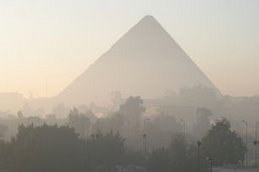
Hawass on the Great Pyramid

http://www.egypttoday.com/article.aspx?ArticleID=6785
In a similar type of concept to the Dig Days column that appears on the Al Ahram Weekly website, Egypt Today has started a feature entitled "From the notebook of Dr Zahi Hawass" this month: "In the first of his regular columns, Egypt’s foremost archeologist wonders what lies beyond the secret doors of the Great Pyramid of Giza."

Bosnian pyramid update

"Bosnia's mystery pyramid will now be probed and inspected by a team of experts from the U.N. Educational, Scientific and Cultural Organization."
See the brief post above for a few more details.
The same report has also been posted at:

Monday, June 05, 2006

KV63 updates

http://tinyurl.com/nxh6x ( commercialappeal.com)
This article quotes an interview with Otto Schaden about some of the recent and future work at the site: " The team hopes to get a portable X-ray machine and scanner to the site within "a week or so" to peer into the last two, made brittle by ravaging termites, the team's leader, Dr. Otto Schaden, said in a phone interview from Luxor, Egypt". Schaden also says that the time remaining for the completion of the excavation cannot be predicted with any accuracy.

http://dsc.discovery.com/beyond/?bclid=70421639&clik=fanmain_leftnav
Unfortunately I don't have access to the Discovery Channel, but the KV63 feature aired last night, and the Discovery website has been updated with some video out-takes showing scenes from the excavation.
If anyone sees a review of the programme, I would be grateful for the link/s.

'Tut' is all show, no art

http://tinyurl.com/qlato (Chicago Tribune)
An interesting piece on the Chicago Tribune website which takes a critical look at the Tutankhamun and the Golden Age of Pharaohs exhibition, raising questions about the information value of such blockbusters in general, and questioning why they must emphasise the "romantic" nature of the find, rather offering explanations of the artefacts: "We get stagecraft — walls painted sand or black to resemble desert and tomb, sconces with cutout hieroglyphs, an avenue of columns — enhanced by projections, animations, photo-murals, lightboxes, even pseudo-Egyptian music. We also get enough objects from before the time of Tut to see how radical his predecessor Akhenaten was and how the conservative Tut sought to return to earlier forms and values. Everything is presented, however, in relation to his short life — Tut died at 19 — as if that, his riches, and the ancient Egyptian view of death make stronger connections with us than the impact of the finest objects.Would fewer people come to the show if, in addition to the 'story of [Tut's] royal ancestors,' some of the labels told more about the objects' making than their function or conjectural owner? Back in 1977, as now, there seems to have been the assumption that only simple, non-artistic narratives would keep the turnstiles clicking because any audience large in number would automatically recoil from two or three lines unfolding in parallel."

Climate change in the prehistoric Sahara

http://news.independent.co.uk/environment/article625034.ece
This article summarizes and includes extracts from a book about the impacts of climate change - The Last Generation by Fred Pearce, published by Transworld . The write-up also offers a brief overview of what the Sahara was like following the end of the last ice age, after 13,000 years ago, when the desert could sustain human and animal life, and sites like Nabta Playa were occupied: "Jon Foley of the University of Wisconsin found that a reduction in Holocene summer sun sufficient to reduce temperatures by just 0.4C would have cut rainfall across the Sahara by a quarter, and by much more in the furthest interior. He says that once a region such as the Sahara becomes dry and brown it requires exceptional rains to trigger a regreening. Beyond a certain point - such as that reached 5,500 years ago - virtually no amount of extra rain is likely to be enough. Lack of vegetation "acts to lock in and reinforce the drought.
The people of the Sahara couldn't have known if the droughts were permanent. But as the desert asserted control, and waterways dried up, they had to leave. Lakeside settlements near the Sudanese border in Egypt were all abandoned at about the same time."
See the above page for the full review".

Happy birthday to the Luxor News blog

http://touregypt.net/teblog/luxornews/
Best wishes and congratulations to Jane Akshar, whose Luxor News blog has been running for a year. Keep up the good work! Jane has updated the blog with some of the key items that have appeared on the site in the last year.

Ancient dinar discovered

http://tinyurl.com/grkvg (Egypt State Information Service)
"Minister of Culture Farouq Hosni said Friday June 2nd that a research mission has discovered the remnants of a two-room house dating back to the era of Salaheddin El-Ayoubi and a single golden dinar of the same age in Al-Shaboul district of Daqahliya governorate. . . . Old as it is, the coin gains its importance being of the Ayoubi age when minting gold money was a rarity."
See the above page for the rest of the short bulletin.

Sunday, June 04, 2006

EEF News Digest

http://www.geocities.com/TimesSquare/Alley/4482/EEFNEWS.html
Last week's EEF News Digest is now available online at the above address, for all the latest information about exhibitions, conferences, lectures and new online and print publications, grants awards and fellowships, new websites, courses and trips, plus a round up of last week's main news items.

Saturday, June 03, 2006

KV63 Video

A video entitled Unearthing the Golden Coffin shows Otto Schaden and team finding the miniature golden mummy. There's no new information, but it does show an exciting moment at the excavation. It is preceded by an irritating but short advert.

Tomb of Nefersekheru online at Osirisnet

http://www.osirisnet.net/tombes/nobles/nefersekherou/e_nfrskhru_01.htm
Thierry Benderitter has announced that, thanks to Jon Hirst, details of the tomb of Nefersekheru TT296 are now on line. The four-page section is lavishly illustrated with photographs, plans and drawings. I particularly like the diagrammatic plans of the friezes - in some cases clicking on an area of the frieze will bring up a photograph. In most cases the thumbanil photos can be clicked on to show a larger image. This small tomb is open to the public, so these pages might provide a useful reference to anyone travelling to Luxor.

Exhibition: Egyptian papyrus in Bulgaria

"An exhibition showing ancient Egyptian papyri opened in Sofia's National Library. The eternal charm of Egyptian papyri is organised by the Egyptian Embassy in response to the active interest of Bulgarians towards the history of this ancient civilisation. . . .The Sofia exhibition, to stay open until June 20, unveils to its visitors various papyrus portraits dating from the pharaoh epoch and depictions of legends and religion of ancient Egyptians."
See the short article on the above page for the full story.

Friday, June 02, 2006

Issues surrounding the Nefertiti bust.

Nevine El-Aref talking about the request, made by Zahi Hawass, to lend Egypt the famous Nefertiti bust, currently on permanent display in Berlin, for a three month period: "Hawass asked the German government to offer the famous bust to Egypt on a three-month loan so that it could go on show at the Egyptian Museum in Cairo to coincide with the centenary celebrations of the German Archeological Institute in Egypt in November 2006. In return, Hawass pledged that the SCA would offer another statue on loan to the Egyptian Museum in Berlin for the three months while Nefertiti was in Egypt. Hawass told Al-Ahram Weekly that the SCA was willing to provide the Germans with all the guarantees required to assure the return of the bust after the completion of the exhibition."
Berlin has so far declined to return the bust on either a temporary or permanent basis. The article puts the request into the general context of the history of the Nefertiti bust and previous requests by the SCA for its return. It also looks, in brief, at other repatriation cases. See the above page for the full story.

KV63 - Speculation

http://tinyurl.com/mu3k3 (dailytelegraph.news.com.au)
Speculation about the contents of the unopened coffin: "It has been 84 years since Egypt's famed Valley of the Kings revealed its last great riches – the fabulous gold of Tutankhamen's tomb. Now archaeologists believe they have stumbled across one final secret: The mummified remains of the boy king's widow buried 3000 years ago. In a mysterious shaft less than 15m from Tutankhamen's burial ground, US archaeologists found seven coffins. They believe one they have not yet been able to open may contain the remains of Queen Ankhesenpaaten. . . . Ankhesenpaaten's link to the tomb was further underlined when a coffin seal was found with part of her name on it."

Laser cleaning tomb of Neferhotep

"If only Neferhotep could see it: 3 300 years after his death, a researcher enters his tomb, directs a beam of light at the wall, and the accumulated dirt of millennia comes off with no trouble at all! Dr. Michael Panzner of the Fraunhofer Institute for Material and Beam Technology IWS in Dresden is the first scientist to use a laser for cleaning an Egyptian tomb. Adorned with wall paintings, stone sculptures and reliefs, the tomb was once that of the senior scribe Neferhotep, who served in the temple of the god Amun."
See the above page for the full story.

German President honours Egyptian archaeologist

http://tinyurl.com/m2hcp (Egypt State Information Service)
"German President Horst Koehler has conferred Merit on illustrious Egyptian archaeologist Dr. Ali Radwan, Professor of Antiquities at Cairo University.
Radwan was granted the medal for his contribution in enhancing cultural cooperation between Egypt and Germany.
Meanwhile, Director General of the Egyptian Supreme Council of Antiquities Zahi Hawwas, in statements to MENA, lauded Radwan's efforts and described him as the doyen of Arab and Egyptian archaeologists.
He added that the council has recently held a reception in honour of Radwan on the occasion marking the issuance of the first three volumes on archaeology.
The German embassy in Cairo will host a function on Thursday on this occasion during which the German Ambassador will decorate the veteran Egyptian archaeologist."
This is the complete item on the State Information Service website

Travel: A week in Egypt

A travel article describing a holiday to Cairo, taking in the Western Desert. It looks mainly at the authors attempts to reconcile, the ancient and on the modern, and at how Egypt lived up to her expectations: "And that's just the thing: if there's one thing about this crazy country, it's that new and old are entwined and concomitant, and the contradictions are ultimately redeemed in the flux and fervency of each generation of life.In one moment, I stare out over the Nile, contemplating the bushels of bulrushes that line the banks — Moses' first and reeded savior. And then, looking up, my face is aglow with an enormous florescent-yellow TGIFriday's sign, which is itself flanked on both sides by Pepsi-Cola billboards and advertisements beseeching tourists to participate in "belly dancing aerobics." In one moment I'm awed by the Sphinx, its paws shiny with the erosion of thousands of years, and the next I'm seated in a 5th-floor Pizza Hut."
See the above article for the full story.

Zahi Hawass on the Valley of the Kings

Zahi Hawass's Dig Days column looks, this week, at the changing role of Egyptians in the recovery of their own heritage. He points out that while in the past the contribution of Egyptians was as members of foreign missions, there are now Egyptian-led teams working on sites: "The young Egyptian archaeologists were working with the foreign missions. This made me mad! I wondered why we could not do our own work. Later, I found out that we needed an excellent education. Education in all aspects of Egyptology is extremely important. For example, it is essential to know the best excavation techniques so as to carry out the best excavations and produce good publications. This is what encouraged me to leave Egypt and study for seven years on a Fulbright fellowship at the University of Pennsylvania. The result of education is clear, because for the first time the leaders of Egypt's antiquities are Egyptian. Egyptians are now on an equal playing field with our foreign colleagues and we all work together for the benefit of the monuments."
See the above article for the full story, which is part IV of a set of installments, all looking at the Valley of the Kings.

Prehistoric tombs in Sinai

This is a frustratingly brief piece, but I will try to find some more information: "An archaeological mission belonging to the Supreme Council of Antiquities (SCA) announced the discovery of 36 tombs dating back to the pre-history era. Dr. Zahi Hawwas, Secretary-General of SCA said that the mission unearthed the tombs during an archaeological survey in Ain Hadra and Abul Rdeis, central Sinai."

Zahi Hawass profile

There is a short piece on the Al Ahram Weekly website this week, complimenting SCA figurehead Zahi Hawass, and highlighting his attempts to repatriate key artefacts: " His burning mission of late has been the retrieval of some of Egypt's precious monuments, scattered around the world. With a burning flame within, he flies from city to city, capital to capital, shaking his finger, raising his voice, lecturing to sympathizers about returning our monuments, in adherence to the 1972 international law, stipulating that property removed after that date, must be returned to its home country. Some have been kindly returned, but Hawass wants more. He wants the bust of Nefertiti from Berlin, the Rosetta Stone from the British Museum, and the Zodiac from the Louvre. He cannot have them back. Thereby, the eternal note of sadness in his quest."

Thursday, June 01, 2006

More on the KV63 gold coffin

http://www.usatoday.com/tech/science/2006-05-31-discovery-egypt_x.htm
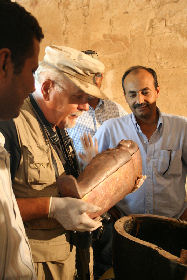
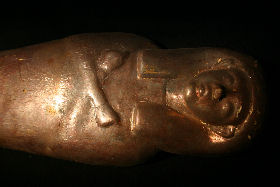
Another report about the tiny golden coffin found at KV63: "The archaeologists discovered seven coffins; there are no mummies in the first five they have opened, but there is one big surprise.
When they first peered into one of the coffins, they found a layer of six pillows, all of which were almost perfectly preserved in the vacuum-packed tomb after more than 3,000 years. At least one of the pillows contained hieroglyphic markings reading, 'life, stability, and power.' But as the team carefully removed them, they noticed a much smaller coffin buried inside.
As lead archaeologist Otto Schaden picked it up, the light of a torch caught a glimmer of gold.
'Everybody burst into applause,' says Anthony Geffen, producer of the Discovery Channel's Egypt's New Tomb Revealed, who was present for the discovery May 24. 'Everyone's (usually) very reserved in the world of archaeology.'
Schaden, an Egyptologist for the University of Memphis in Tennessee, cradled the coffin like a child as others broke into tears.
See the above page for the full story.

Thanks very much to Crew Creative Media for their invitation to use photographs associated with the Discovery Channel's above-mentioned programme.
The official Discovery press release was linked to yesterday:
http://tinyurl.com/lkl4c (prnewswire.com)