Monday, November 06, 2006

Exhibition: "Quest" in Portland

"There are images that stand out in every art exhibit. In the Portland Art Museum's exhibit The Quest for Immortality: Treasures of Ancient Egypt, it may be one of the smaller objects, a statue of the goddess Isis -- as pristine as if it had been carved yesterday, not in the 26th dynasty, 664-525 B.C. Seated on a throne, serenely looking ahead above the level of any mortal, she is delicately crafted, with smooth surfaces and fine detailing. You have to shake yourself to remember that many of these works have endured for 3,500 years, from a civilization that lasted for 3,000 years. Some of the objects in this exhibit were new when the pyramids already were 1,000 years old."
See the above page for the full story.

Another article reviewing the exhibition is at:
http://www.dailyvanguard.com/vnews/display.v/ART/2006/11/14/45598270e1f29

The preparation for the exhibition is covered at:
http://tinyurl.com/yc6qu5 (oregonlive.com)
"Before a single ticket is sold for "The Quest for Immortality: Treasures of Ancient Egypt" at the Portland Art Museum, staffers had to clear a series of hurdles nearly as long as the Nile. (OK, maybe not quite that long). First, Portland had to compete with several other museums to host the show, which began at the National Gallery of Art in Washington, D.C., one of its organizers. The five-year, 11-city tour of the United States includes Boston, Houston and Denver; Portland is the only West Coast stop. . . . .Moving and construction for the traveling Quest for Immortality exhibit is overseen by an Egyptian curator designated by the Supreme Council of Antiquities in Cairo, as well as representatives from United Exhibits Group of Copenhagen, Denmark, a show organizer. And lots of Portland Art Museum employees will help once the crates arrive. But only a select few have license to touch any of the objects."

Sunday, November 05, 2006

New Title: Ancient Egyptian Chronology

http://www.brill.nl/
Now available from Brill publications: Ancient Egyptian Chronology Edited by Erik Hornung, Rolf Krauss, and David A. Warburton • ISBN 90 04 11385 1 • List price EUR 159.00 / US$ 215.00 •

Saturday, November 04, 2006

Minerva Magazine November/Decemer 2006

http://minervamagazine.com/issue1706/index.html
Minerva Magazine's latest edition features an article called Roman Amheida: Excavating A Town in Egypt’s Dakhleh Oasis by Roger S. Bagnall, Paola Davoli, Olaf E. Kaper & Helen Whitehouse. For the full contents listing see the above page.

Travel: Tale of Two Cities

http://abclocal.go.com/wpvi/story?section=local&id=4726568
"Modern Cairo is a city of 18-million people. Like many large cities, residents enjoy the conveniences of technology and availability of culture and nightlife, but struggle with dense gridlock and small spaces. There is something that clearly distinguishes Egypt's Capital as a unique Metropolis. The sprawling city is a backdrop to one of the most recognizable images in the world the Giza Pyramids. . . . Luxor is nearly 400 miles south of Cairo. Its simplicity is a stark contrast to the capital city. Many residents don't even have running water. The parched mountains of sand and rock have not seen rain since 1994."

CT scan of Philadelphia mummy

An article accompanied by a video report about the investigations into a mummy nick-named Annie, originally from Akhmim (c.300 miles south of Cairo), dating to between 300 and 200BC: "Back in April, Annie was taken from the Academy of Natural Sciences to Hahnemann Hospital. Without disturbing Annie's wrappings, she was given a CT scan. These images were then sent to a laboratory to produce a skull model. Now, forensic sculptor Frank Bender will start facial reconstruction."
see the above page for the remainder of this short story

Saturday Trivia: Silly Symphonies

A bit of high quality trivia for you today, thanks to Kat Newkirk:
The 1931 Walt Disney classic animation 'Silly Symphonies - Egyptian Melodies' can be seen at the above URL on YouTube. I'd never seen it before, and it is really quite charming. A spider, making a web at the side of the Great Sphinx travels into the Sphinx via a gate betweeen its front legs, and finds itself traveling to a tomb full of mummies who come to life and have a party. It is in black and white.

Zahi Hawass - Dig Days

http://weekly.ahram.org.eg/2006/818/he3.htm
This link was broken yesterday, but is now up and running - Zahi Hawass discusses Egyptian museums: "Museums in Egypt are entering a new era. New institutions are being constructed, and there is a change from the concept of museums as storage facilities to modern museums with educational and cultural messages. In conjunction with this development, associations for 'Friends' of various museums, including the Islamic Museum, Coptic Museum, and the Cairo Museum, have been organised. For the first time, each of these museums also has educational programmes that teach archaeology and art to both adults and children. We are building a number of new national museums."

Tutankhamun and Tutmania

http://tinyurl.com/yhe8lj (dailylobo.com)
"Emily Teeter said Tut-mania didn't begin until after museums started exploiting ancient Egyptian artifacts with traveling shows.Teeter, an Egyptologist at the Oriental Institute at the University of Chicago, gave a lecture titled Tutankhamun: How His Treasures Changed Our World, Thursday in the Hibben Center. She discussed the global impact of the discovery of King Tut's tomb.She said the tomb's discovery changed people's expectations of the museum experience and the government and businesses' function in the exchange of artifacts. In 1976, Cairo allowed 55 of the tomb's pieces to leave Egypt and be revealed in several cities around the United States.Teeter was an assistant curator of that show."
See the above for the full article.

Friday, November 03, 2006

11th International Conference of Nubian Studies

http://weekly.ahram.org.eg/2006/818/he1.htm
"Of more than 150 papers that researchers presented at the 11th International Conference of Nubian Studies, the largest group concerned recent studies with special emphasis on current rescue operations in the area of the Fourth Nile Cataract.
Organisers made an effort to bring together papers that would present an overview of the most important archaeological sites under excavation in recent years, those where significant discoveries have recently been made. The conference provided an excellent opportunity to review the achievements made in Nubian studies over the 34 years since the 2nd conference took place in Warsaw in 1972, and conference committee director W Godlewski made particular mention of Nabta Playa, Kerma-Doukki Gel, Naga, Banganarti and Dongola."

Polish activities upstream

http://weekly.ahram.org.eg/2006/818/he2.htm
"One of the most important achievements during the Nubia Salvage Operations under the auspices of UNESCO in the 1960s was unquestionably the discovery of an ancient cathedral in Faras which contained wall paintings preserved in excellent condition. As a result of four years of investigation and conservation by a Polish mission under the direction of K Michaowski, these magnificent and unique paintings can today be seen in special galleries in the National Museums of Warsaw and Khartoum.
The discovery can be regarded on a par with the most important archaeological discoveries of the second half of the 20th century, and certainly among the most significant achievements of the Nubian campaign."

More about the Reisner papyri at Berkeley

http://abclocal.go.com/kgo/story?section=local&id=4718864
There is a video report aout the Reisner papyri on the above page (preceded by an irritating but very brief advert). The text from the video is also shown on the above page. "They've arrived -- ancient papyri from an Egyptian excavation conducted for U.C. Berkeley more than a century ago. The documents are on campus today after a long journey worthy of a mystery novel. Some of it, 4,000 years old. The papyri was excavated by archaeologist George A. Reisner, who was devoted to distraction.
Some academic presentations are more elaborate than others. With that in mind, one should not discount the importance of this one at U.C. Berkeley's Morrison Library. It was 105 years in the making. "
See the above page for the full story.

History from on high

http://arts.guardian.co.uk/features/story/0,,1937151,00.html
A new exhibition in London, UK, looks at some of our more admirable achievements from the air in an exhibition entitled The Past From Above, at the British Museum from November 16 2006 to February 11 2007. There were all taken by Swiss photographer Georg Gerster, who has been photographing from the air since 1963: "He came back from more than 40 years of aerial photography with an exceptional record of monuments as their long-dead creators could only hope to see them from some celestial viewpoint in the afterlife.Pharaoh Ramesses II, for instance, had to be content to imagine the magnificent pattern of the Ramesseum, his mortuary temple dating from the 13th-century BC, from 1,000ft up. He had only his architect's plans and the vast but partial views available from the flat desert ground surrounding it. Visitors to the museum see not only the bird's-eye view, but the striking effects of later history on the monument - and the hundreds of others alongside it in the exhibition."

Egypt draws the crowds

"Life and death in ancient Egypt is proving to be a big draw at the Museum of St Albans in more ways than one.For the exhibition called The Red and the Black, which has returned to the museum in Hatfield Road by popular demand, was also at the heart of its contribution to the nationwide Big Draw.Then children were invited to produce their own pictures in the style of ancient Egyptian art.The title of the exhibition refers to the Egyptians' concept of their land - the black land was that part fertilised by the Nile floods each year and the red lands were the desert where their ancestors were buried.As well as using the museum's own exhibits, it also contains artefacts on loan from other museums across the country, including the Fitzwilliam in Cambridge and the Egypt Exploration Society.The exhibition goes on until June next year."

Thursday, November 02, 2006

Tourism damaging Egyptian heritage

Michael Jones, of the American Research Centre in Egypt, and Gaballa Ali Gaballa, a former head of Egypt's Supreme Council of Antiquities highlighted the problems of managing the impacts of tourism on Egypt's heritage at the meeting of the British Egyptian Society and the London Middle East Institute on Wednesday, with careless scuffing and moisture from breath and perspiration being two of the main problems: "Booming tourism, a key part of Egypt's economy, is having a catastrophic effect on the country's unique cultural heritage, experts said on Wednesday.
So large were the numbers of people now visiting Egypt's famed ancient sites like the Valley of the Kings that they were causing serious damage in a way that even centuries of weather had failed to do, they said at a meeting in London. . . . After tailing off sharply following a string of attacks by militant Islamists in the 1990s, tourist numbers in Egypt climbed to eight million in 2004 and up again to 8.6 million last year.
Figures from the Egyptian Tourism Authority show that in the first six months of this year tourist numbers were 12 percent up on the same period the previous year, and there are plans to boost numbers to 16 million by 2014."
See the above page for the rest of this short report.

Egyptian papyri arrive on campus

http://www.berkeley.edu/news/media/releases/2006/11/01_papyri.shtml
A rather nice piece from UC Berkeley looking at the arrival of a set of Reisner's Middle Kingdom papyri at Berkeley. The article gives details about the content of the papyri, Reisner's role in their aquisition, and some background to their travels: "Ancient papyri from an Egyptian excavation conducted for the University of California, Berkeley, more than a century ago have arrived on campus after a circuitous journey worthy of a mystery novel, campus officials announced at a new conference today (Wednesday, Nov. 1).
Following their discovery in Egypt, the papyri were sent to a German conservator, hidden in Berlin during World War II, concealed from East Germans intent on seizing them, smuggled to West Berlin and stashed in a shop, and stored in Switzerland. One roll was shipped to Boston in the 1930s, but the others remained hidden until the 1960s, when they, too, were shipped to Boston. They remained there until just a few weeks ago.
Four large rolls of the papyri found resting atop an Egyptian coffin during archaeologist George A. Reisner's 1901-1904 dig at Naga ed-Deir near the Upper Nile Valley arrived recently at UC Berkeley's Center for the Tebtunis Papyri in The Bancroft Library."
See the above page for the full story.

Institute boosts Egypt program

http://www.yaledailynews.com/Article.aspx?ArticleID=34071
"Yale's Egyptology program may not yet have a large presence on campus, but it will soon have a home overseas as construction continues on the Yale Institute in Egypt.
Construction of the many components of the institute ­- which will be spread across various sites west of the Nile River - began last year and is now picking up pace. Egyptologist John Darnell said living spaces, storage work spaces and expedition headquarters to be used during fieldwork will be built in the western desert region of Egypt by the end of this academic year. He said the institute also hopes to soon open offices in Cairo and Luxor. The other major component of the program's growth will be the expansion of the institute's Web site to include scholarly accounts of fieldwork in Egypt, Darnell said. . . . Darnell brought his two projects - the Theben Desert Roads Survey and the Toshka Desert Survey - to Yale when he came to the University from the University of Chicago in 1998".
See the above page for more details.

Travel guide: Egypt's Mediterranean

Description, with input from the authors, of a travel guide to Egypt's Mediterranean: "Egypt’s Mediterranean coast is associated with leisurely summer holidays where the vacationers lounge on the white sandy beaches and swim in the cool, choppy waters of the Mediterranean. For the most part, holidaymakers stay within the confines of the resort compounds that have pervaded the coastal beaches. From the Western village of Sallum bordering Libya, to the beaches of Rafah on the East, Egypt’s sprawling Mediterranean coast has a lot more to offer than a relaxing spot to pitch an umbrella on the beach. Jenny Jobbins, along with Mary Megalli, trekked along the coast to provide an essential traveler’s guide for the more adventurous holidaymakers who want to discover the area’s rich history and natural heritage."
The book is: Alexandria and the Egyptian Mediterranean: A Traveler’s Guide by Jenny Jobbins and Mary Megalli, American University in Cairo Press, 2006 (new and revised edition). Paperback.

Tut, tut, those hedonists

http://www.hindustantimes.com/news/181_1833780,0012.htm
One of the more light hearted looks at this week's news that John Hopkins have uncovered scenes of debauchery at Luxor: "The ruins of a temple in Luxor in Egypt point to a discovery that could be the ultimate excuse for any teenager facing the music the day after a night out. Archaeologists have found evidence that way back in 1470 BC — in other words, much before today’s parents were yesterday’s teenagers — Egyptians would take part in great festivals the point of which would be to partake in sex, drugs and rock’n’roll, or at least, sex, alcoholic concoctions and pyramidal rock formations. Any doubts about the ancient youngsters not making a Woodstock out of their lives have been dispelled by evidence of a drinking ritual and naughty graffiti."
See the above for more.

Wednesday, November 01, 2006

Saqqara Online update 09/2006

http://www.let.leidenuniv.nl/saqqara/homepage.htm
The Leiden Excavation team have updated the Saqqara Online website. Click the What's New link in the left hand navigation bar on the above page to see the latest update (September 2006): "We have entered a text about the Decipherment of hieroglyphs and we have updated the calender (only on the site of the Friends of Saqqara). We have changed the text from the pages about Memphis and Saqqara and Four thousand years history."

Made in China

http://www.metimes.com/storyview.php?StoryID=20061031-091400-4221r
"Figurines of King Tut, Ramses, and Queen Nefertiti in Cairo's famous Khan Khalili bazaar all bear the hallmarks of Pharaonic regalia, from the goats-hair beards to the golden scepter. But the slanting eyes framed by the ancient Egyptian rulers' trademark kohl lining betrays the statuettes' Chinese origins. While Egypt is increasingly betting on the irresistible rise of China's economy for its own prosperity, the unbeatable prices of the Asian giant's products are breaking into the last strongholds of local manufacturing."
See the above for more.

Lecture series at Luxor Mummification Museum

Thanks very much to Jane Akshar and her Luxor News Blog for the information that the Luxor Mummification Museum has announced its new lecture series, now being held on a Sunday, and kicking off with an update about the work on reducing water at Luxor and Karnak temples.

Tuesday, October 31, 2006

Blog Update

First, apologies for the lack of update yesterday. My desktop PC crashed and burned in a most spectactular manner, and I wasted the entire day trying to restore it. In the end I went and drowned my sorrows in the pub, and it meant that the blog wasn't updated. I'm on the laptop today, and not even looking at my wretched desktop!

Second, just an advance warning that I am off for a week to Egypt on Sunday, and won't be updating the blog whilst I'm there. Assuming no more technological breakdowns, I'll hopefully have some nice photos to put online when I get back. If you have any requests for photos from the areas I'm visiting in Egypt, and it's not a bog-standard itinerary, the itinerary can be found at:
Just email me if you need any digital images taking.

Sex and booze figured in Egyptian rite

A short piece describing new scenes found depicting the so-called Festival of Drunkeness: "Archaeologists say they have found evidence amid the ruins of a temple in Luxor that the annual rite featured sex, drugs and the ancient equivalent of rock 'n' roll. Johns Hopkins University's Betsy Bryan, who has been leading an excavation effort at the Temple of Mut since 2001, laid out her team's findings on the drinking festival here on Saturday during the annual New Horizons in Science briefing, presented by the Council for the Advancement of Science Writing."
It is wonderful just how many of you picked up on and emailed details of this story to me :-)

Water damage at Temple of Seti I

http://touregypt.net/teblog/luxornews/?p=306
Jane Akshar has updated her Luxor News Blog with a set of photographs demonstrating deteriorating conditions at the temple of Seti I, accompanied by a heartfelt commentary: "I am sorry there is no other word, the rising water damage has always been an issue there and has scared the living daylights out of me but look at this photo. The entire piece is about to fall of and disappear into the trench surrounding it. But it gets worse, the shameful neglect of this site is appalling. there is vegetation growing everywhere and damaging both restoration and pharonic stone. This is the picture of the temple palace, it looks more like a garden than a palace."
The photographs illustrate her point perfectly. See the above page for the photos and the rest of her comments.

Getty Museum improves acquisition standards

"Under growing international scrutiny for buying potentially looted antiquities, the J. Paul Getty Museum has dramatically tightened its acquisition standards.The move, announced Thursday, is designed to screen out any item whose history since 1970 is murky. In doing so, two experts said, the Getty is essentially taking responsibility for making sure an item's recent history is clean, instead of challenging critics to prove it's dirty.
The move is not retroactive — if it were, the museum would have to relinquish scores of ancient items from its galleries and storerooms — but some authorities see it as a potential turning point in a global confrontation between curators and archeologists over the way museums do business."
Apologies about this story - I went onto the page linked to in the TinyURL first thing this morning and got access to the article in full, but when I went back to check something it asked me to register. Maybe you'll have more luck.

Egyptology search engine on Glyphdoctors

Glyphdoctors is developing a new Egyptology search engine, as a part of their Open Egyptology Forums. It is described by Nicole Hansen as follows: "Powered by Google, this search engine allows you to restrict your search to trustworthy Egyptological sites, both professional and amateur alike. I have added only a few sites myself to get it started, but in order to make it as useful as possible, I need your recommendations on what sites to include. It could be the Web site of an archaeological project or an amateur site with great photos of Egypt. You decide what you would like to search! You can start using the search engine now or suggest more sites to be included."
See the above links for more.

Mastaba of Kagemni on OsirisNet

http://www.osirisnet.net/mastabas/kagemni/e_kagemni_01.htm
Thanks to Thierry Benderitter for the information that the mastaba of Kagemni has been entirely rewritten on the OsirisNet website. The hieroglyphic text has not yet been added to the pages, but they hope to have it updated soon when they have found a source for the texts. There are now more than 100 photographs.

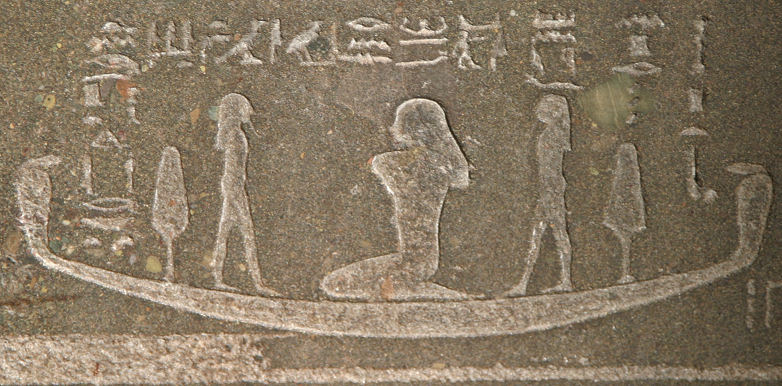
Ancient Egyptian Boats

Not really news, per se, but a useful summary, posted on athe Your Boat Portal blog yesterday, about ancient Egyptian boats from Predynastic through Pharaonic times. Here's an extract: "The ancient Egyptians were creating ships with technological skills far beyond their time, well before the invention of the wheel. Egyptologists suspect that simple light rafts made from bundled papyrus reeds may have been made by hunter-gatherers who moved to the Nile Valley during the Upper Paleolithic period; of course, no specimens remain today. However, there is evidence of the presence of boats in the Naqada II culture, which immediately preceded the dynastic period. Archaeologists have unearthed red painted pottery with designs that include boat motifs as important symbols, and some interpretations stress the boats were used in a religious or ritual capacity. Further evidence for the early use of boats lies in tomb reliefs (ship building scenes were among the most popular motifs in tombs), paintings, and model boats dating from predynastic times through the New Kingdom."
See the above page for the full item.

Sunday, October 29, 2006

Archaeological Diggings - Photo Album

http://www.freewebs.com/diggingsmag/photoalbum.htm
There's a rather good photo album of Egytian images on the Archaeological Diggings website at the moment. See the above page. You will need a Flash 5 compatible plug-in to view it. Scroll using the left and right arrows, and click on the thumbnail image to see the bigger picture.

Book Review: The Archaeology of Early Egypt

http://www.ucl.ac.uk/prehistoric/reviews/06_08_wengrow.htm
A detailed review by Alice Stevenson of David Wengrow's The Archaeology of Early Egypt: "The Archaeology of Early Egypt is ambitious in scope covering the period from the end of the last Ice Age (c. 10,000 BC) through to the emergence and early development of the state (c. 2650 BC). Accounts of this period, or parts of it, have been attempted before. Refreshingly, what sets Wengrow’s work apart from many of these other studies, with the notable exception of Michael Hoffman’s (1979) volume, is the balanced, critical engagement with social theory which situates the evidence within a broader academic narrative.
Writing such an authoritative account is not an easy task. This is particularly the case given that this large span of time encompasses fundamental social transformations, such as the emergence of farming, the origins of kingship and writing, as well as the evolution of the Egyptian state."
See the above page for the rest of this very useful review.

Saturday, October 28, 2006

Team helps save Egypt tomb mural

"A Japanese research team has successfully removed a mural in an ancient Egyptian tomb at the World Heritage site of Saqqara, using a technique used on Japanese murals, so that preservation work can be done on it, team members said Friday.
A Japanese researcher prepares to remove part of a mural from the underground tomb of Princess Idut at the World Heritage site of Saqqara, Egypt.
The Kansai University team removed the plaster mural from the underground tomb of Princess Idut, which dates back to around 2360 B.C. The mural depicts birds, food and beer in color and has hieroglyphs engraved in it.
In the rare removal of a fragile plaster mural, the team glued rayon paper with resin over parts of the mural to be removed, using a type of seaweed paste to protect them, and carefully separated the plaster from the rock wall with knives."
See the above page for the full story.

Sarcophagus to go on sale at Christie's

"The leading lot in Christie’s sale of Antiquities, to take place on December 7, is an Egyptian painted wood sarcophagus and mummy for Neskhons, Third Intermediate Period, Dynasty XXI, circa 990 – 940 B.C. (estimate on request). Sarcophagi of this quality rarely appear on the market and Christie’s is delighted to offer this exquisite consignment. The last time a mummy with sarcophagus was sold at auction was in May 2003, when Christie’s South Kensington sold the sarcophagus and mummy of a priest of Amun for $1.4 million which still stands as the world auction record for a sarcophagus and mummy."
See the above page for the full story, including background information about the sarcophagus, and a lovely photograph.

Cairo beyond the Pharoahs

"It’s a great oddity. Millions of tourists go to Cairo, and almost all of them take the same route, visiting only the ancient relics at Giza and in the Egyptian Museum. But Cairo was not a city of the ancient Egyptians. The city was founded by the Copts as Babylon — one theory holds that its name has nothing to do with the biblical city, but rather Bab il-On, the Gate of On. After the Arab conquest in 641, it became perhaps the greatest Islamic city in the world.
Its mosques and monuments are preserved as far back as the flood-recording Nilometer of 861 and the mosque of Ibn Tulun, built in 879. There are architectural treasures from almost every historical period since then, including a supreme run of Mamluk architecture, the dynasty which ruled between 1250 and 1517. It’s a cornucopia that compares with treasures from the Roman Baroque, or the Florentine Renaissance."
See the above page for the full story

Friday, October 27, 2006

Une zone archéologique exceptionnelle

http://hebdo.ahram.org.eg/arab/ahram/2006/10/25/voy2.htm
Thanks very much to EEF for including this on their weekly News Digest. A series of Pharaonic inscriptions have been found in the vicinity of Al-Aïn Al-Sokhna, in the vicinity of ancient copper mines: "Une mission égypto-française a mis au jour la plus riche mine de cuivre de l'Egypte Ancienne au bord de la mer tout près du golfe de Suez. Des caves, des fours, des objets en cuivre ainsi que de tessons de poterie et de nombreuses scories ont été dégagés dans ce site minier exceptionnel de 2000 ans av. J.-C. . . . Le plus ancien de ces documents est ainsi une représentation au nom d’un souverain mal connu, le dernier pharaon de la XIe dynastie, le roi Montouhotep IV, qui semble avoir connu un règne éphémère (deux ans), autour de 2000 av. J.-C. "

Conservation in Egypt

http://education.guardian.co.uk/higher/columnist/story/0,,1932420,00.html
An article looking at conservation issues in Egypt, with particular reference to the Valley of the Kings: "Kent Weeks, of the American University of Cairo, launched the Theban Mapping Project more than 20 years ago simply because no precise plan existed of the 60 or so tombs in the Valley of the Kings. He is still at it, not least because in the course of taking a closer look at a tomb known as KV5, under threat from a tourist car park, "undecorated, unimportant, uninteresting, unnecessary to save," he made the biggest find in Egyptology: 150 chambers and still counting. But there's the catch: as he and his team crawl through the rubble and flash flood debris of 3,000 years, trying delicately to excavate the burial chambers of the sons of Ramses II, more than 7,000 tourists a day are jostling their way into some of the other tombs in the Valley of the Kings, playing merry hell with the heat and humidity levels in dark places that have survived 30 centuries, but may not survive the next 30 years. It isn't just the tourists. Egypt's history is under threat from growing cities, agriculture, manufacturing and pollution. "
See the above page for the full story.

BES 2006-2007

http://www.egyptology-uk.com/besdirectory/introduction.htm
"After a gap of two years, Sussex Egyptology Society has once again taken on responsibility for the BES Directory of British Egyptological Societies. The 2006-2007 edition is now available online with PDFs downloads (either of individual society pages or the complete directory). . . .Founded by the Manchester Ancient Egypt Society, the directory was created to help keep the growing band of UK Egyptological groups informed about each other. It provides details about each society’s officers and membership, its lecture venues, and links to the individual society web sites for details of lecture programmes where available."
See the above page for more details and the BES Directory.

Thursday, October 26, 2006

Exhibition: Description de l'Egypte in Missouri

http://www.kansascity.com/mld/kansascity/news/local/15849664.htm
"Historians at the Linda Hall Library wanted to celebrate the library’s expansion in a big way. So, they are preparing a display of giant books that describe Napoleon’s 1798 military invasion of Egypt that became better known as a scientific and cultural expedition. Napoleon, the emperor of France, took scientists, engineers and artists along with his soldiers.
The library, near the University of Missouri-Kansas City campus, has owned an original 23-volume set of illustrations and text since 1970 but has never publicly displayed the set because of lack of room . . . . The books, called “Description de l’Egypte,” will be on free public display for six months, starting today at the library, 5109 Cherry St."
See the above page for the full story, together with opening hours.

The Linda Hall Library home page is at:
The site's page for the exhibition is at:

Professor unwraps truth of mummies

http://www.connpost.com/localnews/ci_4546171
A short feature about Gerald Conlogue, whose speciality is the analysis of mummies of all types and ages: "Seeing dead people is a way of life for Gerald Conlogue. And although they're shrouded in mystery when he meets them, it is Conlogue's job to demystify his mummified acquaintances by uncovering the truth about them."

National Geographic pyramids pages

http://www.nationalgeographic.com/pyramids/pyramids.html
I don't know how long these pages have been on the National Geographic website, but they provide a rather good introduction to the pyramids of Egypt. I particularly like the interactive pyramid graphic on the above page. Thanks to Kat for pointing it out.

Wednesday, October 25, 2006

Saqqara dentist tomb videos

A short video clip of the newly discovered tombs. A good panoramic view of the site helps to put the previously posted photographs into context.

http://fullcoverage.yahoo.com/s/ap/20061023/ap_on_sc/egypt_new_tombs_5
A longer video is available from this page, including some good footage of the tombs themselves and an interview with Zahi Hawass at the site. There is also a 7-image slide show on the same page.

Zahi Hawass feature

http://news.nationalgeographic.com/news/2006/10/061024-hawass.html
Two-page National Geographic feature on Zahi Hawass, who is a National Geographic Society explorer-in-residence and his priorities: "Since the days of the pharaohs, priceless artifacts from Egypt have been falling into the wrong hands. But Zahi Hawass, head of Egypt's Supreme Council of Antiquities, is on a mission to protect the relics of his country's storied past."
The second page lists five unique artifacts which Hawass believes should be repatriated regardless of their provenance.

Upenn Williams Director steps down

"Dr. Richard M. Leventhal, the Williams Director of the University of Pennsylvania Museum of Archaeology and Anthropology, has announced his intention to step down from the directorship effective November 1, 2006. Dr. Leventhal will continue as a tenured faculty member in the School of Arts and Sciences, will be a curator in the Museum, and will launch a new initiative within the Museum focusing on national and international issues of cultural heritage and cultural property preservation. . . . Dr. Jeremy A. Sabloff, Christopher H. Browne Distinguished Professor of Anthropology and curator of the American section of Penn Museum, will serve as Interim Director."
See the above press release for the full story.

Travel: Cairo

http://tinyurl.com/yfboev (iol.co.za)
Summary of tour from Johannesburg (S.A) to Cairo, with visits to the Egyptian Museum, Giza pyrmaids and Khan El-Khalili Bazaar described in brief. The writer also touches on security issues and the notorious Cairo traffic.

Tuesday, October 24, 2006

Archaeological Find Links Syria And Egypt

http://www.allheadlinenews.com/articles/7005269998
"An important archaeological dig in southern Syria found evidence of extensive trade between ancient Egypt and Syria during the middle and old Bronze Age. An excavation team at Tel al-Dibbeh in Sweida, southern Syria, discovered clay pots with hieroglyphs used for burying children. Most of the items date to the middle to old Bronze Age and show a link between Egypt and Syria during this period, most obvious in the use of Egyptian hieroglyphs."
See the above page for the remainder of the story.

Tourists see perpendicular sunrays on Ramses II face

http://tinyurl.com/y27sh9 (sis.gov.eg)
"Some 4,000 tourists converged at dawn on Sunday on Abu Simbel Temple to watch the perpendicular sunrays on the face of the statue of ancient king of Egypt, Ramses II.
Authorities in the governorate of Aswan, Upper Egypt, set up two giant screens so that tourists outside the temple could also see the picturesque phenomenon.
The sun falls on Egypt's renowned Pharaoh twice a year, on February 22, the date of his birth, and on October 22, the date of his accession to the throne of Egypt."
This is the entire bulletin on the State Information Service website.

Record figures for Tutankhamun on Discovery

http://www.channelcanada.com/Article1606.html
"Last night's 9 p.m. ET/10 p.m. PT broadcast of the new one-hour special, King Tut's Mystery Tomb Opened was a huge success for Discovery Channel Canada, drawing a record-setting 407,000 viewers A25-54 and 314,000 viewers A18-49 in the Sunday night 'Discovery Presents' timeslot. This hour is the highest ever A25-54 'Discovery Presents' audience in the channel's 11 year history. King Tut's Mystery Tomb Opened surpassed previous record holder, Nefertiti Resurrected, which attracted 371,000 viewers in that demo when it premiered in August 2003."
See the above page for more.

Travel: Guide to the Nile

http://www.belfasttelegraph.co.uk/lifestyle/travel/story.jsp?story=711283
This article talks more about the river itself than the monuments that flank it, and offers suggestions for holiday companies offering different types of Egypt experience.

Monday, October 23, 2006

Old Kingdom tombs of dentists found in Saqqara

http://english.people.com.cn/200610/23/eng20061023_314258.html
"The first cemetery of Pharaonic dentists has been unearthed by an Egyptian antiquities mission at the Saqqara pyramid complex south of the capital Cairo, the Egyptian official news agency MENA reported on Sunday.
The cemetery, built with bricks, dates back to the end of the fourth dynasty and the start of the fifth dynasty (more than 4,000 years ago), the mission's leader Zahi Hawas, chief of Egypt's Supreme Council of Antiquities, said in a statement.
The statement said that the cemetery consists of three tombs of the king's three dentists, a chief one and two others who used to live near the royal palace to care for the teeth of the king and the royal family."

http://tinyurl.com/y6brf4 (thestaronline.com)
"Thieves led an Egyptian archaeological team to discover three tombs of dentists to the ancient kings, unveiled Sunday at the Saqqara pyramid complex south of Cairo. . . . About 4,200 years old, the tombs honor a chief dentist and two other dentists, who served the royal families. They show that the ancient Egyptians 'cared about the treatment of their teeth,' Hawass said. He pointed out two hieroglyphs, an eye over a tusk, appearing frequently among the neat rows of symbols decorating the tombs' doors, that he said identify the men as dentists.
Thieves beat the archaeologists to the site of the new tombs, launching their own dig one summer night two months ago, before they were captured and jailed. . . . They likely didn't notice a curse inscription just inside the prominent doorway to the chief dentist's tomb, which showed a crocodile and a snake, designed to ward off invaders."

http://localnewsleader.com/jackson/stories/index.php?action=fullnews&id=18359
"The pictorial letters also spell out the names of the chief dentist — Iy Mry — and the other two — Kem Msw and Sekhem Ka. Hawass said the men were not related but must have been partners or colleagues to have been buried together.
They depict the chief dentist and his family immersed in daily rituals — playing games, slaughtering animals and presenting offerings to the dead, including the standard 1,000 loaves of bread and 1,000 vases of beer. Just around the corner of the doorway is a false door, its face painstakingly inscribed with miniature hieroglyphics. A shallow basin was placed below it"

http://tinyurl.com/y4frb6 (washingtonpost.com)
This site has a photograph of part of the site (click on the photograph to see the bigger image).

http://tinyurl.com/y8hdh8 (theglobeandmail.com)
A photograph of the false portal surmounted by a lintel with a two-line inscription.

http://tinyurl.com/ydgwp9 (townhall.com)
A different photo is on the above page, this one showing some of the hieroglyphic inscriptions naming the dentists, accompanying a two-page article about the discovery.

http://snipurl.com/103yp (yahoo.com)
A round-up of all the best photos is at the above address (thanks Aayko - you're a star)

Also at:
http://tinyurl.com/ya8d4s (mlive.com)
http://www.iht.com/articles/ap/2006/10/22/africa/ME_GEN_Egypt_Ancient_Tomb.php

See the above web addresses for the rest of these stories.

Geological feature key to finding & protecting tombs

http://live.psu.edu/story/20294
"A 42-year-old method for finding water, monitoring pollution and helping with tunneling may also be a way to locate and protect tombs in the Valleys of the Kings and Queens and other burial sites in Egypt, according to Penn State researchers.The idea that fracture traces could bare some connection to the rock cut tombs found in Egyptian valleys came to Katarin A. Parizek as she toured Egypt. . . . While locating previously unidentified tombs is a worthy endeavor, perhaps even more important is preserving the tombs. Many of these are open for viewing by the public and are the responsibility of the Egyptian Ministry of Antiquities. Maintaining the tombs is a complex and complicated job"
See the above pag for the full story.
Photos are available at:
http://www.psu.edu/ur/2006/kingsphotos.htm

Domestication of the donkey

A few years ago, Egyptologists found a new Pharaonic burial site more than 5,000 years old. They opened up a tomb. 'They're expecting to find nobles, the highest courtiers,' said Washington University archaeologist Fiona Marshall. "And what do they find? Ten donkey skeletons. The ancient Egyptian burial shows how highly valued (donkeys) were for the world's first nation state. After the horse came, they became lower status. Of course, they're the butt of jokes and all the rest of it. That has to do with the name mostly.'
Hee haw. Marshall wants to know how the donkey was domesticated from the Somali wild ass. By traveling around the world, searching for bones in London museums and African deserts, she hopes to pinpoint the time and place of this event, which Marshall says was as revolutionary as the invention of the steam engine. She also hopes to understand why the ass was domesticated and not, say, the zebra.
Animal domestication events are rare in human history. Of 148 land-dwelling mammals that weigh more than 100 pounds, only 14 were domesticated. These animals tend to have certain characteristics, like a strong hierarchy. That allows humans to slip in atop the order. Calm, social and non-territorial animals also made good candidates. Yet wild asses - stubborn, territorial, flighty - have none of these characteristics. 'That is the conundrum. By all the rules of domestication, they're not at all suitable,' Marshall said."
See the above page for the full story.

Donkeys were domesticated early in Egypt, the earliest being known from the Neolithic site El Omari (to the south of Cairo), and they continued to be of considereable value throughout the Predynastic and Pharaonic periods. It is shown in numerous Old Kingdom scenes, and plentiful records of transactions concerning the purchase and leasing of donkeys have been found at the New Kingdom tomb-workers village Deir el Medineh. Camels were not mainstream in Egypt until the Graeco-Roman period, so donkeys were the most widely used beast of burden.

Sunday, October 22, 2006

Seven Egyptian sites in Euromed Heritage Program

http://www.dailystaregypt.com/article.aspx?ArticleID=3561
"Seven heritage sites in Egypt have been selected for restoration through 'Adopt a Mediterranean Heritage,' a new and innovative initiative from the Euromed Heritage Program. Twenty-five historical sites in the Mediterranean partner countries have been selected for restoration through the program. Chief among its aims is increasing contact between endangered heritage sites and international investors — public and private — interested in financing restoration and conservation in order to support a responsible public/private partnership for cultural heritage to achieve social development and preserve educational value."
See the above page for the full story.

Nile valley monument entrance prices to rise

http://touregypt.net/teblog/luxornews/?p=302
Jane Akshar's Luxor News blog has listed some new prices for entry into monuments along the Nile. The SCA has confirmed that prices will rise, but has been unable to confirm when this will be implemented.

Sun to fall on Ramses II at Abu Simbel

"Egypt will witness the annual celebration of the perpendicular sun fall on the face of Pharaoh Ramses II statue in Abu Simbel Temple in Luxor on Sunday October 22. . . . Mohamed Hamid, director of the Abu Simbel antiquities department, said the perpendicular sun fall on the face of Ramases II will begin early Sunday. The occasion marks the beginning of the winter and the agriculture seasons for the Pharaohs, he added. This event takes place twice a year; namely in October and February. It brings thousands of tourists from all around the world to mark the marvelous occasion."

Discovery Channel specials

http://tinyurl.com/yzkot4 (canada.com)
"Discovery Channel has back-to-back specials that go inside a burial chamber discovered in February just 14 and a half metres from the entrance to the tomb of King Tutankhamen. The latest tomb included five mummies in intact sarcophagi with painted funeral masks according to Zahi Hawass, head of Egypt's Supreme Council of Antiquities.
From the description in the publicity material, we'll have to suffer through the usual 'who lies in this mystery tomb?' voiceovers torquing the bejesus out of the revelation to come, but the Discovery Quest team of scientists usually produce the real deal in the end."
See the above page for more details - you will need to scroll to the end of the first page, and then click to the second page for the full review.

Cairo Museums

A useful summary of the museums of Cairo, with brief summaries, address and contact details. Most of these are marked on this useful map of Cairo:

Saturday, October 21, 2006

More on the Barnum mummy of Pa-Ib

http://tinyurl.com/yfuumu (zwire.com)
Detailed and informative summary of the work completed so far: "The scan was unique because the Toshiba Aquilion CAT Multi-Detection machine uses technology that is only about a year old and few radiology units have them. The technicians also did an MRI on the mummy, but MRIs work by finding water and certain hydrogens in the body. After 2,500 years, there was apparently not much of either in Pa-Ib. In the MRI machine, the 5-foot 3-inch mummy was invisible."

Review: Lagunilla collection in Havana, Cuba

http://www.granma.cu/ingles/2006/octubre/vier20/43lagunillas.html
A review of the collection of the Dr. Joaquín Gumá, Count of Lagunilla (1909-1980), housed in the Museum of Fine Arts in Havana, Cuba, which includes a two large halls dedicated to the Egyptology collection: "The vast majority of the exhibits belonged to Lagunillas, seven came from the Academy’s collection, and there has also been one recent donation – specifically for the scientific event celebrating the 50th anniversary of the Lagunillas Collection – from Christian Loeber, principal curator at the Museum of Hanover: a vase from the Neolithic culture of Nagada.
Nor did the multi-colored wooden sarcophagus belong to Lagunillas: this was donated by Egypt in recognition of Cuba’s assistance in the salvage and rescue of the Abu-Simbel temples in 1974.
The group of funereal artifacts, dating back to distinct eras, includes four exquisitely-made chalices to guard the internal organs of the deceased, votive steles, scarabs of the heart, and a papyrus from the Book of the Dead."
The collection also includes a number of Faiyum portraits. See the above page for the full story.

Exhibition: Cairo then and now

http://tinyurl.com/tp47v (mlive.com)
"Henry Matthew's recent trip to Egypt is responsible for an interesting dual exhibit featuring a modern artist's interpretation and a 19th century view of this ancient land.
Matthew, who is director of galleries and collections for Grand Valley State University, asked Cairo artist Rana Chalabi for a large group of watercolors depicting everyday life in that city.
Contrasted and compared with a similar series of prints by David Roberts, they bring to life the millennia-old monuments of Egypt and the life and times of Egyptians as Chalabi sees them."
See the above page for the full story.

Exhibition: Nesperennub opens in Tokyo

"The Tokyo exhibition, Mummy: The Inside Story, was originally seen at the British Museum in 2004, and features the mummy of the priest Nesperennub, plus 130 related artifacts including coffins, statuettes representing ancient Egyptian gods, and canopic jars that held the organs taken from the dead in the mummification process.
Among the beautiful jewelry on display is a necklace featuring carnelian barrel-beads and tiny amulets of golden lizards, which were regarded as a symbol of regeneration.
However, the highlight is the 20-minute film that visitors see before they reach the exhibit areas. The film is shown on a huge screen--14 meters wide and 4 meters high--at a special theater, and gives fresh 3-D insights into the priest from all angles, re-creating his bone structure, bad teeth and even the bowl that is stuck on his head--mistakenly left behind by the embalmers, it is believed."
See the above page for the full story.

Exhibition: More re Sinai at the Getty

"Mount Sinai in Egypt is perhaps best known as the site where Moses encountered the burning bush and received the Ten Commandments.
But also in this desolate desert landscape, Justinian, the Byzantine emperor in Constantinople, in the middle of the sixth century ordered the construction of a monastery, St. Catherine's, that has become the oldest continuously operating Christian monastic community. Over the 1,400 years of its existence, St. Catherine's has accumulated one of the finest and most extensive collections of religious icons in the world.
Now, many sacred treasures from the Greek Orthodox monastery are to be shown for the first time abroad. The exhibition Holy Image, Hallowed Ground: Icons from Sinai will be on view at the J. Paul Getty Museum in Los Angeles from Nov. 14 to March 4."

Friday, October 20, 2006

Campaigning to take Tutankhamun to Vancouver

"In a private meeting at UBC Robson Square on Tuesday morning (October 24), local entrepreneur Michella Frosch will try to convince members of the Downtown Vancouver Association to support her campaign to bring a large touring exhibition of ancient Egyptian treasures to Vancouver in 2008. Tutankhamun and the Golden Age of the Pharaohs, boasting over 130 artifacts from Egypt’s official collections, is currently installed at the Field Museum in Chicago. (See www.kingtut.org/.) According to Frosch, more dates on the tour are being planned, including one in the Pacific Northwest—most likely Seattle. But Frosch is doing her best to make a case for a six-month stop in Vancouver instead."
See the above page for the full story.

Three Mameluke edifices restored in Cairo

http://weekly.ahram.org.eg/2006/817/eg3.htm
"During the holy month of Ramadan many Cairenes flock at night to the heart of mediaeval Cairo, especially in the surrounding area of Al-Azhar for folklore performances and Oriental sohour. However, on Wednesday the scene was slightly different. In a departure from the norm, Culture Minister Farouk Hosni, Minister of International Cooperation Fayza Abul-Naga, Cairo Governor Abdel-Azim Wazir and a score of other high-ranking government officials paid a visit to Al-Azhar to attend a Nassir Shamma oud concert and help inaugurate three Mameluke edifices -- Al-Ghouri, Mohamed Bek Abul-Dahab and Khan Al-Zaraksha -- following their restoration."
See the above page for the full story.

Thursday, October 19, 2006

Repatriating disputed antiquities

An article by Jane C. Waldbaum, President of the Archaeological Institute of America on the Archaeology Magazine website: "By repatriating disputed antiquities, museums will be able to bring even more of the ancient world to the public. The restitution of antiquities to their countries of origin by museums has been much in the news recently. The government of Italy has claimed--and the Metropolitan Museum in New York is giving back--the famed Euphronios krater and a hoard of silver objects probably looted from Morgantina in Sicily; the Getty Museum in Malibu is returning "a number of very significant objects" to Italy and two ancient sculptures to Greece; and Boston's Museum of Fine Arts recently announced it will return several pieces to Italy. Greece is making additional claims on these same museums, and Egypt is demanding that the St. Louis Museum of Art return the 3,000-year-old mummy mask of Ka-Nefer-Nefer, a noblewoman whose tomb at Saqqara was excavated in the 1950s.
What's going on? Are U.S. museums the only targets of countries requesting the return of artifacts, as claimed by the Met's director Philippe de Montebello in a speech to the National Press Club last April? In fact, claims for restitution of artifacts are being leveled at many museums outside the United States."
See the above for the full story.

Barnum Mummy Talks

More about the Barnum mummy, and its purchaser, Phineas Taylor Barnum: "Recently, Pa-Ib, a mummy purported to be an ancient Egyptian priest, was moved from Bridgeport's Barnum Museum to a radiology office for tests that showed the mummy probably was an adult female, and was most definitely Egyptian.
Considering P.T. Barnum's good-naturedly spotty record on the provenance of some of his exhibits, that's news. As his era's combination of Disney and Donald Trump - hurly-burly entertainment with a developer's eye on the horizon - Barnum is famous for never letting the truth get in the way of a good exhibit. That the mummy might have been roughly what people thought it was is a bit of a hoot to people who know him. 'He's been dead over 100 years, and he still exhausts me,' said Kathleen Maher, museum executive director. The entire project - though scientifically sound and serious as bones - has its participants smiling. . . .
The CT scans found arthritis in Pa-Ib's pelvic region, indicative of child birth, Maher said. Her teeth are somewhat flattened - perhaps by her diet - and her arms are crossed the same way those of other mummies of higher stature are found crossed. There is no sign of blunt trauma, and a packet of organs resting inside her abdomen bears further study, said Maher."
See the above address for the entire story.

Coptic language's last survivors

http://www.dailystaregypt.com/article.aspx?ArticleID=106
"Considered an extinct language, the Coptic language is believed to exist only in the liturgical language of the Coptic Church in Egypt. The ancient language that lost in prominence thanks largely to the Arab incursion into Egypt over 1300 years ago remains the spoken language of the church and only two families in Egypt. Coptic is a combination of the ancient Egyptian languages Demotic, Hieroglyphic and Hieratic, and was the language used by the Ptolemaic rulers of Egypt following the spread of Greek culture throughout much of the Near East. In essence, it is the language of the ancient Egyptians themselves."
See the above article for the full story.

Valley of the Kings tomb openings

http://touregypt.net/teblog/luxornews/?p=287
Jane Akshar's Luxor News Blog has an extremely useful list of all the tombs in the Valley of the Kings that are open and closed, together with her recommendations for the best ones, of those available, to view. See the above page.

Wednesday, October 18, 2006

Update on the New7Wonders

http://tinyurl.com/yar4tp (today.reuters.com)
"Only one of the ancient wonders of the world still survives -- now history lovers are being invited to choose a new list of seven. Among 21 locations shortlisted for the worldwide vote is Stonehenge, the only British landmark selected. The 5,000-year-old stones on Salisbury Plain, Wiltshire, will be up against sites including the Acropolis in Athens; the Statue of Liberty in New York; and the last remaining original wonder, the Pyramids of Giza in Cairo. An original list of nearly 200 sites nominated by the public was narrowed to 21 by the organizers and experts, including the former director general of Unesco Professor Federico Mayor."
See the above page for the full story and a complete list of the 21 finalists.

Interview with Dr. Zahi Hawass

http://149.48.228.121/wgbh/nova/pyramid/excavation/hawass.html
This interview dates back to the late 1990s, but I had not come across it before, and it has some nice content. It is a low-news day so I have thrown it in on the offchance that it might be of interest to anyone. Hawass is talking about the monuments of Abusir and Giza, including the tombs of the pyramid builders at Giza: "We've uncovered titles of the craftsmen, draftsmen, tombmakers, the overseer of the east side of the Pyramid, the overseer of the west side of the Pyramid, and so on. We found that the average age at death of the workmen was very early, 30 to 35, while officials died at 50 to 60. We've also studied the bones in these tombs, which have provided much information. All the skeletons of men and women show signs of stress in their backs, because people were involved in moving heavy stuff. We determined through x-rays that someone had syphilis, and we found evidence of brain surgery on a workman, who lived for two years afterwards. The ancients even had emergency treatment for workers on site, because we discovered that they were fixing broken bones and even amputating legs that had been crushed by a falling stone."
See the above page for the full story.

Tuesday, October 17, 2006

Blog Note

Thanks to everyone who emails me. Just to let you guys know that my Easynet address isn't working at the moment, so if you want to get hold of me please email me at:
a.byrnes@ucl.ac.uk

Thanks!
Andie

EEF News Digest

http://www.geocities.com/TimesSquare/Alley/4482/EEFNEWS.html
No news items today - probably partly due to yet more technical hitches with my ISP.
But don't forget that last week's EEF News Digest is online at the above address, for all the latest information about exhibitions, conferences, lectures and new online and print publications, grants awards and fellowships, new websites, courses and trips, plus a round up of last week's main news items.

Monday, October 16, 2006

Police detain group of Egyptians

http://tinyurl.com/y3f7eo (iht.com)
"Prosecutors began investigating five Egyptians Sunday after they were detained while allegedly trying to sell pharaonic antiquities, security officials said. The five included a former archaeologist in the government's antiquities department, a university professor, two workers and a driver, said the officials who spoke on condition of anonymity for not being authorized to speak to the media. The five allegedly had found five antiquities, including small statues of King Ramses II, chief god Ra and the falcon-headed god Horus, and tried to sell them, the security officials said."

Also on:

World Heritage Sites: Threat or Promise?

http://tinyurl.com/yxnyep (arabnews.com)
An article about the pros and cons of establishing a site as a World Heritage Site. It is specific to three sites recently nominated in Saudi Arabia, but puts them into the context of more general issues: "Automobile traffic is becoming a major threat to many other World Heritage sites. The road close to Stonehenge in the United Kingdom has threatened the integrity of the site. The proposal to build a highway close to the site of the Great Pyramids in Egypt from Giza to Dahshur was stopped by the Egyptian authorities at the request of UNESCO. The World Heritage Convention, referring to the List of World Heritage in Danger, mentions the serious threat of rapid urban or tourist development projects."

Travels With Goats

More on the dissemination of goats from the Near East. This focuses on a cave in France, but goats also disseminated south into Egypt, and the study is therefore of potential interest to anyone studying prehistoric Egypt: "Goats are a lot like people, in one way at least. They are genetically diverse, with variations that bear little relationship to continental boundaries. This characteristic, revealed in a study in 2001, suggests that like humans, goats spread through the world, their various populations mixing quite easily. Of course, goats didn’t travel on their own. They were taken along by settlers. But scientists weren’t sure when all this traveling, and genetic mixing, began. Goats were domesticated in the Near East about 10,500 years ago. . . .Now Dr. Taberlet, Helena Fernández and colleagues have shown that the mixing began very early. In a new study published in The Proceedings of the National Academy of Sciences, they found evidence of strong genetic diversity by analyzing DNA from 7,000-year-old goat bones found in a cave at Baume d’Oullen in southern France."
See the above pages for the full story.

Sunday, October 15, 2006

Museum roundup

http://www.dailystaregypt.com/article.aspx?ArticleID=3418
"Living in Cairo we tend to forget there's a number of places to explore at our doorstep. We pass museums every day, often making note that we should pop in for a visit – one day. But that day never seems to come. Whatever your interests you're bound to find a museum that you will enjoy visiting. The Daily Star Egypt has compiled a list of some of their favorite museums."
See the above page for a review of museums including
- The Agricultural Museum
- The Ahmed Shawki Museum
- The Coptic Museum
- The Al-Gawhara Palace
- The Taha Hussein Museum

Goats Key to Spread of Farming, Gene Study Suggests

Two-page article about the role of goat in the spread of farming throughout the Old World: "Goats accompanied the earliest farmers into Europe some 7,500 years ago, helping to revolutionize Stone Age society, a new study suggests. The trailblazing farm animals were hardy and highly mobile traveling companions to ancient pioneers from the Middle East who introduced agriculture to Europe and elsewhere, researchers say. The onset of farming ushered in the so-called Neolithic Revolution, when settled communities gradually replaced nomadic tribes and their hunter-gatherer lifestyles between 8000 and 6000 B.C. A team of archaeologists and biologists has traced the origins of domesticated goats in Western Europe to the Middle East at the beginnings of the Neolithic period. The study is based on DNA analysis of goat bones from a Stone Age cave in France and suggests the animals spread across Europe quickly after their introduction. The team says its findings, reported this week in the Proceedings of the National Academy of Sciences, indicate that goats may have played a key role in the rise and spread of farming worldwide."
See the above page for more.

Barnum Mummy Photo

http://www.dailystaregypt.com/article.aspx?ArticleID=3400
A photograph of the Barnum Mummy, mentioned in a post last week

Egyptomania: Egyptian Theatre, DeKalb (U.S.)

http://www.star.niu.edu/articles/?id=33558
"Since 1929, the Egyptian Theatre, 135 N. Second St., has been a colorful fixture in DeKalb. Since the nonprofit organization Preservation of the Egyptian Theatre (PET) took over the building in 1978, more than $2.3 million has been put into renovation projects to return the theater to its original state. Even so, many people know little about this historic DeKalb landmark."
There's a lovely photo of the theatre on the above page.

Tomb robbing at its finest

http://tinyurl.com/y2w2yq
"Sara Orel, associate professor of Art at Truman State University, spoke at Passport to Egypt programs Kings and Commoners: Everyday Life in Ancient Egypt Oct. 6 in Pegasus Theater at 11 a.m. At 2 p.m. the same day, UCO's legal counsel, Dr Brad Morelli talked on the subject of illicit traffic in antiquities. Orel, art historian and anthropologist, outlined the basic geography of Egypt tracing the development of the ancient civilization. 'Egypt wouldn't last a day without the Nile,' she said. 'But it was essentially a very stable civilization. Even the Roman emperors are shown wearing the same costume as ancient Egyptians.' In ancient Egypt, the dead were buried in pits in the dessert, surrounded with grave goods. These earliest mummies are the best-preserved bodies, said Orel."
See the above page for the full story.

Egyptologist Opens Children's Museum Exhibit

"An exhibit in town is designed to inspire kids with something that shows them the way to adventure. It is at the Children's Museum of Indianapolis, its title: Maps, Tools for Adventure. . . . . Dr. Hawass is in Indianapolis to speak about his passion for the riddles and mysteries of his country that have been uncovered and those that are yet to be discovered . . . . Over 35 years as an archeologist he has solved many mysteries, tombs of pyramid builders, mummies, and he is adamant about the restoration of Egypt's 5,000-year-old treasures. He now oversees all excavations in Egypt. 'We need to preserve these monuments. I always say these monuments don't belong to us, they belong to the world.' And he's spreading those words through a new exhibit at the Children's Museum."
See the above page for the full story

Blog update: Technical problems

Apologies for not updating the site for the last couple of days - I've had technical hitches with my Internet provision. I am in the process of updating details at the moment and will hopefully be able to post news items later this evening - failing that things should be back to normal tomorrow morning.

All the best

Andie


Friday, October 13, 2006

Tests begin to shed light on Barnum mummy

http://tinyurl.com/yxwv2u (boston.com)
"Radiological tests on the mummy in the Barnum Museum indicate the remains may be those of a woman who was at least 18 years old and possibly 30 or older.
Dr. Ruben Kier, chairman of the board at Advanced Radiology Consultants in Fairfield where the tests were performed Wednesday, said CT scans showed evidence of arthritis in the pelvic area, which is common with women who have given birth.
The examination showed no external genitals, another indication the mummy may have been female, he said. However, the remains were severely dried out, making a definitive identification of the gender difficult."
See the above page for the rest of the story.

Travel: One woman's trip to Egypt

http://www.thefridayflyer.com/FF-2006-10-13/FFS-5384.htm
"To find a relic from 1,000 years ago or even 500 years ago is cause for celebration in America – but to gaze upon the work of human hands from 4,500 hundred years ago never fails to stir the imagination of visitors to Egypt, as it did for Loel Rosenberry, who recently traveled down the Nile River. Unable to coax anyone else to make what they apparently thought was a perilous trip to the Middle Eastern country of Egypt, Loel traveled alone from August 26 to September 9 with Grand Circle Travel, spending a week in Cairo and its environs, and then taking a riverboat down the mighty Nile from Luxor to the Aswan Dam."
See the above page for the full story.

Exhibition: Amarna, Ancient Egypt's Place in the Sun

http://biz.yahoo.com/prnews/061011/phwfns1.html?.v=1
More re UPenn's Amarna exhibition (duplicating the exhibition home page): "Tutankhamun, ancient Egypt's famous boy pharaoh, grew up 3,300 years ago in the royal court at Amarna, the ancient city of Akhetaten, whose name meant the "Horizon of the Aten." This extraordinary royal city grew, flourished - and vanished - in hardly more than a generation's time. Amarna, Ancient Egypt's Place in the Sun, a new exhibition at the University of Pennsylvania Museum of Archaeology and Anthropology in Philadelphia, offers a rare look at the meteoric rise and fall of this unique royal city during one of Egypt's most intriguing times."
See the above page for more.
The exhibition runs from Sunday afternoon, November 12, 2006, and runs through October 2007.
The exhibition home page is at:

Polish Egyptological Journal 2

Thanks to Jerzy Prus for the information that the October issue of the Polish Egyptological Journal is now online at the above address. The preface, from the above page, is as follows:
In 'Essays' we have a deliberation about etymology of 'gans' not only in English, but in almost all European languages; an essay was written by J. Prus. Onomatopeic hypothesis is a rival of hypothesis of Egyptian genesis of this word.
We have an article written by Professor Włodzimierz Godlewski on Polish research and excavations project done in Nubia, and there are also materials from the Polish Centre of Mediterranean Archaeology in Warsaw University. The XI International Conference of Nubian Studies was in Warsaw, lists of lectures were presented. At the same time, a similar subject was on exhibition in the Warsaw National Museum.
In the Dahesh Museum of Art in Manhattan is an exhibition called “Napoleon on the Nile”, there is a presentation with many illustrations.
In the “Historical Records” section the stela of Indi, from the 8th dynasty (c. 2181 - 2161 B.C.), was given with a Polish translation. The title “Lord of Thinis”, probably belongs not to Indi, as asserted by W. Hayes, W. Schenkel and M. Lichtheim, but to the god Onuris, and it was a traditional title given to this god.
A few new books and electronic media was presented, among them was a bibliography of Andie Byrnes on prehistoric climate.
In the “Pro Memoria” section we have the biographies of the two passed Egyptologist: Dominic Montserrat (1964-2004) and George Henry Fisher (1923-2005).
In the new section: “Aegyptiaca Americana” – will be presentation of objects from modern America connected to ancient Egypt.

Bode Museum reopens next week

http://rawstory.com/news/2006/Refurbished_museum_to_display_Berli_10122006.html
"One of Berlin's great museums from the age of the kaisers, full of Byzantine, medieval and renaissance sculptures, is to reopen next week after eight years of closure and millions of euros of refurbishment. The Bode Museum is one of five monumental treasure-houses on the German capital's Island of Museums." Bode Museum houses one of world's top collections of late Coptic art.

Thursday, October 12, 2006

Exhibition: Final month of Egypt Through Other Eyes

For anyone wishing to visit the exhibition Egypt Through Other Eyes: The Popularization of Ancient Egypt at the Brooklyn Museum of Art, it is in its last four weeks: "The show is presenting more than thirty books from the Museum's Libraries, documents Western fascination with ancient Egypt in the nineteenth and early twentieth centuries. Showcasing many works never before on public view, the exhibition includes rare material from the Museum's Wilbour Library of Egyptology, one of the world's most comprehensive Egyptological research collections. . . . Included is an illustrated plate from a rare book by Giovanni Belzoni, one of the first Europeans to excavate Egyptian temples and tombs. Other works include a catalogue and poster for the first major North American exhibition of Egyptian antiquities of the Abbott collection, now part of the Brooklyn Museum collection. Also on view are chromolithographs from books by Émile Presse D'Avennes, whose work provided the earliest reliable images of Egyptian architecture, and a book by Charles Dana Gibson, depicting the Temple of the goddess Mut."
See the above page for the full story.

The Brooklyn Museum of Art (New York) website is at:
The exhibition is open until November 12th 2006

Wednesday, October 11, 2006

Ancient Egypt Magazine - October/November

The October/November issue of “Ancient Egypt” magazine (published in the U.K.) is now available.
This issue is also available as an electronic version which can be found at the web site on the above address. This may be useful for anyone with a broadband connection who may have difficulty in getting hold of a paper copy of the magazine, or who might want to see a copy before subscribing.

Contents of this issue include;

News from Egypt: The magazine’s Egypt Correspondent brings the latest news from Egypt which includes the uncovering of the complete Neferhotep I double statue at Karnak, other finds and discoveries in the temple of Karnak and on the West Bank at Luxor and a full report on Egypt’s newest museum, the Imhotep Museum at Saqqara
Tomb KV 63 in the Valley of the Kings: The last of a total of four special reports on the tomb, which sees the small chamber finally cleared of all the objects it contained.
Another New tomb in the valley of the Kings? Nicholas Reeves explains what some important and revealing radar images taken in the heart of the valley might mean. Could it be another new tomb?
The Ancient Stones Speak: Hieroglyph teacher Pam Scott gives an introduction to reading and understanding the hieroglyphic inscriptions. This is the first in a three part series of articles which will enable beginners to make some sense of the ancient script.
Friends of Nekhen News: The fifth of the reports on the important and revealing work being done at Hierakonpolis. This article looks at the Nubians in Hierakonpolis and the evidence found of their lives there.
Images of the Rekhyt from ancient Egypt: Kenneth Griffin looks at the many images of the lapwing which features in ancient Egyptian art for a period of over three thousand years. Was it just a representation of a bird, or was there much more to it?
Per Mesut: For younger readers: This issue Hilary Wilson looks at pomegranates.


Book Reviews:

The cat in ancient Egypt, by Jaromir Malek.
Cairo Cats: Egypt’s Enduring Legacy, by Lorraine Chittock.
Photographing Egypt: Forty years behind the lens, by John Feeney.
Clothing Culture: Dress in Egypt in the First millennium AD, by Frances Pritchard.
Egypt’s Sunken Treasures, Edited by Franck Goddio and Manfred Clauss.
Karanis: An Egyptian town in Roman times, Edited by Elaine K. Gazdaby.
A velvet Silence – Pinhole Photographs of Egypt and Israel, by David Wise.
The Middle Kingdom in ancient Egypt, by Wolfram Grajetzki
Lost Nubia: A Centennial Exhibit of Photographs from the 1905-07 Egyptian Expedition of the University of Chicago, by John A. Larson.

Plus other Regular Features, that include:

Egyptology Society details for the UK and many overseas and full listing of forthcoming lectures and event in the UK from October to December.

Exhibition: Coptic icons from Sinai

http://travelvideo.tv/news/more.php?id=9885_0_1_0_M
A reminder that Coptic exhibits from Sinai's St Catherine's Monastery are currently touring the U.S.: "Saint Catherine Coptic artifacts to be displayed in USPrime Minister Ahmed Nazif approved holding two exhibitions in Washington, D.C., and Los Angeles, the United States, to display Coptic artifacts of Saint Catherine Monastery. Culture Minister Farouk Hosni said the first exhibition, which will be held in Los Angeles under the title "Icons from Sinai...Sacred Pictures from the Holy Land," will run from October 1 to March 4. He said the second fair, which will be held in Washington, D.C., under the same title, will run from November 1 to April 4."
The above page also contains reminders of other recent news items.

Tuesday, October 10, 2006

Engine vibrations damage Step Pyramid

http://tinyurl.com/zkk7u (motoring.co.za)
A South African motoring ezine is the last place I would have expected to find an item about the Saqqara Step Pyramid, but here it is all the same: "Idling vehicles have been banned in Saqqara, south-west of Cairo, because new cracks have started to show on the country's oldest pyramid.Supreme Council for Antiquities head Zahi Hawass has 'decided to ban the running of engines of all cars and buses waiting for tourists in the archeological area of Saqqara 'The engines have caused some shaking which has in turn has caused cracks in the pyramid of Djoser,' he explained."
See the above page for the rest of this brief item.

Exhibition: Last day of Quest at the Frist

http://tinyurl.com/zxz8j (fairviewobserver.com)
"At 4 p.m. the day of the final viewing, admission tickets were sold out until 8 p.m. The center extended its hours to midnight, and visitors were able to purchase tickets until 11 p.m. Each 15-minute start had a 100-person viewing capacity.
With more than 125,000 visitors having seen the exhibit, it's on track to be one of the biggest ever at the Frist Center, said Mark Scala, chief curator. During the exhibition, the Frist celebrated its 1 millionth visitor."
See the above page for the full story.

Tourism: Plans to double tourist numbers

Inspired by record numbers in tourist arrivals last year and high popularity rates among northern charter companies, Egyptian tourism authorities aggressively are to market their country as a leading tourism destination abroad. By 2014, Cairo authorities hope to double tourist numbers, and they are well on schedule despite the terrorist attacks earlier this year.
The Egyptian Tourism Authority today announced its strategy on how to achieve its ambitious aim of 2004 - to 'double visitor numbers from eight million in 2004 to 16 million in 2014.' Ahead of this year's northern winter season, a highly profiled marketing campaign was today launched in Cairo, which is to be aired in Egypt's major tourist markets.
See the above page for the full story.

Monday, October 09, 2006

Tomb of Meryra (I)

http://www.osirisnet.net/tombes/amarna/meryra/e_meryra_01.htm
It is great to see that Osirisnet.net has been updated with two pages dedicated to the tomb of Meryra (I), at Tell el Amarna. As usual there are plenty of photographs and plans, and extensive textual description, including translations of some of the key hieroglyphic passages.

Security for visitors to Egypt

Description of a set of tourists visiting Egypt and their impressions of the security as they travelled around: "If you're a first-time vacationer to Egypt who is concerned about fast-breaking developments in the strife-torn Middle East, odds are that you may have asked yourself two crucial questions before departure: 'Should I go?' 'What kind of security does Egypt have for tourists?'
An unofficial on-site survey I took recently among Grand Circle Travel group members on an escorted tour revealed that all were asking those questions. Yet, 109 decided to take their chances and make the trip, while 20 others who were signed up backed out."
See the rest of the article for the opinions of the tourists in the survey.

Tutankhamun curse: curse: Fact or fiction?

"Press reports claimed a dire warning carved into the walls of Tut's tomb foretold the British lord's demise. In reality, no such warning existed. Indeed, very few curses have been found on ancient Egyptian tombs. Nevertheless, many believed the mummy's curse was magical, a metaphysical retribution for violating the sanctity of an ancient burial site.
Over time, however, some theorists put forward the idea that the mummy's curse had a scientific basis: Intentionally or not, the ancient Egyptians had placed pathogens in King Tut's tomb that would infect would-be grave robbers. Could there really be a scientific explanation?"
See the above page for the rest of the story.

Sunday, October 08, 2006

British Museum displays abused

http://tinyurl.com/gtlbz (telegraph.co.uk)

An article about the problems experienced by the British Museum, at the hands of unruly and ill supervised school children. I was at the BM last week, taking photos in the monument gallery - including several of the sarcophagus shown in the photograph - and it was absolute bedlam. School teachers allowed children to run riot, crashing into other visitors and exhibits. Bad for the exhibits, bad for the visitors. The BM is a great institution and it is a privilege to get so close to such wonderful items - it is such a great shame that this privilege is being so thoroughly abused.

"A pair of sniggering schoolboys grope the breasts of a 3,500-year-old bust of an Egyptian queen, while a sarcophagus dating from 1500BC is used as a makeshift rubbish bin and a climbing frame. It sounds like a scene from Carry On Cleo, but it's just another day at the British Museum. The boorishness and schoolboy antics frequently witnessed in the museum, have forced curators to put the bulk of their precious Egyptian collection behind glass. Documents reveal that staff fear deteriorating public behaviour is putting exhibits at risk. The papers also show that curators have pleaded in vain with management to put 'Do Not Touch' signs in Gallery 4, which houses much of the Egyptian collection.
In a letter in February, Jeffrey Spencer, the deputy keeper of the collection, sympathises with an outraged member of the public who witnessed 17 inappropriate incidents on a single visit."

Details from the letter are published on the above web page.

Mummy DNA Reveals Birth of Ancient Scourge

An article about analysis of mummies to determine the approximate age of the disease leishmaniasis which is caused by microscopic parasites, is transmitted by sand flies and results in painful skin sores: "Albert Zink of Ludwig-Maximilians University in Munich and his colleagues tested the DNA of bone samples from 91 ancient Egyptian mummies and 70 from old Nubia--modern Sudan--to determine if they had suffered from leishmaniasis. In nine of the 70 Nubian mummies--taken from graves stretching as far back as A.D. 550--mitochondrial DNA of the parasite was discovered, proving the disease was endemic at least that far back. It likely has even more ancient roots; four of the Egyptian mummies carried the parasite's DNA, each dating from the Middle Kingdom period of 2050 to 1650 B.C. when trade ties with Nubia were strongest."
See the above page for the full story.

A tall tale - Esna's hoax obelisk

"Early this week the Upper Egyptian city of Esna was peacefully going about its usual business. Farmers were busy in the fields, merchants were trading in the market and weavers sat in front of their looms. Housewives were cooking Ramadan's iftar meals. Yet on Monday the city woke up to breaking news: a Ptolemaic obelisk dating from the reign of the famous Queen Cleopatra VII, found half-buried under the house of an Esna resident named Sayed Mahmoud, was up for sale with an asking price of $100 million.
The obelisk was said to be six metres high, carved of schist and decorated with hieroglyphic texts, lotus flowers and cartouches featuring Queen Cleopatra's face and profile. The news appeared on the Internet as well as in several Egyptian and foreign newspapers.
Intensive investigations carried out by the Esna police and antiquities inspectors, however, revealed the story to be a hoax and an attempt by Mahmoud, a well-known local crook, to defraud tourists by spreading a rumour that antiquities lay buried under his house."
See the above page for the full story.

Saturday, October 07, 2006

Desert origins of the pharaohs

http://tinyurl.com/fxjdg (saudiaramcoworld.com)
Detailed article (10 pages of A4 when printed) about the importance of Dakhleh Oasis in the prehistoric period: "The Western Desert of Egypt, near the Dakhleh Oasis, appears to be one of the most uninhabitable places on the planet. Any search for signs of life on this Martian surface seems pointless. But as we crest a ridge of sand, with chunks of ironstone clinking underfoot, archeologist Mary McDonald is about to show me something that puts paid to that notion: evidence that she has found not only the beginnings of settled life in North Africa, but almost certainly the beginnings of the longest-lasting civilizationthe world has ever known—the Pharaonic, or Dynastic, civilization of the Nile Valley, heretofore thought to have derived from elsewhere in the Middle East."

Gilf Kebir meteor craters

http://tinyurl.com/q2bss
Not archaeology, but still potentially of interest: "New research on a few of the more than 1,300 enigmatic craters found deep in Egypt's western desert has scientists scratching their heads.
The craters look like they were created by a spectacular ancient rain of meteors, or perhaps from a vast eruption of steam and gas from inside the Earth. Or maybe from something else entirely."

Saturday Trivia

Bosnians go mad for pyramids
http://www.thefirstpost.co.uk/index.php?menuID=2&subID=960
"While today's Bosnian papers are dominated by results of yesterday's elections, many readers will be skimming through to check for news of the pyramids. Bosnians have gone pyramid crazy ever since an amateur historian, Semir Osmanagic, claimed to have discovered three of them outside the town of Visoko."

http://www.guardian.co.uk/international/story/0,,1887640,00.html
Good summary of the Bosnian pyramid situation: "In Bosnia's Valley of the Pyramids, only one man is king. Semir Osmanagic, new-age philosopher and amateur archaeologist, splits his time between Texas and Sarajevo, but these days is mostly to be found scraping away at a hillside 40 minutes north of the Bosnian capital.
It is here that he claims to have made the most extraordinary discovery of the millennium: Europe's only pyramids, dating back to the late Ice Age, exceeding in scale and perfection those of ancient Egypt or Latin America. . . . The experts strongly dispute his claims. Mr Osmanagic, 46, says they are jealous. And at Visoko, an army of amateurs is busy digging up the hillsides to uncover traces of man-made structures that the Houston Bosnian insists date from a prehistoric cycle of civilisation rich in its sophistication and washed away "in the flood".
The locals love it. Farmers are turning fields into car parks. Coach tours are arriving from all over Bosnia and beyond. Cafes, bars, and hotels are doing booming business in what was a severely depressed Muslim town on the frontline of a war that ended 11 years ago."
See the above page for the full story.