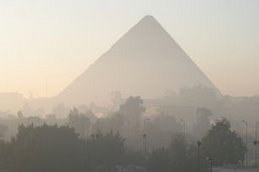
From the Pyramids of Giza to the Red Sea resorts, tourist numbers have plummeted to just a trickle, dealing a devastating blow to the millions of Egyptians whose livelihoods depend on the 14 million or so visitors who once thronged to the country.
At the height of the 18-day uprising that ousted president Hosni Mubarak, embassies issued travel warnings and many tour groups canceled their trips, throwing an industry that is a major source of foreign currency into crisis.
Two months later, the chaos has largely subsided, the police who deserted their posts during protests are mostly back on the job and the travel warnings have been eased.
But the tourists have yet to return, and Egypt's tourism minister has forecast the industry's 2011 revenue will be 25 percent lower than the previous year.
Sunday, April 24, 2011
Egypt tourism remains in disarray
Al Masry Al Youm


From Egyptian Museum to 'torture chamber'
Al Masry Al Youm (Ali Abdel Mohsen)
This is an article about allegations that the military used the museum for interrogating and possibly torturing people they arrested in Tahrir Square during the revolution but there are also sections discussing the status of the museum in the eyes of Egyptians following these alleged events. There is also an interesting mention of multiple break-ins by looters, one/some after February 11th. Here's an excerpt:
Despite the testimonies of Sobhy and others, many refuse to believe that the armed forces are perpetuating the human rights abuses of the previous regime by imprisoning, torturing and humiliating protesters within the walls of the nation’s most prominent cultural landmark. But regardless of the extent of brutality allegedly taking place on its grounds, there is little doubt that the role of the Egyptian Museum has significantly shifted during the revolution, in a way that mirrors the complicated and at times contradictory nature of the current Egyptian situation.
“The museum is clearly very valuable, and precious, to the Egyptian people,” said Fayza Haikal, a professor of Egyptology at the American University in Cairo. This value, though, is double-edged. Immediately following the withdrawal of police forces, the museum was seen as a jackpot for looters, whose pilfering was largely prevented by a brigade of volunteer civilians forming a human shield around the building.
“The museum was looted more than once, especially after 28 January and 11 February. Luckily, most of what was stolen was retrieved, and all that remains missing is a few smaller artifacts," Haikal said.
“The fact that civilians took it upon themselves to defend the museum from looters is an indication of how valuable it is to Egyptians. Both in terms of our historic wealth, and as a cultural icon."
Haikal seems to be among a minority who do not think the museum’s status as a “symbol of the Egyptian people” will suffer in the face of allegations that the institution is currently doubling as a “torture camp.”

Saturday, April 23, 2011
Lahun excavation is shut down
Ahram Online (Nevine El-Aref)
Hopefully further information will emerge to clarify the situation.
Hopefully further information will emerge to clarify the situation.
Excavations at the Lahoun archaeological site in Fayoum have been halted due to negligence of the excavators
The Permanent Committee of Egyptian Antiquities decided today to stop all excavation works being carried out by the Egyptian mission at Lahoun archaeological site in Fayoum.
The committee has also approved the decision taken by the archaeological mission which was sent in early March to inspect excavation works being carried out in Lahoun and the artefacts discovered there.
The archaeological mission was sent at the request of Zahi Hawass, who was then minister of state for antiquities affairs, and found that the site was subject to deterioration.
Ancient Coptic graffiti adorns walls of 3,200 year-old Egyptian temple
Unreported Heritage News (Owen Jarus)
A new research project led by Professor Jennifer Westerfeld, of the University of Louisville, is taking a look at a unique set of graffiti scribbled onto the walls of a 3,200 year old Egyptian temple.
The temple was built at Abydos by Seti I, a powerful pharaoh who pushed the borders of the Egyptian empire as far as modern day Syria. It contains two courtyards, two hypostyle halls, chapels and an enigmatic structure known as the “Osireion,” which may commemorate the Egyptian story of creation.
Today this complex is covered in a large amount of graffiti dating from ancient times up until the medieval period. Westerfeld believes that a community of nuns contributed to this defacement, writing on its walls around 1,500 years ago.
New site openings
drhawass.com (Zahi Hawass)
According to Hawass the following sites are to open soon. There are some notes about some of the sites on the above page.
According to Hawass the following sites are to open soon. There are some notes about some of the sites on the above page.
- The Hanging Church (Coptic), Cairo
- Suez Museum
- Crocodile Museum, Kom Ombo
- Visitor Centre, Amarna (Thanks to Claudia Ali for the correction)
- Zaghloul Mosque, Cairo
- Six Islamic-era houses, Rashid
- Salaheddin Citadel, Taba
- Qalawoun complexes in Al-Muizz Street, Cairo
- The mosque of Prince Soliman, known as the Hanging Mosque, Cairo
- The restored Serapeum, Saqqara
- New Kingdom cemetery (including tombs of Maya and Horemheb), Saqqara
- The restored Temple of Hibis, Kharga Oasis
Hawass faces criticisms about his job, ties to Mubarak
Washington Post (Philip Kennicott)
After two months of revolution and recrimination, which has seen him in and out of power, he is madly multitasking: Struggling to preserve ancient sites from theft and the encroachment of illegal construction, while working just as frantically to preserve his power base in a wildly shifting political landscape.
“I am not from the old regime,” Hawass says.
On March 3, with angry young archaeologists calling for his head, Hawass resigned from the top ministerial position given to him by now-deposed president Hosni Mubarak. That job not only made him powerful in Egypt, it also gave him sway over the careers of international archaeologists who work in this land of pyramids, temples, churches and mosques. But 27 days later, Hawass was put back in charge, because, he argues, no one else can do the job.
His position is far from secure. On Sunday, a criminal court convicted him for ignoring an earlier civil judgment brought against his ministry in a case involving concession contracts at the Egyptian Museum. It is likely only the first step in a protracted legal battle, and the sentence — a year in jail, loss of his post and a fine — hasn’t been enforced.
The ugly web of controversy in which he is embroiled, however, goes well beyond this latest contretemps, which Hawass describes as no more than a misunderstanding.
Hawass and the avoided prison sentence
Hawass has been figuring very prominently in the headlines at the moment, partly because of the clothing line he gave his name to (see post below) but mainly because of the prison sentence which he has now apparently escaped. A law suit had been brought against him for failure to comply with a court ruling regarding the gift shop in the Egyptian Museum in Cairo. The judgment and sentence were fought in a court of appeal and the the original court's ruling was overturned.
Articles and posts about avoiding the prison sentence:
Al Ahram Weekly (summary from the point of view of the Ministry of Antiquities, but before the results of the appeal had been announced)
Talking Pyramids (Vincent Brown's summary of the reasons for the original judgement, looking at the evidence)
drhawass.com (a statement by Zahi Hawass on the reprieve)
CNN (an overview of the reasons for the lawsuit and the arguments made at the appeal)
Africa Online (short summary)
Articles and posts about avoiding the prison sentence:
Al Ahram Weekly (summary from the point of view of the Ministry of Antiquities, but before the results of the appeal had been announced)
Talking Pyramids (Vincent Brown's summary of the reasons for the original judgement, looking at the evidence)
drhawass.com (a statement by Zahi Hawass on the reprieve)
CNN (an overview of the reasons for the lawsuit and the arguments made at the appeal)
Africa Online (short summary)
Hawass and the designer clothing line
Hawass again found himself under fire in the headlines, this time for selling his name to a clothes designer who launched a clothing line named after him, currently for sale in Harrods. Part of the furor was that seemed as though they had used the Egyptian Museum in Cairo to promote the new line, but Hawass and the team who took the photographs say that the photo shoot actually took place in the U.S. when the Tutankhamun exhibition was touring and that any of the objects handled or sat upon were replicas. The photographic team also confirms that a photograph of a model with a foot on an item was achieved with photo manipulation. He is quoted saying that all his income from the line will go to a children's cancer hospital in Cairo.
Al Ahram Weekly (a summary of the case for the defense)
New York Times (a good summary of the furor and a description of the line, together with one of photographs used to promote it)
Portable Antiquity Collecting and Heritage Issues (Paul Barford wonders if the world has gone mad, over-reacting to the Hawass-branded clothing line)
Egypt’s antiquities ministry releases first official replicas
Al Ahram Weekly (Nevine El-Aref)
A state monopoly on 1:1 reproductions?
A state monopoly on 1:1 reproductions?
The new Egyptian Minister of State for Antiquities Affairs (MSAA) production unit has just fabricated its first batch of replicas. The batch includes 130 replica statues depicting the unique collection of King Tutankhamun. The replicas are to be produced for tourists and hotels in Sharm El-Sheikh, which bought them from the MSAA for LE2.3million to be paid within 18 months.
Zahi Hawass, minister of state of the MSAA, stated that the newly created production unit is an implementation of the new antiquities law and its amendments, such as article number 36 of the law, which establishes the intellectual property rights and trade mark of the MSAA production of replicas. According to the law, the MSAA is the only foundation with permission to produce exact replicas on a 1:1 scale.
Ewart Hall antiquities, Cairo
Caravan, AUC
Caravan, AUC
Six unnamed suspects have been charged with the theft of 145 artifacts and 50 replicas allegedly stolen from a hidden storage area under Ewart Hall, Old Campus. An investigation has been launched by the Prosecutor’s Office after the AUC administration reported the case to the authorities in March.
Meanwhile, the administration has established its own Investigation Committee to look into the matter, according to a member of the Committee and AUC’s Legal Advisor, Karim Abdel Latif.
“We don’t know if more convicts will turn up [due to the investigation],” he said, adding that not all six defendants, who have been taken into custody, are AUC employees.
Last Tuesday, the administration sent out a press release verifying reports of “what appears to be the theft of antiquities,” yet refrained from any mention of the arrests.
Caravan, AUC
The Caravan’s investigation into the recent theft of antiquities has revealed that in a period spanning several decades AUC faculty and officials collected more than 1,600 artifacts described by Egyptology experts to be ‘of no great significance’ in value.
Ironically, the theft of some of these items brought to light the previously unknown cache stored beneath Ewart Hall.
Renowned Egyptologist and professor emeritus Kent R. Weeks told The Caravan that “the objects in Ewart Hall were acquired by then-President Richard Pederson, who for some reason thought it would be nice to have a teaching collection of antiquities on campus.”
Weeks said that all the objects were legally acquired by the university and registered at the Supreme Council of Antiquities (SCA).
Egypt court jails officials over Van Gogh theft
Los Angeles Times
An Egyptian court Thursday jailed five officials, including a former head of the state's fine arts department, over the theft of a Van Gogh painting worth an estimated $55 million, state media said.
"Vase with Viscaria" was stolen in August from Cairo's Mahmoud Khalil museum, home to one of the Middle East's finest collections of 19th and 20th-century art.
The state MENA news agency and court officials said the five had been found guilty of "causing the theft of the painting," without giving further details.
A very ancient Egyptian Easter: Sham El-Nasim
Ahram Online
Monday 25 April marks Sham El-Nasim, in the same breath as Easter. The rituals and beliefs associated with today’s Sham El-Nasim celebrations link it directly to ancient Egyptian feasts.
Celebrated since 2700 BC by all Egyptians regardless of their religion, beliefs, and social status, the name Sham El-Nasim (Inhaling the breeze) is derived from the Coptic language that, in turn, is derived from the ancient Egyptian language. Originally pronounced Tshom Ni Sime, with tshom meaning “gardens” and ni sime meaning “meadows.”
Like most ancient Egyptian feasts, Sham El-Nasim was also affiliated with astronomy and nature. It marks the beginning of the spring festival, which is the time they believed day and night are equal, (when the sun is in the Aries zodiac) hence marking the beginning of creation. They confirm the exact date annually by sighting the sun in relation to the great pyramid. Ancient Egyptians named it The Feast of Shmo (the revival of life) and have officially celebrated it since 2700BC.
Book Review: The Last Pharaohs
Scholia Reviews (Review by John Atkinson)
As usual the page will not display in Firefox but is fine in most other browsers.
Scholia Reviews ns 20 (2011) 8.
J. G. Manning, The Last Pharaohs: Egypt under the Ptolemies, 305-30 BC. Princeton: Princeton University Press, 2010.
As usual the page will not display in Firefox but is fine in most other browsers.
Scholia Reviews ns 20 (2011) 8.
J. G. Manning, The Last Pharaohs: Egypt under the Ptolemies, 305-30 BC. Princeton: Princeton University Press, 2010.
Manning, with numerous previous publications in the field of Ptolemaic studies to his credit, here plunges straight into the issues which he proposes to address, and dispenses with the customary historical survey of the Ptolemaic period. His brief historical introduction is entitled 'Egypt in the First Millennium BC’ (pp. 19-28), and picks up the story from the end of the New Kingdom, giving more space to Persian rule than to the period of Alexander and Ptolemy. This is appropriate as he identifies with the trend in scholarship over the last three decades to lay greater stress on Egyptian culture in the Ptolemaic era, and on Persian administrative practices (p. 2).
Photo for Today - Medinet Habu
Apologies for the late post, nearly a week after my previous one. I've been running around like a headless chicken for the last few days, partly with the launch of Egyptological and partly with making preparations for coming up to Wales for a couple of weeks and meeting up with old friends over the last two days before going off somewhere else in Wales tomorrow. It has been somewhat chaotic to say the least! Things have calmed down a lot now.
A very happy Easter to all who celebrate it.
You may find the posts somewhat Hawass-laden due to the twin controversies of the court case and the clothing line, but this was unavoidable.
A very happy Easter to all who celebrate it.
You may find the posts somewhat Hawass-laden due to the twin controversies of the court case and the clothing line, but this was unavoidable.

To complement Owen's story about Coptic graffiti I have
chosen a photograph of the some of remains of the Coptic town of Jeme today.
Jeme was built into the remains of Medinet Habu,
and fragments of it remain in mudbrick, surrounding
the temple precinct.
chosen a photograph of the some of remains of the Coptic town of Jeme today.
Jeme was built into the remains of Medinet Habu,
and fragments of it remain in mudbrick, surrounding
the temple precinct.
Sunday, April 17, 2011
Blog update
You will find today's news posts underneath the announcement about the launch of Egyptological, which was originally posted yesterday lunchtime (and which I wanted to keep near the top for obvious reasons!).
Egyptological launches
After several months of development Kate Phizackerley and I are very pleased to announce that we are ready to invite writers and photographers to contribute to the first issue of our free online magazine, Egytpological. There is some sample content published already, so do give it a look.
 In order to appeal to a wide audience Egyptological is divided into three main sections - Journal, Magazine and Colloquy - representing academic and more popular interests. As well as articles we will publish book, conference, exhibitions and DVD reviews. Have a look at the sample articles in some of the sections to give you an idea about what sort of material we hope to attract.
We are aiming to publish issues every two to three months in the Journal and Magazine sections, but we will add brief pieces and short reviews to Colloquy as they become ready.
If you represent an Egyptology society have a look at our Events calendar and let us know if you would like us to add upcoming activities, study days or lectures. Our Photo Album section is aimed at readers who would like to share their photographs with readers for an issue.
Finally we have two projects under construction, both of which are part of the Egyptological family of websites – Hieropaedia and Egyptopaedia. Hieropaedia is currently available for use and will be developed further. It includes hieroglyph plug-ins for WordPress which will be essential if you want to use hieroglyphs on Egyptological, but can be used anywhere on WordPress and will eventually become available for other platforms. We are developing Hieropaedia as a portal for anyone learning and using hieroglyphs. Egyptopaedia will be our Encyclopaedia of Egyptology. Read more about it on the Egyptopaedia page on our website.
If you are either an experienced writer or just starting out, and would like to contribute to Egyptological we would be interested to hear from you. If you have already talked to us about contributing we will be in touch with you individually. To find out more about contributing, see our detailed guidelines in the Write For Us and Contribute Photos sections on the site.
We are looking for volunteers to help us run Egyptological and Egyptopaedia and to assist with editing and translations. If you have an interest in Egyptological and have a little time have a look at our Volunteers Wanted page.
If you want to keep an eye on our progress you can follow us on Twitter or subscribe to RSS via our Follow or Subscribe page.
To see more about Egyptological see our About section. To find out more about Andrea Byrnes and Kate Phizackerley see our Founders section.
Egypt's Antiquities Caught in the Revolution
The Middle East Quarterly, Spring 2011, pp. 73-78 (Alexander H. Joffe)
The initial spasm of images from the Cairo Museum shocked observers. As tens of thousands of demonstrators confronted the security forces in what quickly evolved into the first popular revolution in Egypt's history, the museum was ransacked in a scene reminiscent of the looted tombs of ancient Egyptian kings. A statue of Tutankhamun astride a panther was ripped from its base but then cast to the floor when thieves discovered it was gilded and not solid gold. A boat model from a tomb was smashed, the figures huddled in the boathouse pulverized but the navigator at the bow still pointing sadly forward. Two mummies were beheaded, mouths agape; it was rumored that they were Tut's grandparents.
At the Cairo Museum, a statue of Tutankhamun astride a panther was ripped from its base but then cast to the floor when thieves discovered it was gilded and not solid gold.
The extent of the chaos was unknown but ominous. Egypt's antiquities were suddenly caught up in a revolution. But those antiquities have always been both a tool to create Egypt and Egyptians in the present as well as a telling map of Egyptian society.
Conflicting Narratives
A second narrative quickly appeared. In this one, the police, military, and most importantly "everyday Egyptians," joined together to protect museums and sites. Farid Saad, a 40-year-old engineer, was quoted as saying, "I'm standing here to defend and to protect our national treasure."[1] The nation was united in protection of its past.
More work by the EES Delta Survey
EES Delta Survey
With photos.
With photos.
Thursday again and the last working day of the week. We’ve continued investigating some of the high mud-brick walls, though some of the chunks of what look like mud-brick are deceptive. In some cases what has survived is a wall with fill beside it which contains some fallen or displaced bricks, but isn’t actually part of an articulated wall itself. It is just what was left when people stopped work, digging away the mud bricks to use as fertiliser on the fields.
Although the site has many low mounds which (on the surface at least) appear to contain mainly burned bricks, there are no extant red brick walls standing on the site, though there are a few chunks of burned brickwork on the surface.
New research shows 3,500 year old tomb contained infants who suffered from disease, Valley of the Kings
Unreported Heritage News (Owen Jarus)
It certainly wasn’t a tomb for a pharaoh.
New research presented recently at the annual meeting of the American Research Center in Egypt (ARCE) shows that a tomb in the Valley of the Kings, KV 44, contained the remains of infants who were suffering from disease. The skeletons of adult women were also found but no men.
The tomb was first discovered in 1901 by Howard Carter who found it to be looted and containing “rubbish.” Its design is remarkably simple, consisting of a shaft entryway and chamber with no apparent decoration on the walls.
It was constructed at some point during Egypt’s New Kingdom period (3,500 to 3,100 years ago), a time of great prosperity that saw the valley become populated with the tombs of pharaohs. During the 22nd dynasty (around 2,900 years ago) it was re-used, housing a woman named Tentkerer.
In the 1990’s a team led by Professor Donald Ryan, of Pacific Lutheran University, excavated the tomb and found skeletal remains. Recently another team led by Dr. Jerome Cybulski, of the Canadian Museum of Civilization, examined the skeletons and made some surprising finds.
Returned Shabti Wrongly Identified
Talking Pyramids (Vincent Brown)
The four stolen museum pieces that were recently recovered have already caused quite a stir in the couple of days since their mysterious return. News reports have mocked the official story which stated that they were “accidentally” found in an unidentified black bag at the subway by an employee of the Ministry of State of Antiquities Affairs (MSAA). Bloggers and Egyptologists have also been scratching their heads over this astounding account of recovering these four items.
British archaeologist Paul Barford took issue at the report’s claim that the shabti was returned “undamaged” when there is clearly a long crack down it’s front. Paul noticed this crack is not apparent in images of the shabti taken prior to it’s theft and seems to has appeared since then.
Egyptians continue protecting their ancient heritage
The Art of Counting
There is no doubt that many Egyptian sites have suffered terribly in the last months, and there is really no way of knowing what we have actually lost. Information unrecorded and objects not photographed are truly lost when destroyed. However, it seems that control is being regained. Dr. Hawass has already petitioned the Egyptian authorities to remove all illegal constructions that have been erected during this unsettled time, foreign archaeological expeditions have returned (such as those at Saqqara and Abusir) to assess their sites or never stopped working in the first place, and tourists are again visiting Egypt’s museums and monuments. More data will continue to emerge from archaeological expeditions and antiquities authorities; much of it will surely be devastating to hear, but it is a relief to have verified information after weeks of rumors. No matter what, we must be grateful for what has survived the millennia and all the events that separate their context from ours.
Egypt’s Chief Archaeologist Defends His Rights (and Wrongs)
Biblical Archaeological Review (Hershel Shanks)
On Sunday, January 16, I interviewed Zahi Hawass in his office in Zamalek, the elegant Cairene island in the Nile and home of the Gezira Sports Club, from which Hawass commanded an army of 32,000 employees as secretary general of the Supreme Council of Antiquities. The following Thursday, I left Egypt. And five days later the mass protests erupted that would topple the government of Hosni Mubarak. As part of an effort to save his thoroughly despised regime, Mubarak appointed Hawass Minister for Antiquities. One blogger described Hawass’s appointment this way: “Zahi Hawass, the bombastic, clownish pseudo-archaeologist who has tyrannized, bullied, and manipulated Egyptologists and Egyptian Villagers alike for years now, today officially accepted President Hosni Mubarak’s appointment as Minister of State for Antiquities.” On March 3, Hawass resigned but was reappointed in March (see sidebar).
But my interview with Hawass was before all this. True, Hawass was widely vilified—but also widely admired. The New Yorker called him the “international star of Egyptology … at the intersection of archaeology, show business and national politics.”
The New York Times, on the other hand, had characterized him as “obnoxious.” He threw “tantrums,” the Times said, at his subordinates. I was also aware, as the Times put it in another article, “He has been taken to task for his critical statements about Jews.”
I found him confident, overbearing, domineering, brash and loud. But he was also sometimes reasonable and often even charming.
Rumors About a Tunnel Between the Cairo Museum and AUC
drhawass.com (Zahi Hawass)
Over the last few months I have heard many rumors that no one ever mentioned before. Lately I have heard a story that there is a tunnel that runs from the Cairo Museum to the campus of the American University in Cairo in Tahrir Square. People are saying that this imaginary tunnel is used to take antiquities from the Museum to the University to be stored at the University. I used to laugh when I heard this rumor, because it is not true and I do not know where people come up with these stories.
I think I have found a possible basis for where this story came from.
Video: Nicholas Reeves - Behind the Mask of Tutankhamun
You Tube
See the video on the above page. Here's the caption:
See the video on the above page. Here's the caption:
Nicholas Reeves, Sylvan C. Coleman and Pamela Coleman Memorial Fellow, Department of Egyptian Art, The Metropolitan Museum of Art
The magnificent gold headpiece from Tutankhamun's tomb is the best-known Egyptian artwork in the world today. Hear Nicholas Reeves discuss recent scholarship on this exquisite mask, as he reveals the astonishing secret of this object's original intent.
Online Resource: Baked Clay Figurines and Votive Beds from Medinet Habu
The Oriental Institute
Baked Clay Figurines and Votive Beds from Medinet Habu
Emily Teeter
Baked Clay Figurines and Votive Beds from Medinet Habu
Emily Teeter
This catalog presents the entire corpus of 272 baked clay figurines and votive beds excavated at Medinet Habu in Western Thebes by the Oriental Institute of the University of Chicago during its 1926-1933 campaign. The figurines represent women, women with children, men, deities, and animals. They date from the sixteenth century B.C. to the ninth century A.D., illustrating permanence and change in themes of clay figurines as well as stylistic development within each type. The group of votive beds and the small stelae made from votive bed molds are among the largest and most diverse collections of such material. Each object is fully described and illustrated and is accompanied by commentary on construction, symbolism, and function.
Hawass meets employees
Ahram Online (Nevine El-Aref)
During his meeting today with representatives of the employees of the Ministry of State for Antiquities Affairs (MSAA), Zahi Hawass as minister discussed the current issues facing the organisation. The meeting discussed how to improve the ministry, to raise salaries, and secure better health insurance and other benefits.
“We are also planning to enforce stricter rules concerning bonuses, which will be granted only to hard workers,” Hawass told employees, adding that the ministry will also equalise its pay scale, so each position earns a fair salary according to effort. A finance committee has also been created to investigate how to raise salaries.
Hawass announced during the meeting that the ministry will give scholarships to employees based on qualifications, also taking into consideration those with special needs or health issues.
Photos of scans looking for mummy disease
National Geographic
Slideshow.
Slideshow.
An unidentified Egyptian mummy dated back to between 688 and 332 B.C. slides into a CT scanner as part of a recent study of ancient disease.
The mummy was among 52 from the Egyptian Museum in Cairo subjected to medical scanning by a joint U.S.-Egyptian team. The tests revealed that almost half of the dead have clogged arteries associated with a condition called atherosclerosis, which can lead to heart attack or stroke.
One of the mummies, a princess who died about 3,500 years ago, is now the oldest known case of the arterial disease, the researchers say.
"If the princess was in a time machine and I was to see her now, I would tell her to lay off the fat, take plenty of exercise, then schedule her for heart surgery," said study co-leader Gregory Thomas, a professor of cardiology at the University of California, Irvine. "She would require a double bypass."
Egyptology News goes audio!
You can now listen to Egyptology News. I am very interested in making online content available for the visually impaired so I have added an Odiogo feed to Egyptology News. Thanks to Kate Phizackerley for pointing me at Odiogo.
Just click on the "Listen Now" icon at the head of each post to listen to it.
 The voice used is male and American whereas I am female and English, but that scarcely seems to matter! This seems like an excellent solution and I hope that people find it useful. The only serious downside is that I only post experts from articles so if you want to gain access to the entire article you will still need to click the link to go to the source, which is very unlikely to have an audio option. Still, rather better than nothing!
So far Odiogo seems to be doing a great job of dealing with Egyptian and other difficult names. I was worried about how it would handle block quotes but it picks them up, announcing opening and closing quotes to let you know which material is quoted and which isn't. For anyone planning to use the audio alternative instead of reading the text it will be helpful to have a good grasp of how I format the content on the blog in order to listen out for the title, the source website, any comments and the block quote etc.
I hope that we will be able to add something for Egyptological eventually.
If you try it, or pass it on to someone visually impaired to try, please can you let me know how you or they get on with it? I would be most grateful for any feedback. andie [at] oddthing . co. uk.
Video re recovery of the four items found in subway
The Telegraph, UK
This video and various photographs show officials handling objects without protective object-handling gloves. On the video there is not a glove in sight when handling the gold Tutankhamun statuette.
Disappearing desert at the Sinai borders
Discovery News (Emily Sohn)
This focuses on the environment but the area is also rich in prehistoric archaeology.
This focuses on the environment but the area is also rich in prehistoric archaeology.
On the Egyptian side of the Israel border near the Gaza Strip, armed soldiers pace along barbed wire fences, which stand three layers thick in some places, while Israeli soldiers look out from their own towers on the other side.
The goal of this high-security border is to keep out intruders. But the barriers have begun an unintentional experiment on the ability of ancient deserts to survive tough political times. And so far, things are not looking good for the desert and its creatures.
Thanks to an arbitrary line drawn in the sand, Israel's dunes are starting to crust over with green algae that make the sand hard and crunchy. Egypt's dunes, on the other hand, remain soft, yellow and rippled -- mainly because nomadic Bedouins are still allowed to graze their sheep and goats there.
The contrast is so stark that, in satellite images, the sharp yellow-green line is the most visible border in the world from above, said Yaron Ziv, a landscape ecologist at Israel's Ben-Gurion University of the Negev.
Photo for Today - Sekhmet at Medinet Habu

Sekhmet, positioned opposite yesterday's statue
Fractionally less battered Kat? :-)
Thursday, April 14, 2011
Four items returned to the Egyptian Museum
Luxor Times
With photos showing the state of the objects on their return.
SCA Press Release
Ahram Online (Nevine El-Aref)
With photos showing the state of the objects on their return.
Four objects missing from the Egyptian Museum since the January Revolution have been returned, announced Dr. Zahi Hawass, Minister of State for Antiquities.
The objects returned include the gilded wooden statue of Tutankhamun standing in a boat throwing a harpoon (JE 60710.1). The statue suffered slight damage; a small part of the crown is missing as well as pieces of the legs. The boat is still in the Museum, and the figure of the king will be reunited with it and restored.
SCA Press Release
Four objects missing from the Egyptian Museum since the January Revolution have been returned, announced Dr. Zahi Hawass, Minister of State for Antiquities.The objects returned include the gilded wooden statue ofTutankhamun standing in a boat throwing a harpoon (JE 60710.1). The statue suffered slight damage; a small part of the crown ismissing as well as pieces of the legs. The boat is still in the Museum, and the figure of the king will be reunited with it and restored.
The second returned object is one of the 10 missing shabtis of Yuya and Tjuya (JE 68984). It is still in very good condition; it does not require restoration and will be placed on display again immediately, stated Dr. Tarek El-Awady, Director of the Egyptian Museum.
The third object is the gilded bronze and wooden trumpet of Tutankhamun (JE 62008). It was also received in excellent condition and will be put on display immediately. Also returned was a part of Tutankhamun’s fan. One face is in good condition while the other has been broken into 11 pieces. Part of the royal fan JE 62006 still missing.
Ahram Online (Nevine El-Aref)
Salah Abdel Salam, a public relation personal at the MSAA, came upon these objects during his daily trip to work on the Metro. He related that he accidently found an unidentified black bag placed on a chair in the Shubra Metro station. Doubtful that the bag was concealing an explosive, Salah opened it and found the Tutankhamun statue gazing up at him. He took the bag and handed it over to the MSAA.
Hawass told reporters that he is calling on all Egyptians to return any objects that they have found. He emphasised that the MSAA will not file any law suit against them but instead will compensate them.
“If anyone is afraid of handing over such objects they can put it at the MSAA entrance gate or the Egyptian Museum’s door and we will take care of them,” announced Hawass.
Military arrests 6 men for illegally excavating artifacts
Al Masry Al Youm
Armed Forces personnel arrested two students and four workers on Sunday for excavating artifacts west of Cairo in 6th of October City, according to security sources.
Preliminary investigations showed the suspects formed a group for excavating monuments during a lack of security presence in the country.
On Sunday morning, the suspects went to an ancient cemetary in a village called Beni Suef, part of 6th of October City, where soldiers noticed them digging. They were immediately arrested and referred to prosecutors, who sent them to jail while investigations are carried out.
The tomb of Senemiah (TT127) now on OsirisNet
OsirisNet
Happy Birthday to OsirisNet, which has now been going for 10 years, from April 2001 to April 2011. To celebrate the event, they have updated OsirisNet with an unpublished tomb, that of
Senemiah.The tomb TT127 is, at first sight, only a little inviting, blackened by human occupation. However, it includes decoration in relief of a remarkable level. Created by Senemiah, at the time of Hatshepsut-Thutmosis III, it would be reused (but non usurped) during the Ramesside period by Piay and Pairy, who completed and added decor without altering what had already been produced.
Even though the photographic coverage is far from being complete, this tomb is a good example of the help which OsirisNet can bring, even when nothing or nearly nothing exists for a monument. We do this in the hope, on the one hand, to provide an attractive visit, on the other hand to attract to it the attention of the professionals, and finally to modestly contribute to its preservation.
http://www.osirisnet.net/tombes/nobles/senemiah127/e_senemiah127.htm
Roland Tefnin (in the publication "La peinture égyptienne, un monde de signes à préserver") estimated (in 1994), that about only 3% of the Theban tombs had made the object of true scientific publication, the others having to be content with old monographs or quotes, and that 1/3 were completely unpublished. It is very probable that these numbers have not changed much since that time, and it is obvious that the traditional system of publication of the tombs showed its limits, while the deterioration of the monuments, themselves, doesn't slow down.
The solution exists nevertheless, which is simple and less expensive: to photograph correctly all these monuments and to put the images (free) on the Internet, so that the scientists use them for study, and everyone can admire them.
Investigating a monumental wall
EES Delta Survey
We spent most of our time on site today investigating the large chunk of mud brickwork which first aroused our interest in the site when we visited it in 1990. It is shown in the photograph of Jeff with Sabri Abdel Aziz in the first update for this season, and has clearly articulated mud bricks on its eastern exposed side, though this is not the original face of the wall, but is within its original core.
New Book: Qasr Ibrim: The Textiles from the Cathedral Cemetery
Egypt Exploration Society
The Egypt Exploration Society’s new title, Qasr Ibrim: The Textiles from the Cathedral Cemetery by Elisabeth Grace Crowfoot is now available to order.
Elisabeth Grace Crowfoot is an expert on ancient textiles and in 1976 she was invited to join the Egyptian Exploration Society’s expedition to Qasr Ibrim, after having worked in Cambridge on textiles from the Ibrim seasons in the 1960’s. She worked with the expedition until 1984, analyzing, sorting, washing and cataloguing textiles as they were excavated, assisted in the field by Nettie Adams. Miss Crowfoot had completed this text before her death in 2005 and it has been edited for publication by Nettie Adams.
The dry height of the site of Qasr Ibrim above the Nile river has resulted in superb preservation of organic material. The textile collections from the excavations have already become one of the largest from any site in the middle Nile valley. They are unique as an unmatched sequence, dating from the Twenty-Fifth Dynasty to the Late Ottoman Period and ranging from the domestic remains of town life and tiny exotic imports of the site’s great years to the cast off garments and furnishings, pitifully mended and re-mended, from ages of disaster and decline.
Sad News - Lewis Binford
I was very sad to read on Tony Cagle's Archaeoblog that Lewis Binford has passed away. Not familiar name in Egyptology he was, however, a landmark in his own right in Anglo-American archaeology. His influence on how modern archaeology evolved was remarkable, partly due to the discussion and controversy he inspired. See Tony's blog for links to obituaries.
A shameless plug for the a Bloomsbury Study Day on the Hyksos (London, UK)
Bloomsbury are reinstating their annual study days. This year's will take place in London on Saturday May 14th: The Hyksos Legacy: Technology, Arts and Culture in the Age of the Chariot with Dr Stephen Harvey as the principal lecturer.
This study day will examine the legacy of the Hyksos and other foreign influences on Egypt in the developing empire of the New Kingdom. Once seen as mysterious invaders from the East, the Hyksos may now be regarded as important catalysts for technological and cultural change in Egypt. The Hyksos Period in Egypt represents about a century of foreign rule by settlers and occupiers from the Levant (ca. 1650-1525 BCE). Perhaps best known for their apparent introduction of the horse and chariot to Egypt, the Hyksos rulers seem to have been responsible for introducing a wide series of technological innovations, including glass making, metallurgical technologies, and the use of the compound bow, while the Canaanite religion of these people was in part adopted within the Egyptian pantheon. Following the defeat of the Hyksos, Egypt expanded the borders of her empire, and engaged in vigorous international diplomacy, warfare, trade and exchange of ideas, building on the innovations developed in response to Hyksos influence.
For further details: http://www.egyptology-uk.com/bloomsbury/study_days.htm
This study day will examine the legacy of the Hyksos and other foreign influences on Egypt in the developing empire of the New Kingdom. Once seen as mysterious invaders from the East, the Hyksos may now be regarded as important catalysts for technological and cultural change in Egypt. The Hyksos Period in Egypt represents about a century of foreign rule by settlers and occupiers from the Levant (ca. 1650-1525 BCE). Perhaps best known for their apparent introduction of the horse and chariot to Egypt, the Hyksos rulers seem to have been responsible for introducing a wide series of technological innovations, including glass making, metallurgical technologies, and the use of the compound bow, while the Canaanite religion of these people was in part adopted within the Egyptian pantheon. Following the defeat of the Hyksos, Egypt expanded the borders of her empire, and engaged in vigorous international diplomacy, warfare, trade and exchange of ideas, building on the innovations developed in response to Hyksos influence.
For further details: http://www.egyptology-uk.com/bloomsbury/study_days.htm

Monday, April 11, 2011
Around 1000 items stolen during uprising
Google / AFP
Thieves stole around 1,000 relics from museums and archeological sites across Egypt since protests against the government broke out in January, Egypt's minister for antiquities Zahi Hawass said Sunday in a newspaper interview.
"We are investigating all the incidents to find the items. Up until now we have identified many culprits, criminals who were looking for gold or mummies and who lacked knowledge of the value of the items they stole," he told Spanish daily El Mundo.
"They were not organised, they lived near the archeological sites where the objects were kept. They would take advantage of the night to enter the archeological sites and pillage," he added.
"About 1,000 objects were stolen, none of them major items. There is an inventory of everything and it will be difficult for the items to leave the country."
Events at Giza
drhawass.com (Zahi Hawass)
There is an area in the desert, about 2 or 3 kilometers away from the pyramids at Giza, which was used as a camp by soldiers during the 2nd World War, and they left behind the remains of ammunition and other things. When it rained heavily in Cairo last week, the rain began to wash away the sand and these remains began to appear on the surface. A group of people who are horse and camel drivers from the pyramids area found some of unused ammunition and brought it back to the Giza area.
We know that during the troubled times of the Revolution, some of these people who own horses and camels near the pyramids began to move into the Giza area, and they even began to use the ancient tombs as stables for their horses and camels! The police were not there to stop them, so they were able to do whatever they like. Three of them brought the ammunition they had found in the desert and near Giza it detonated and injured the three men.
New Egyptian era, new complaints section
Ahram Online (Nevine El-Aref)
A new department has been established at the Ministry of State for Antiquities Affairs (MSAA) to receive complaints against ministry employees.
Zahi Hawass, Egypt’s minister of state for antiquities affairs, said that the administration will look into and review all complaints and suggestions to develop the MSAA. Archaeologist, Magdi El-Ghandour, director of the archaeological documentation centre, will lead these efforts.
Minufiyeh survey comes to a close
EES Minufiyeh Survey (Joanne Rowlands)
The season drew to a close on 7 April and, as always, the last few days of work were hectic, and included report writing, and packing up things in the flat in Shibin and returning everything to the storage facility. On 5 April, we spent the day with Ashraf Senussi, looking at the ceramics from this season and then making photographs of all of the diagnostic sherds that have been drawn. Ashraf chooses one of each type of vessel to describe in detail, analyse and draw and then he will list the number of other occurrences of the same type.
Of pyramids and protesters
Newsweek (Peter Der Manuelian)
“There’s the Great Pyramid. Since you are new here, please go over to the entrance and try to bribe the guard to let you spend the night in the King’s Chamber.” This was my first encounter as a student Egyptologist with Zahi Hawass, 34 years ago. He wanted to test the loyalty of the pyramid police (fortunately, they showed not the slightest interest in my “offer”). Even back then, as a young antiquities inspector at Giza, Hawass had a concern for protecting Egypt’s monuments, a concern that only grew in the past decade with his meteoric rise as the most famous (some would say infamous) face of Egyptian archeology. What a whirlwind these last few months have been, as he, like many of us, was caught off guard by the Egyptian revolution. Hawass’s status and that of the ancient sites and monuments have swayed somewhat precariously since January; both could be metaphors for the tumultuous and uncertain birth of a new and, it’s hoped, democratic era for all Egyptians. If the culture of despair, fear, and inequality can truly be lifted, then the world might witness the vast potential of the Egyptian people.
Tourists return to Egyptian Museum
Al Masry Al Youm
Ahram Online (Nevine El-Aref)
Four tourist groups visited the Egyptian Museum in Tahrir Square following its re-opening on Sunday morning. The Museum was secured from both the inside and out following the government's decision to re-open the museum to international and local tourism.
The Egyptian authorities had closed the Egyptian Museum on Saturday after bloody clashes erupted between the armed forces and demonstrators. The latter were staging a sit-in at the square to demand that deposed Egyptian President Hosni Mubarak be brought to justice.
In a statement on Sunday, Egyptian Minister of State for Antiquities Zahi Hawass said the Egyptian Museum is completely secure.
Ahram Online (Nevine El-Aref)
Today the Egyptian museum in Tahrir re-opened its door for visitors after closing for a day after violence erupted in Tahrir Square and the military allegedly attacked protesters.
The media rumoured that the museum would close until further notice, however, Zahi Hawass, minister of state for antiquities affairs, confirmed that today at 9:00am five tourist groups from different nationalities visited the museum and toured freely around its halls.
Coptic and Islamic Museums closed
Thanks to Luxor Times for the information that the Coptic and Islamic Museums in Cairo have been closed on a temporary basis, apparently because they considered to be less secure than the Egyptian Museum.
Photo for Today - Medinet Habu, Temple of Ramesses III


Mortuary Temple of Ramesses III at Medinet Habi,
West Bank, Luxor.
First Pylon, showing Ramesses III engaged in
smiting enemies before deities
(Ra-Horakhty and Amen-Ra)
West Bank, Luxor.
First Pylon, showing Ramesses III engaged in
smiting enemies before deities
(Ra-Horakhty and Amen-Ra)
Sunday, April 10, 2011
Egyptian Museum closed following clashes
Al Masry Al Youm
Authorities closed the Egyptian Museum on Saturday after at least two demonstrators were killed when the military dispersed a peaceful sit-in in Tahrir Square. The demonstrators were demanding the prosecution of ousted president Hosni Mubarak and other figures from the toppled regime.
Egyptian Minister for Antiquities Zahi Hawass said in a statement that the museum, located in Tahrir, was closed due to “the events that have been taking place in Tahrir Square and the area surrounding the museum, as a precaution to secure the museum and visitors."
The statement quoted Tariq Al-Awadi, director of the museum, as saying its re-opening will be coordinated with the Armed Forces, adding that the building has not been affected.
On Saturday, demonstrators hurled stones at troops stationed near the museum, which is widely believed to contain chambers for the military police.
Saturday, April 09, 2011
145 Islamic artifacts stolen from AUC
bikyamasr
Egypt`s Minister of State for Antiquities Zahi Hawass said on Tuesday that around 145 Islamic artifacts were stolen from the American University in Cairo in March.
He said in a statement that along with the artifacts, 50 other replicas were stolen from a storage house belonging to the University.
Hawass added in his statement that the thefts took place between March 15 and March 17, saying that after an inventory, 145 artifacts and 50 replicas were found to be missing.
More on the Norwich Shroud - Ancient Egyptian spells for a high-ranking lady
British Museum (John Taylor)
In the last few weeks the shroud of Ipu has given up more – but not all – of its secrets. A close comparison of the piece belonging to Norwich Castle Museum with a photograph of the portions in the Cairo Museum has shown that the torn edges certainly join. The Cairo fragments have parts of spells from the Book of the Dead, some of the missing words of which are supplied by the piece belonging to Norwich.
All of the texts on the Cairo pieces have been published by Irmtraut Munro, and I have now identified those on the Norwich section. So we can now say that the shroud contained the words of at least 23 spells, and it is possible that others were originally present, which are now lost.
The texts on the Cairo portion include spells to allow the dead person freedom of movement, air to breathe and the ability to control one’s heart. There is also a self-contained group known as the ‘Transformation Spells’, which enabled the dead to assume different forms, including those of a falcon, a heron, a swallow and the god Ptah.
GE Healthcare Gives CT Scans to Mummies
Today's TMJ4 (Jesse Ritka)
They have been dead for thousands of years, but some very special patients could still help save lives. They date back to 250 B.C. but they still have access to the latest in CT scan technology.
Nilesh Shah of GE Healthcare CT Scans tells TODAY’S TMJ4 Jesse Ritka "These are built for living patients to help them and get treated better but now they get mummies scanned. We tell patients when they are being scanned to hold their breath I guess we don't have that problem with the mummies, they are very still."
A selection of mummies from the Mummies of the World Exhibit may be thousands of years old but scientist at the GE Healthcare Campus in Waukesha hope their ancient remains help the patients of tomorrow.
Researchers found a circular hole on a CT scan of one of the mummy’s sculls, it could be evidence of early Egyptian brain surgery.
Photographs of discovery of puppy mummies
National Geographic
Photographs on the above page.
Photographs on the above page.
As part of the first full excavation of Egypt's ancient Dog Catacombs, scientists examine 2,500-year-old animal remains—a small sample of the roughly eight million animal mummies in these tunnels.
Likely supplied by ancient puppy mills, most of the mummies are dogs, and many were just hours old when taken for mummification, according to new research based on the summer 2010 excavation.
Snaking beneath the desert at the ancient royal burial ground of Saqqara (map), the Dog Catacombs were discovered more than a century ago. But only now is research shedding light on the massive number of mummies found in this complex of tunnels and chambers dedicated to Anubis (picture)—jackal-headed god of the afterlife.
Poorly mummified and piled high, the carcasses long ago deteriorated into indistinct heaps, experts say.
Hawass sworn in as Minister of Antiquities, again
Egypt State Information Service
Minister of Antiquities Zahi Hawas took on Monday 4/4/2011 the constitutional oath in presence of the head of the Supreme Council of the Armed Forces Field Marshal Hussein Tantawi.
After the swearing-in ceremony, Hawas and Tantawi discussed new ideas to develop the performance of the newly-formed ministry.
Tantawi underlined the importance of coordinating with international bodies concerned to protect Egypt's monuments and restore those stolen abroad.
Hawas expressed appreciation for re-assigning him to hold the antiquities profile, saying he agreed with Tantawi that the immediate removal of all encroachments on antiquities' lands would be on the top of his priorities.
He said he will make a list of all transgressions and will set a timetable for removing them.
He also promised to work in coordination with the Armed Forces as well as the tourism and antiquities police to restore all stolen monuments.
Hawas added he will continue the construction of the national projects that were suspended because of the latest events in Egypt and will open the already-finished ones, including the Hanging Church and Suez National Museum.
Egyptian authorities stop truck driver from smuggling antiquities to Jordan
Al Masry Al Youm
Egyptian authorities arrested a Jordanian truck driver as he attempted to smuggle 107 Pharaonic and Islamic artifacts from Nuweiba into Jordan at dawn Thursday.
The suspect had 40 metal statuettes, 52 amulets, five wooden masks and other artifacts including a copper vase and four metal shields.
Ramsess II's last journey
Ahram Online (Nevine El Aref)
Downtown Cairo did not sleep last Friday night. Its streets were enlivened with the scene of a huge carnival, with hundred of thousands of Cairenes leaving their homes to line the pavements and bridges as they bade farewell to the red granite colossus of the 19th-dynasty Pharaoh Ramses II. The colossus, the central point of Bab Al-Hadid Square since 1954, was now making the overnight journey to its new home at the Grand Egyptian Museum (GEM) overlooking the Giza Plateau.
As the 'royal' cavalcade rolled through the streets, where thousands of policemen were deployed in a bid to form a cordon allowing for the safe passage of the convoy, people stood at their windows and balconies waving, clapping, whistling and ululating to greet the pharaoh, while others climbed buses, cars and buildings trying to catch the last glimpse of this familiar downtown landmark.
Damage to Egypt’s antiquities cannot justifify refusal to repatriate items
elginism
A lot has been made in some news sources, of the amount of damage (or potential damage, because at the time that things like this are reported, it is often hard to make a full assessment) done to the collections of museums in Egypt during the recent protests there. Many sources then jump straight on to the next conclusion that this means that it is right to keep disputed Egyptian artefacts in the big museums of the West, despite the fact that even a year ago these riots could not be anticipated & that no one appointed certain big museums as official custodians of global culture.
Further to this, there is of course the fact that artefacts aren’t necessarily safe in any country.
One promising thing though, is that while some rioters were vandalising the museums, many more Egyptian citizens were making every effort they could to try & protect these places from damage.
The search for gold in the Egyptian Museum
Ahram Online (Zahi Hawass)
Archaeologists spend their lives excavating sites and making major discoveries, and at the end of their dig seasons they bring all of their finds to the Egyptian Museum in Cairo. I, myself, used to come to Cairo all the time when I was excavating at Kom Abou Bellou in the Delta. For more than six years I would come with trucks full of treasures, such as statues and gold jewellery.
Now, for the first time, the Egyptian Museum was broken into by a group of criminals who tried to steal from their own country in an attempt to ruin the revolution for freedom and democracy. I visited the museum the morning after the break-in and at first glance it did not look like any items were missing: all of the masterpieces seemed to be in place. There were many broken objects scattered throughout the galleries and it appeared that the criminals just broke cases and threw objects on the ground. I believed then that nothing had been stolen.
Photo for Today - last one from Deir el Medina

View from the village up
towards the workmens' tombs
Sorry Tim - this is the last one of the village for the time being!
towards the workmens' tombs
Sorry Tim - this is the last one of the village for the time being!
Tuesday, April 05, 2011
Mummy Royalty Show Signs of Clogged Arteries
Science (Heather Pringle)
Bloomberg (Pat Wechsler)
LA Times (Thomas H. Maugh II)
Kansas City Star (Alan Bavley)
In the ancient tomb paintings of the Nile Valley, Egypt's nobility often appears lithe, beautiful, and, above all, healthy. But researchers have long doubted that life at the top of the social pyramid in ancient Egypt was quite so rosy. At least as early as 1500 B.C.E., Egyptian physicians observed symptoms of angina, heart attacks, and congestive heart failure in patients and recorded them in medical papyri. Yet they gave little indication of how often they saw such cases.
Now a team led by cardiologists Adel Allam of the Al Azhar Medical School in Cairo and Gregory Thomas of the University of California, Irvine, has conducted the broadest and most detailed study yet of atherosclerosis—a hardening of the arteries that causes both strokes and heart attacks—among ancient Egypt's upper classes by building on earlier work and performing CT scans on 52 of their mummies. In a study presented at the scientific session of the American College of Cardiology today in New Orleans, the team found that 44 of the mummies still possessed identifiable cardiovascular tissue, and of these 45% exhibited definite or probable hardening of the arteries.
"We were a bit surprised by how just how much atherosclerosis we found on ancient Egyptians who were young," says team member James Sutherland, a radiologist at the South Coast Radiological Medical Group in Laguna Hills, California. "The average age of death was around 40."
Bloomberg (Pat Wechsler)
Clogged arteries seemed to run in the family of Ahmose-Henutempet, a queen during Egypt’s 17th dynasty almost 3,600 years ago, according to research based on body scans of mummies.
Both the queen, who died in her 40s, and her sister, the princess Ahmose-Meyret-Anon, showed signs of atherosclerosis, a buildup of fatty substances in heart vessels that lead to heart attacks and stroke, according to a report today at the American College of Cardiology meeting in New Orleans.
The study scanned 44 mummies from the royal family, their ministers and staff that still had remnants of arteries. It found 20 with a disease that doctors now mostly tie to the stresses and bad habits of modern life, said Randall Thompson, a cardiologist and study author.
LA Times (Thomas H. Maugh II)
CT scans of Egyptian mummies show that many of them suffered from hardening of their arteries, researchers said Sunday. Cardiologists have generally believed that atherosclerosis is a byproduct of the modern lifestyle, caused by eating foods that are too high in fats, lack of exercise and smoking. The new findings indicate that "we may understand atherosclerosis less well than we think," Dr. Gregory S. Thomas, a cardiologist at UC Irvine, told a New Orleans meeting of the American College of Cardiology. It may be that humans "are predisposed to atherosclerosis," he said, "that it is part of our genetic makeup."
Thomas and his colleagues reported 18 months ago on a study of 16 mummies, in which they found hardening of the arteries in nine. Eight of those nine were older than 45 when they died. The oldest of the atherosclerotic mummies belonged to a woman known as Lady Rai, who had been a nursemaid to Queen Ahmose Nefertiti.
Kansas City Star (Alan Bavley)
She didn’t smoke. Never ate a double bacon cheeseburger. Never sacked out on the couch watching cable. Yet by the time she reached her early 40s, she was a candidate for a heart attack.
That was nearly 3,600 years ago.
Princess Ahmose-Meryet-Amon, of Egypt’s 17th Dynasty, had the world’s oldest known case of coronary heart disease, researchers say.
Atherosclerosis — commonly called hardening of the arteries — was surprisingly widespread in ancient times, at least among the Egyptian mummies examined by an international team of scientists and heart specialists, including one from St. Luke’s Hospital.
More re reinstatement of Hawass
drhawass.com (Zahi Hawass)
Video - 4.46 minutes.
Ahram Online
Modern Ghana (Kwame Opoku)
Video - 4.46 minutes.
On Wednesday, March 30th, Dr. Zahi Hawass was called from the Prime Minister Essam Sharaf in his office to be appointed Minister of Antiquities. In this video Zahi Hawass is addressing a message to all friends of Egypt.
Ahram Online
Five days after his meeting with Egypt Prime Minister Essam Sharaf renowned Egyptologist Zahi Hawass has been officially reappointed to the post of Egypt’s minister of state for antiquities affairs.
A 30-minute meeting was held between Hawass and Field Marshal Hussein Tantawi, the head of the Supreme Council of Armed Forces to discuss security measures necessary to safeguard Egypt’s antiquities and efforts to be exerted to restore Egypt’s looted artefacts in collaboration with the world community and UNESCO.
Hawass told Ahram Online that the first order of the day is to repel the 500 encroachments on archaeological sites that have been found within the past two weeks, as well as the resumption of projects that were on halt due to the revolution.
Modern Ghana (Kwame Opoku)
When Hawass resigned we questioned whether the time he choose was right seeing that Egyptian antiquities were in a bad situation, with lootings going on in several museums and archaeological sites. We cautioned those who rejoiced at his resignation that the respite the retentionists had unexpectedly gained would be very short:
“Many Western museum directors may be rejoicing at the resignation and departure of Zahi Hawass from the position of the Secretary-General of the Egyptian Supreme Council of Antiquities. Let them rejoice for the period of respite they have unexpectedly gained will be shorter than they wish.” (2)
On his re-appointment, Hawass met representatives the young archaeologists who had protested and picketed the Egyptian Museum, Cairo, because they had no jobs. They received a promise from the new Minister of Antiquities that he would assist by continuing to create more jobs in his Ministry but he also pointed out that the problem of unemployment which is general in Egypt cannot be solved by his ministry alone
Tel el Dabaa warehouse break-in
Ahram Online (Nevine El-Aref)
Armed looters broke in to the Tel El-Dabaa antiquities warehouse on Thursday, stealing artifacts and breaking several pieces of the stored collection.
Mohamed Abdel Maqsoud, head of the Central Administration of Antiquities of Alexandria and Lower Egypt, said the warehouse was used to store artifacts found at Tel El-Dabaa's archaelogical sites by Dutch and German excavation missions over the last 30 years. They include a collection of ancient Egyptian clay pots and amulets.
Abdel Maqsoud said that an inventory is now being carried out by Egyptian archaeologists to determine the number of missing objects and the cost.
Reports of looting continue to dominate in Egypt
Al Ahram Weekly (Nevine El-Aref)
With photos.
With photos.
A report issued early this week shows that 800 artefacts are still missing from the Qantara-East warehouse in North Sinai. The storehouse was looted on 29 January -- the fifth day of the Egyptian uprising.
On that day, thieves broke into the warehouse and succeeded in stealing and escaping with what amounted to a significant part of its collection. The warehouse was being used to house the collections belonging to the planned Port Said, Sharm El-Sheikh and Taba museums, as well as many objects originally from Sinai that were retrieved from Israel following the signing of the Egypt-Israel Peace Treaty.
Two days after the break-in, 292 of the stolen objects were recovered with the help of the army and members of the Sinai Bedouin community. However, the Ministry of State for Antiquities Affairs at the time was not able to assess the exact number of objects stolen until the completion of a detailed inventory.
The remaining objects in the Qantara-East warehouse have now been moved to safety in the Egyptian Museum in Cairo.
The result of the inventory revealed that some 800 objects are missing, all dating from the ancient Egyptian, Greek, Roman and Islamic eras.
Online: Tuthmosis III Temple Project
Tuthmosis III Temple Project
An excellent website with full details of excavation and survey work, and campaign reports for 2008, 2009 and 2010.
The excavation, restoration, conservation and site management of the Temple of Thutmosis III, in Luxor’s West Bank first began in 2008 through a collaborative project between the Egyptian Supreme Council of Antiquity and the Academy of Fine Arts, Seville-Spain.
The team is directed by Dr. Myriam Seco Álvarez and Dr. Atia Radwan. Both coordinate the investigations at the Temple of Millions of Years, built by a pharaoh considered to be the “Napoleon” of Ancient Egypt and among the most important pharaohs of the New Kingdom.
Since the beginning, the project has had the support of the Spanish Embassy in Egypt and is sponsored by the Spanish petrol company CEPSA. Starting in 2010 the BOTÍN FOUNDATION also graciously donated funds to support the project. Thanks to our sponsors, we have been able to extend our work season to three months a year; therefore, having a greater opportunity to increase our knowledge of the temple and to restore and preserve more of this significant monument.
EES Delta Survey - First Visit to Daba
Egypt Exploration Society (Patricia Spencer)
With photos.
With photos.
This morning we went to the SCA office and met the Director for Kafr esh-Sheikh, Dr Mohammed Abdel Rafaa, who made us very welcome and actually remembered us from when we were touring around tells in 1990 with Sabri Abdel Aziz! He assigned an Inspector to us, Madame Salwa Galal, and she came with us for a preliminary visit to the site. We set off on the 15 km drive to the site in lovely weather but it started to rain heavily just as we arrived so our first view of Daba was though a very wet windscreen!
Fortunately the rain soon stopped and we were met by the SCA site guard, and walked around part of the site, looking at the substantial mud-brick remains which seem not to have changed in the last 20 years. The surface of the site is covered with burned red brick- fragments and some intact structural remains - and there are also a few weathered red granite blocks visible.
Fundraising for Amarna's monastic history
JustGiving
The Amarna Project has another fundraising project up and running on the JustGiving website. they are trying to raise £1500.00, which seems entirely reasonable. So far they have raised £210.00. Many small donations add up just as quickly as a few large ones. See the photos on the above page.
In 2000, excavations at the 5th-7th century monastic site of Kom el-Nana at Amarna unexpectedly revealed the sanctuary of the monastery’s church and, amongst the rubble, over a thousand fragments of painted plaster. During several study seasons, these were painstakingly rejoined by Dr Gillian Pyke to reveal part of the original decoration of the apse: a scene of Christ and the Apostles.
The next stage of the Kom el-Nana Church Painting Project is to disseminate this important attestation of early Christian faith, and of Amarna's later history. Can you help us with this? Your donation will be put towards the costs of publishing this work in full, and will help make this important research accessible to a wide audience.
Hanging Church in Old Cairo restored
Ahram Online (Nevine El-Aref)
Following 13 years of restorations to the fourth century Hanging Church in Old Cairo, it will finally welcome its worshipers back in time to perform their Easter prayer ceremonies.
Within days, Prime Minister Essam Sharaf is set to officially inaugurate the Hanging Church for Coptic Easter.
Zahi Hawass, Egypt’s well-known antiquities expert, who is expected to accept re-appointment as minister of antiquities, detailed that the LE120m budget (roughly $20m) dedicated to the Hanging Church’s restoration was mainly to reduce the water leakage into the church, strengthen the foundation of the church Babylon fortress in order to protect them from future damage. The walls were reinforced, missing and decayed stones were replaced and masonry cleaned and desalinated. The decorations and icons of the church were also subjected to fine restoration in collaboration with Russian experts and new lighting and ventilation systems have been installed.
Book Review: City of the Ram-man
Bryn Mawr Classical Review (Review by Robert Gozzoli)
Donald B. Redford, City of the Ram-man: The Story of Ancient Mendes. Princeton/Oxford: Princeton University Press, 2010.
This book by Redford is a synthesis of the author’s fieldwork at the site of Mendes, in the northeastern Nile Delta, from 1990 onward, supplemented with a history of the site itself. In fact, the book is a general introduction to the site, as each of the 13 chapters has an initial historical introduction followed by a discussion of the archaeological discoveries of the period. There are numerous textual boxes throughout, giving biographies of ancient Egyptian officials, royal texts or other relevant material. Previously, books for the general public have appeared only for major sites such as Amarna and Thebes; now there is a third: this book describes the entire history of a capital of a Delta nome, which grew to become Egypt’s capital during the first millennium BC. While the idea is certainly lauda-ble, the end result is not entirely smooth.
Chapters one and two deal with the origins of Egypt. Prehistoric Egyptian to later Mendes is described, introducing the reader to the geographical and historical setting. Redford takes pains to describe the growth from the primitive community to chiefdom, led by the Big Man (“Great Man”) and the extension of the settlement, with mudbrick houses and buildings imitating Asiatic prototypes. The integration of the Delta region into the southern kingdom through military conquest is then narrated. The foundation of the White Fort is briefly described, as well as the implications of a unified kingdom over the country, which also brought the development of writing.
From the Elephantine archives, the life of a Jewish woman
The Jerusalem Post (Renee Levine Melammed)
In the sixth century BCE, a large military camp was set up in Elephantine by the Persian rulers who had conquered Egypt. This “city of ivories” was located on a small island in the Nile opposite Syene (Aswan), the site of their civil administrative capital. Persian soldiers and mercenaries served in the army; we know that Jewish regiments comprised part of these mercenary troops needed to protect this southern exposure from foreign attacks and to supervise trade and taxation there. Jewish soldiers were permitted to raise families and to engage in business.
Life for the Jews of Elephantine was quite different from that of their brethren returning to settle in the Land of Israel: They had not been exposed to the ideas being propounded by Ezra and Nehemiah, and they had built their own temple in which two local goddesses were worshiped alongside Yahu, the God of Judah.
In the late 19th century, various archives from Elephantine were discovered, transcribed and translated from the original Aramaic. When property was passed on or decisions were made in court that concerned property, the papyri upon which these legal activities were recorded were retained by the owner. The Jewish woman Mibtahiah’s archive contains 10 documents found in superb condition; they reveal surprising details concerning her life and the options available to Jewish women in this settlement.
Libyan archaeological sites
Archaeological Institute of America
The Archaeological Institute of America (AIA) and the US Committee of the Blue Shield (USCBS) call on the international community to protect the ancient sites and antiquities of Libya, which are now facing very real threats of damage and destruction caused by the civil unrest and military action taking place there.
While our thoughts are primarily for the safety of the people harm’s way, the cultural heritage and archaeological resources located in Libya are irreplaceable elements of the world’s shared memory, going back thousands of years. The importance of guarding these treasures while military operations are underway cannot be overestimated.
In this context information is essential, particularly up to date knowledge of the locations of cultural heritage and archaeological sites. We have posted this map to provide locations of sites in Libya and to illustrate just how close so many are to the danger.
Black-Market Trinkets From Space
New York Times (William J. Broad)
Thanks very much to lovely David Petersen for this link.
Thanks very much to lovely David Petersen for this link.
Ebay and other Web sites pulse with hundreds of sales pitches. “The pieces below have an exceptional patina,” a site called Star-bits.com said of 10 pictured fragments.
The ads are for chunks of meteorites, bits of asteroids that have fallen from the sky and are as prized by scientists as they are by collectors. As more meteorites have been discovered in recent years, interest in them has flourished and an illegal sales market has boomed — much to the dismay of the people who want to study them and the countries that consider them national treasures.
“It’s a black market,” said Ralph P. Harvey, a geologist at Case Western Reserve University who directs the federal search for meteorites in Antarctica. “It’s as organized as any drug trade and just as illegal.”
The discovery of a rich and historically significant meteorite crater in southern Egypt, just north of the Sudanese border, has shown the voracious appetite for new fragments. Just as scientists appeared to be on the cusp of decrypting the evidence to solve an ancient puzzle, looters plundered the desolate site, and the political chaos in Egypt seems to ensure that the scientists will not be going back anytime soon.
Largest whale skeleton found at Siwa oasis
Al Masry Al Youm
With photos. It looks as though these remains date to the same period (and were therefore probably part of the same coastline) as the Faiyum remains of whale, shark and mangrove in the Wadi el-Hitan (Valley of Whales).
The Environment Ministry announced on Monday that it had discovered the largest whale skeleton in the world, dating back 37 million years. The skeleton was found in the area of Siwa Oasis, which became a natural protectorate in 2002.
According to a statement from the Environment Ministry, the Egyptian Fossil Exploration Team found the skeleton during a collaboration with the University of Michigan that lead to the discovery of several important fossils.
The ministry also announced that 150 new palaeontological sites have recently been registered as excavation sites. Among the specimens contained in the sites are three different types of marine species, namely whales, dugongs, and giant sea turtles, as well as water snakes, and shark teeth.

Subscribe to:
Posts (Atom)